Weather:
- Ha Noi 35oC
- Da Nang 27oC
- Ho Chi Minh 31oC
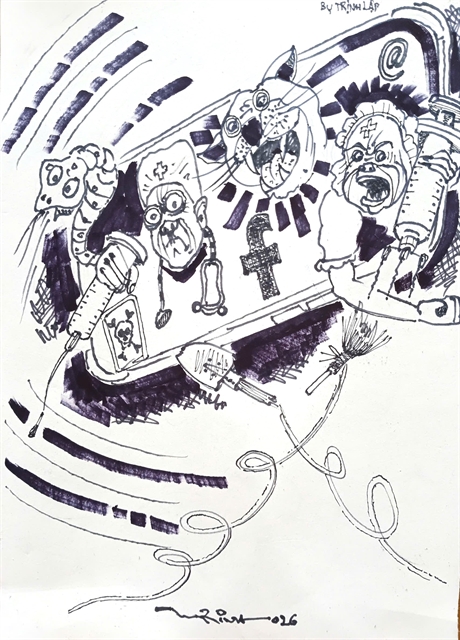
By Thanh Nga
A few seconds of laughter on a livestream have turned into days of public outrage.
Recent videos show medical students in dark blue uniforms livestreaming from a hospital reception desk, using profanity and even joking about “injecting poison” into viewers. In another case, a female medical student threatened to “miss the vein three times” to get back at a patient.
Some have brushed these off as ill-judged jokes. But the reaction online suggests something deeper. This is no longer just about inappropriate language. It raises questions about professional ethics, responsibility among future healthcare workers and, above all, public trust.
The clips spread quickly, drawing thousands of comments. Many criticised the students for crossing a line, especially given the setting of a hospital and the symbolic emblems on their medical uniforms.
In Việt Nam, as elsewhere, healthcare carries strong moral expectations. It is not just a job, but a role built on life, health and trust.
“Once you step into the medical field, every word matters,” one widely shared comment read.
Medical professionals also voiced concern. Dr Nguyễn Huy Hoàng said such offensive remarks, even if meant as jokes, could have serious consequences.
“The first and most dangerous consequence is the erosion of trust,” he noted. "Patients must trust their doctors. Without that trust, the entire treatment process is compromised."
For patients and their families, seeing someone in a medical uniform joke about harm is unsettling. It introduces doubt about not only the individuals involved but also the system they represent. That doubt can turn into fear, suspicion and defensive behaviour in hospitals, where tensions are often high.
Yet not all responses have been harsh, and some have called for a more measured view. The students involved have already faced disciplinary action, including suspension and the end of their hospital placements.
For these inappropriate words, the penalty is significant. What matters now is whether the students can learn from the incident, rather than be permanently defined by a mistake.
This split reflects a broader tension: how society balances accountability with empathy in the digital age. From a psychological perspective, experts say such incidents are not surprising. Communication through screens can create a sense of distance or even anonymity, lowering inhibitions and reducing empathy.
Technology amplifies the effect. Social media algorithms often reward controversial or emotionally charged content, pushing it to wider audiences. What might have been a careless remark becomes a viral moment, judged by thousands.
Media expert Trần Xuân Tiến said livestreaming would blur the line between private and public space.
“Many young people still misunderstand privacy online,” he said. “They think livestreaming is a place to vent or joke casually. But digital platforms have an almost permanent memory. A few seconds can leave a lasting mark.”
Tiến added that those working or intending to work in public-facing professions such as healthcare, education and journalism must meet higher standards of expression. This was about recognising the trust they hold, not restricting freedom of speech.
“A doctor in a white coat, a teacher on the podium or a journalist with a pen represents not only themselves, but also the credibility of their profession,” Tiến said.
Context matters. The same words among friends may carry little weight. But spoken in a hospital, while wearing a medical uniform, they take on a very different meaning.
The incident also points to a wider gap in digital conduct. Experts say punishment alone is not enough, as families shape values and behaviour. Schools need to integrate digital citizenship, communication ethics and online safety into their programmes, while also offering psychological support for students under online pressure.
More importantly, young people need to understand that every post, comment or livestream carries consequences. Not all are immediate, but many are lasting.
What began as a few careless seconds has become a public lesson for those involved, and for a generation growing up online.
In a world where anyone can be a broadcaster, speaking responsibly is no longer just about politeness. It is part of being a digital citizen and, for some, an essential part of earning the trust society places in them. — VNS
