Weather:
- Ha Noi 30oC
- Da Nang 29oC
- Ho Chi Minh 28oC
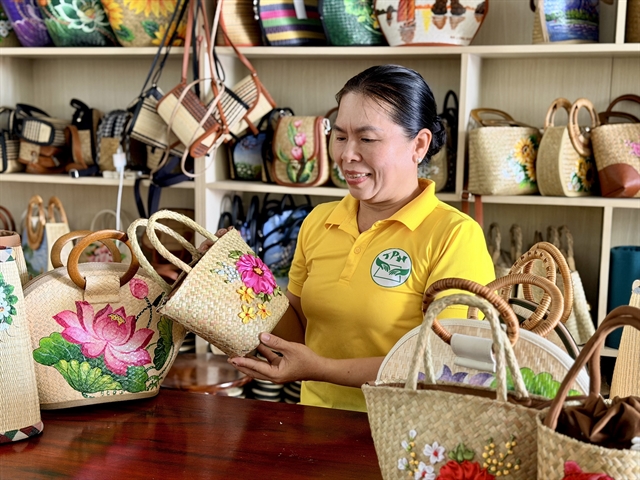
AN GIANG — In the southern province of An Giang, Lê Thị Phương Thảo has transformed wild rush and palmyra palm leaves into handcrafted products that not only revive a fading tradition but also create steady livelihoods for rural women.
Living in the commune of An Phú on the border with Cambodia, she began working with rush after spending many years in the traditional mat-weaving trade.
Before devoting herself fully to the craft in 2009, she spent 12 years as a high school English teacher, teaching during the day and helping her family weave mats in the evenings.
The family’s mat-weaving workshop, passed down through generations, had long supported their livelihood.
But, as lifestyles changed, the craft declined.
Cói, or rush, for weaving mats became scarce and costly, handmade mats struggled to compete with industrial products, and many young workers left for jobs elsewhere.
In 2009 Thảo renovated the workshop, recruited and trained workers and sought new markets.
Just as the business began to recover, the COVID-19 pandemic disrupted rush supplies from Cambodia and forced the workshop to close.
During this period she noticed rush growing along local canals and began experimenting with it.
She tried cutting, drying and weaving the material into products.
In the early stages many batches failed to meet quality standards and some had to be discarded, but she persisted.
After repeated trials the first rush mats and bags gradually took shape.
She discovered through experimentation that rush offers several advantages: its fibres are soft, light and hold their shape well and the material is durable, does not fade easily and is readily available.
Unlike sedge, it does not depend on seasonal harvests or imported supplies, and is environmentally friendly, dovetailing with the growing trend of green consumption.
From mats to craft
After the pandemic ended the workshop began to shift direction.
While keeping the weaving frames, Thảo borrowed money to invest in cutting and sewing tables to produce rush handicrafts.
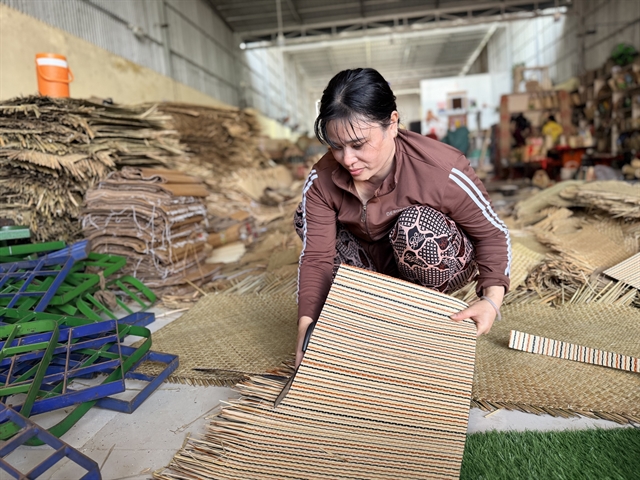
Starting with simple designs, she later studied younger consumers’ preferences and found demand for practical bags with eye-catching decorations.
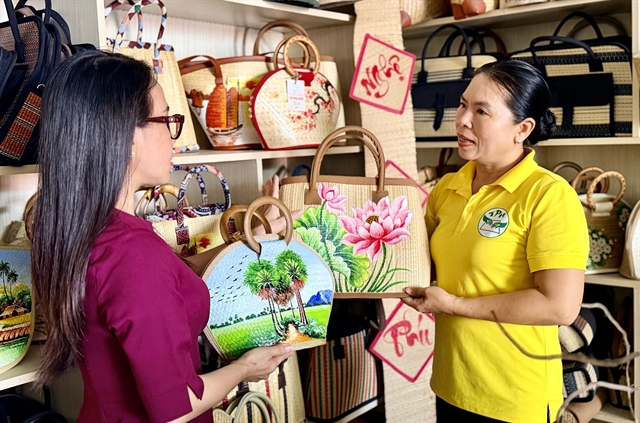
Based on this, she developed new designs, adding wooden handles, fabric straps and the like to create a distinctive look.
She also paints patterns directly on the products by hand, including lotuses, sunflowers, southern rural scenes, and well-known Vietnamese landscapes.
The painting, sun-drying and coating processes are all done manually, giving each item its own character.
Simpler designs take only a few dozen minutes, while more detailed pieces could take two to three hours.
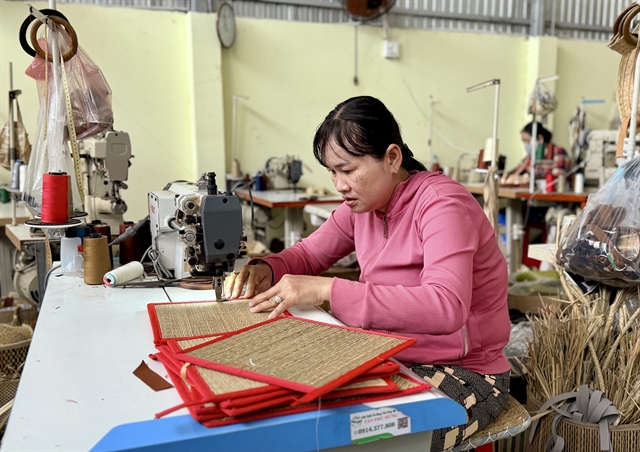
In 2024 Thảo established Tân Phú Hưng Handicraft Establishment, specialising in products made from rush and palmyra palm leaves.
The business now offers more than 150 product lines, including shell-shaped bags, cylindrical bags, backpacks, beach baskets, hats, sandals, and wallets priced from VNĐ90,000–350,000 (US$3.5–13.5).
They are sold in many provinces and cities nationwide. Three rush items, sandals, rolled hats and laptop bags, have received three-star ratings under the country’s “One Commune–One Product” programme.
Her shell-shaped bag is being assessed for a four-star rating.
Sustaining livelihoods
Thảo’s products carry the rustic charm of the southern countryside, while her start-up journey has opened up new opportunities for rural economic development in the border area.
Her establishment provides regular jobs for some 25 workers, who now have year-round employment and earn an average monthly income of VNĐ5–7 million ($190–270).
“Stable jobs like this are rare in rural areas," said Huỳnh Thị Thủy, a worker from Phước Mỹ Hamlet who has been with the establishment for five years.
"The work suits us and is available all year. I earn about VNĐ5 million ($190) a month, enough to support my family and children’s schooling.”
Thảo said her business prioritises training and employing local workers.
“This helps reduce production costs while improving local livelihoods. It limits the need for people to leave their hometowns for work and offers a sustainable approach that combines economic development with social responsibility.” — VNS
