Weather:
- Ha Noi 23oC
- Da Nang 26oC
- Ho Chi Minh 27oC
Nguyễn Khánh Chi
HÀ NỘI Energy captures our attention only when its absence disrupts our daily lives, when a room is plunged into darkness or a fan suddenly stops spinning.
Energy exists both within and beyond human perception: we can see petrol, but cannot directly witness the process by which it burns, releasing heat and generating the force that moves a car or a train. We cannot see the wind itself, yet we can observe its power turning turbine blades to generate electricity.
Woven into every aspect of human life, energy shapes our world far more profoundly than we typically perceive.
Art can make this connection visible, bringing an abstract concept closer to us through movement, vibration and shifting light.
These are just some of the many messages delivered at Invisible Currents, an art installation presented by the European Union Delegation to Việt Nam as part of the Hanoi Creative Design Festival 2026.
According to the organisers, the featured artists offer a rich diversity of reflections and interpretations on the themes of circular and regenerative energy, expressed through a wide range of artistic voices and practices.
Through film, sculpture, sound and installation, the artists invite participants to notice how energy moves through the world we live in and how much it usually escapes our attention.
Reimagining energy
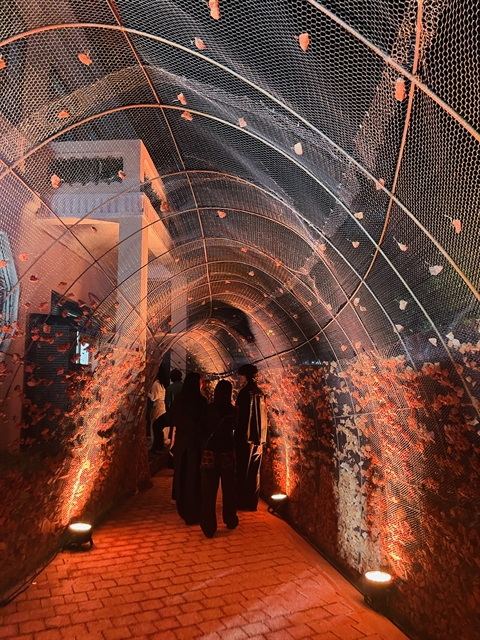
Right at the entrance to the exhibition, Kiều Lam’s Fragments, made from recycled materials, serves both as a gateway to the heritage building and as an artistic intervention that engages with the exhibition’s theme as well as the venue itself.
The building was originally part of the Bờ Hồ Power Plant complex, the first power station in Hà Nội and in Việt Nam, constructed in the early twentieth century. It later served for many years as the headquarters of the Northern Power Corporation.
Using recycled materials sourced from scrap steel and iron recovered from demolished structures, the work draws inspiration from the artist’s site visit several months earlier.
If energy originates from the transformation of different forms of matter, then Lam’s reuse of materials within a new physical structure can be seen as a statement on the carbon emissions associated with construction and development, as well as a reflection on the possibilities of giving matter a renewed existence.
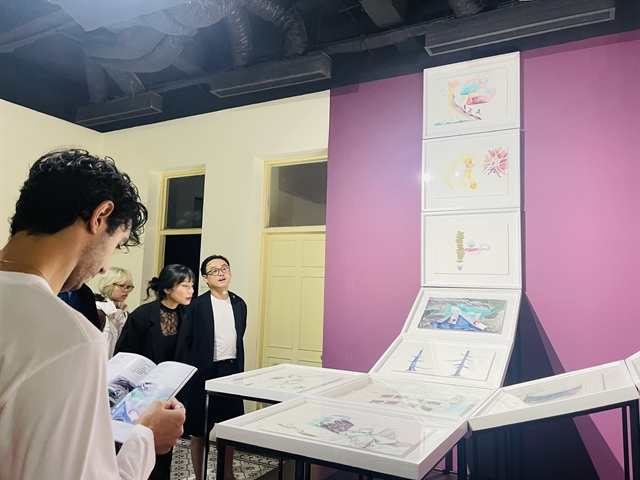
“This building is one of those places that have a long history," said EU Ambassador Việt Nam Julien Guerrier at the exhibition’s opening on Saturday.
"For many years, people came through these doors to work on the system that kept the city lights on. And tonight, we will walk through those same doors to see what seven Vietnamese artists have made in these rooms.
“I find it moving that a building can carry the memory of the people who worked here and still find a new place in the life of Hà Nội. It is also a way to show how sustainability takes a very tangible form: we keep what has served and we give it a new purpose.”
Interactive connections
And that sustainability is obviously observed in the sound-light-spatial installation Convergence by Fustic, which approaches energy as an ‘invisible current’ moving between nature, the human body and technology.
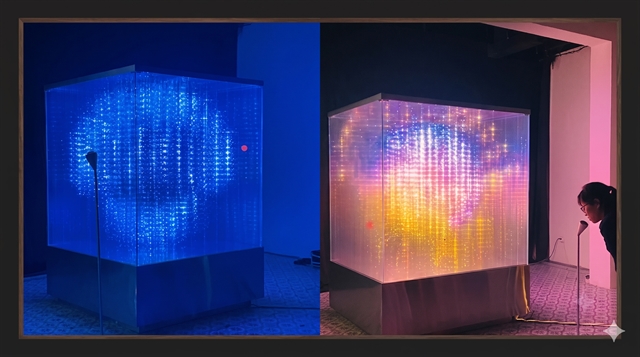
At six interactive stations, sensors capture participants’ breath and voices, converting them into data and, subsequently, light streams that enter the work’s core.
Through that very process, sustainability is presented as a collective responsibility. According to the Fustic creators, ecosystems cannot be sustained by technology alone, but also require attention, care and enduring contributions from each individual.
Curator Nguyễn Anh Tuấn said that when people view the cultural industries as an ecosystem that nurtures and nourishes new creations in many different fields and industries, from non-profit to commercial, then it is undeniable that energy is one of its most important catalysts.
“Culture, in its present interpretation, is a circular flow that generates internal forces that launch every artist’s new creation,” Tuấn said.
" 'Circular' ", he added, “is also one of the most important keywords when speaking of contemporary energy sources. It implies both a generative and an explorative function. It indicates the use of alternative energy sources, whose application in everyday life would require challenging existing preconceived notions and cognitive inertia.”
Nature's vibrations
Ambassador Guerrier said: “A patch of sunlight can mark the passing of time. The vibrations of plants can become something that we can hear. In one installation, a movement you make can change what happens in front of you, so you're part of the installation.”
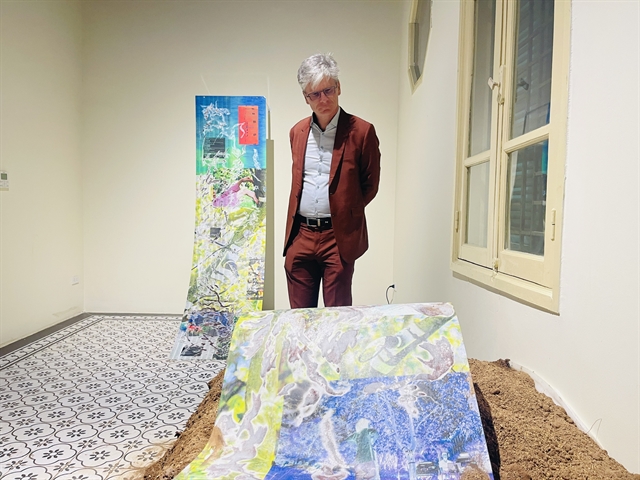
In that spirit, Hiền Hoàng’s Garden of Entanglement explores the hidden vibrational life of trees and how they sense and respond to their surroundings through sound and movement.
“Starting with an initial idea, ‘What will trees remember of humans when we are no longer here?’, I had the opportunity to collaborate with scientists at the University of Florence in Italy and the University of Stuttgart in Germany. We conducted measurements of tree vibrations when we sang to the tree, touched it or walked around it. We used very sensitive sensors to detect the tiniest vibrations inside the tree,” said Hiền Hoàng.
As a result, the artist translates the resulting data into movement, sound and sculptural forms, inviting quiet reflection on how humans shape the natural world. VNS
