Weather:
- Ha Noi 29oC
- Da Nang 28oC
- Ho Chi Minh 29oC
Nguyễn Sỹ Thủy
Amid the windswept landscapes and layered wartime memories of Côn Đảo Island, a new outdoor arts and culture space is taking shape, offering visitors a rare opportunity to experience contemporary art within the island’s nature-rich environment.
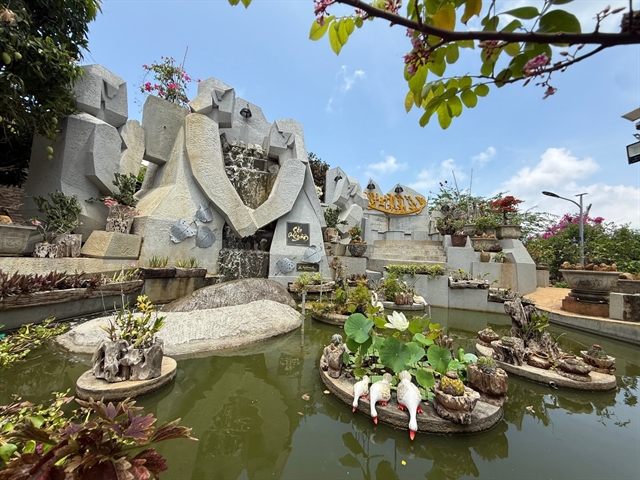
The art space, named Vườn X (Garden X), was one of the destinations that former war correspondents of the Vietnam News Agency (VNA) visited during a trip back to Côn Đảo Special Zone, a group of 16 islands about 230 kilometres off Hồ Chí Minh City, to mark 51 years since national reunification.
Together with families and friends, the ex-reporters offered incense to commemorate fallen revolutionary heroes at Hàng Dương Cemetery, visited the grave of Heroic Martyr Võ Thị Sáu, and toured the Côn Đảo Island historical sites.
Despite its stunning beauty, the islands were long known for their brutal past between the 1860s and 1975 as a prison system, where colonial forces enforced harsh and inhumane regimes.
It is estimated that around 200,000 Vietnamese people were imprisoned on the island. More than 20,000 never returned, remaining there forever, along with thousands of others who were maimed and paralysed, bedridden with crippling illnesses, or suffered from grave diseases.
Today, the archipelago is gradually reclaiming its beauty and charm through the care of over 12,000 residents from all regions of Việt Nam, who are helping make the islands even more beautiful.
Among these efforts is Garden X, an initiative conceived and owned by a woman who was born in Hà Nội and moved to HCM City with her parents at a young age.
The art space, featuring sculptural works by artist Ngô Xuân Lai, 76, helps forge a link between art, landscape architecture and everyday life on the island.
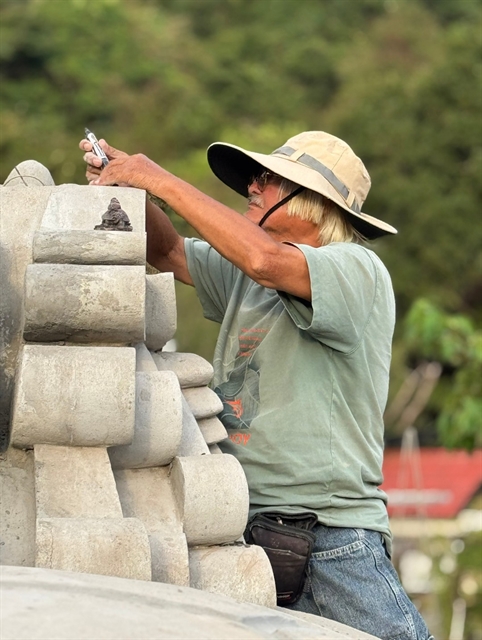
Art & space
Lai studied at what is now the HCM City University of Fine Arts from 1967 to 1974.
He later taught at Biên Hòa Technical School before continuing his teaching career at the Đồng Nai School of Decorative Arts. From 1979 to 1989, he worked at the HCM City Institute of Urban Planning and then served as a visiting lecturer in architecture at the Faculty of Civil Engineering, HCM City University of Technology.
One of his most notable works is Long Hoa Hội, a 400-metre-long dragon-shaped structure, located at Suối Tiên Cultural Tourist Area.
Lai is also known as the creator of the Hàm Rồng Hill structure at Hoa Viên Cemetery in Bình Dương, which stands 27 metres high.
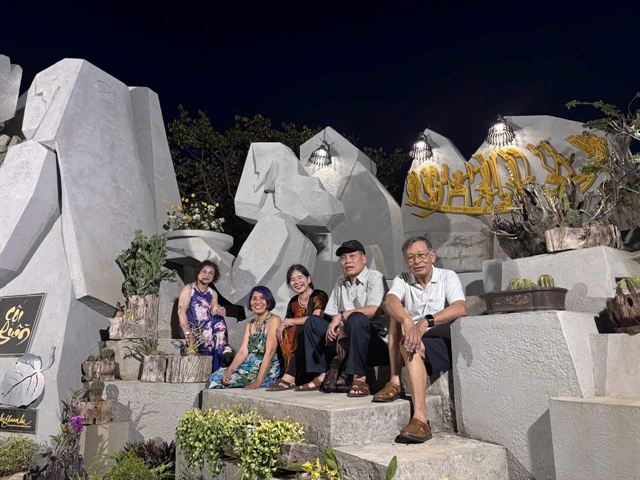
Garden X is conceived as an open spatial composition in which sculpture does not exist in isolation but is closely integrated with architectural and landscape elements.
The artworks are arranged in interaction with greenery, water features and the site’s natural terrain, creating a cohesive and harmonious whole. This approach to spatial planning highlights the artist’s role not only as a sculptor, but also as a creator of architectural-like environments that shape the overall spatial experience.
From the perspective of contemporary art, Garden X can be understood as a site-specific practice, in which artworks are not detached from their context but formed through an organic relationship with space, terrain, and the natural environment.
Local materials such as stone, along with factors like wind direction, humidity, and the site’s landscape structure, are not merely external conditions but become part of the sculptural language itself. This interaction gives Garden X its distinctive character, while also opening up an approach in which sculpture, architecture, and landscape are integrated as a unified whole.
Island vision
Within this 1,800-square-metre space, multiple layers of cultural values are interwoven, from ancient Đông Sơn drum motifs that evoke ancestral origins, to the series Portraits of 54 Ethnic Groups of Việt Nam, which reflects cultural diversity.
This combination helps create a space that is both rooted in heritage and open in character, reflecting an effort to continue and promote Vietnamese cultural traditions in a contemporary context.
Establishing an art space in an island area such as Côn Đảo faces a number of challenges. Its remote location from the mainland makes the transport of materials and equipment difficult, while limited access to labour and construction resources further complicates implementation.
In addition, the coastal environment, with strong winds and high humidity, requires appropriate technical solutions to ensure durability and feasibility.
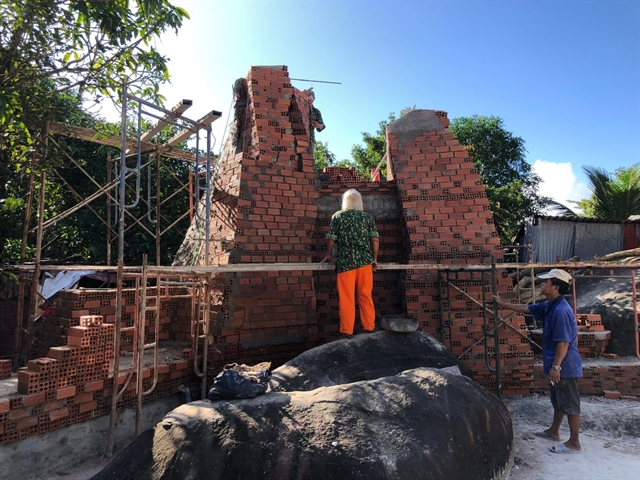
The project shows the sculptor’s efforts in making it adapt to real-world conditions: natural stone blocks are retained and integrated into the spatial composition, while also being repurposed as functional elements.
Old bricks from previous structures, along with other readily available materials, are reused, helping to form a cohesive architectural–landscape whole.
“In terms of ideas, each work is a place where we want to convey something, to say or prove something. First for ourselves, then so that others can understand and empathise with those thoughts and emotions,” Lai said.
“As for form and style, I am still in the process of searching through continued practice. As artists, we all hope to find our own signature style, and I am still on that journey.”
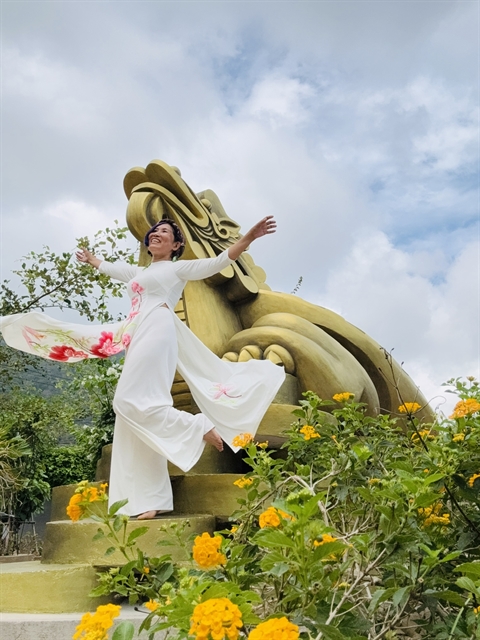
Now about 90 per cent complete, Garden X is envisioned as more than an outdoor exhibition space. Set against the layered landscapes of Côn Đảo, it is expected to become a cultural gathering point where art, nature and memory quietly converge, contributing to the evolving arts and cultural life of the island. —VNS
