
Director of the UNESCO Hà Nội Traditional Arts Centre Tạ Hạnh has spent years collecting songs, reviving forgotten repertoire and teaching free classes so that the centuries-old folk tradition can continue to resonate with younger generations.
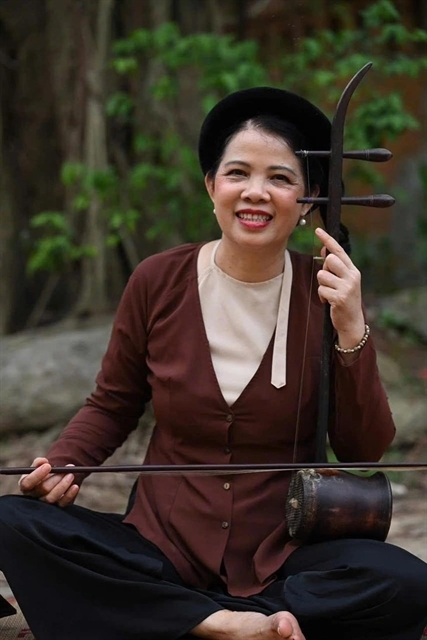
Tạ Hạnh has devoted herself to preserving and teaching xẩm, a traditional Vietnamese folk music genre. — Photo courtesy of Tạ Hạnh
Once the voice of travelling musicians in the markets and streets of the Red River Delta, xẩm is now a fragile heritage. For more than 10 years, singer Tạ Hạnh — director of the UNESCO Hà Nội Traditional Arts Centre — has worked to revive the genre through performances, archival work and free classes for young people, determined to keep the tradition alive for future generations.
Inner Sanctum: Could you share a little about your artistic journey?
I grew up immersed in folk melodies. From the age of eight my grandmother sang to me and taught me excerpts from chèo folk opera. Music was everywhere in my childhood and people called me "the nightingale" because of my singing. I loved Vietnamese folk songs and was always involved in local performances.
But my deeper study of xẩm began more recently. In 2008 I had the opportunity to learn more seriously about xẩm and the wider tradition of Vietnamese music. My first teachers were the late musician Thao Giang and the late Meritorious Artist Hồng Thái, who had served as Head of the Traditional Musical Instruments Department at the Việt Nam National Academy of Music.
They recognised my potential and later introduced me to People’s Artist Xuân Hoạch. I became Hoạch’s student, studied xẩm under his guidance, and began performing.
Since then I have organised many weekend and evening classes to continue learning and to teach others. Teaching helps me learn more deeply, and giving classes is also my way of passing the art on.
Inner Sanctum: Besides performing xẩm, you focus on preservation and restoration. What have you collected?
Over the years I have been compiling and safeguarding nearly 100 xẩm songs. These include traditional pieces and newer lyrics by well-known artists such as Hà Thị Cầu, Nguyễn Văn Nguyên and Ngô Văn Đảm.
I work to restore notable xẩm works and to present them to residents, domestic visitors and international friends in Hà Nội. Among the pieces I revive are songs about Hà Nội life, markets and daily scenes that evoke the city and its people, like Đồng Xuân Market: The Most Joyful Place and Hà Nội’s 36 Streets.
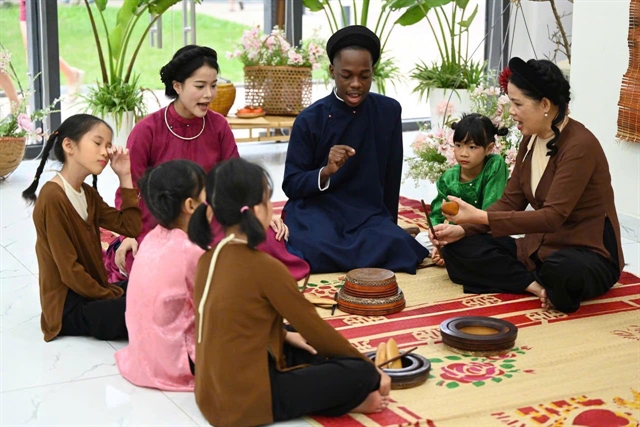
Hạnh, right, teaches xẩm to children and a foreign student. — Photo courtesy of Tạ Hạnh
Inner Sanctum: Since 2000 you’ve focused on xẩm classes for children. Why children?
Children are the future. In my performances and teaching I often met young people who had natural talent for xẩm. They learn quickly, are sensitive to melody and lyric, and are not yet fully swept up by loud, commercial music. If you introduce them to xẩm early, its melodies and values can become part of their emotional landscape.
I believe that to preserve a heritage you must cultivate successors who love, sing and cherish it. Teaching a child is like planting a cultural seed: with care, it will grow and provide shelter for many generations. For that reason, I’ve prioritised classes for children, offering free instruction to make the art accessible regardless of background.
Inner Sanctum: What draws you to xẩm specifically?
I have long loved many forms of folk song but xẩm captured me in a special way. Each xẩm song is essentially a story told in a simple, intimate voice; it speaks of everyday people and their lives. Its melodies are expressive yet unpretentious, and the lyrics often carry deep social or emotional messages.
Some people dismiss xẩm as too rustic, with plain costumes and melancholic tone, especially compared with the colourful theatricality of chèo or chầu văn ritual singing. But that rustic, direct quality is what I love. Xẩm is honest and human, it is the voice of the streets and the markets.
Because there are so few xẩm artists today, I feel responsible for learning from the elders, reviving well-known works, and passing them on before the heritage fades.
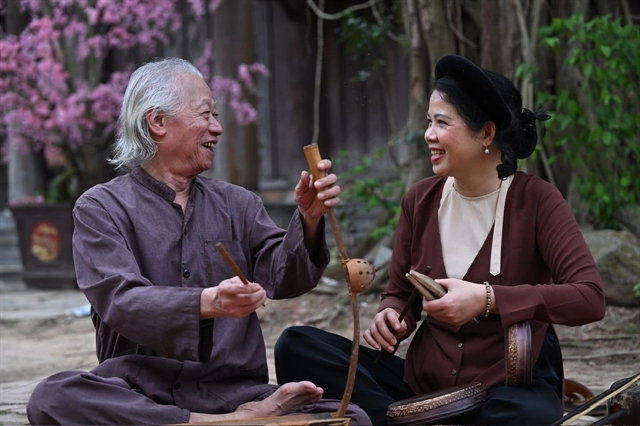
Hạnh, right, sings xẩm with her teacher, People’s Artist Xuân Hoạch. — Photo courtesy of Tạ Hạnh
Inner Sanctum: What are you most proud of in your preservation work?
I’m proud to be the student of People’s Artist Xuân Hoạch. I studied with him for over 10 years. He praised my recordings and performances and introduced me as his student when I performed. His guidance has shaped my technique and understanding of the art.
I am proud, too, of committing myself fully to traditional music. I do not learn merely for myself, I learn so I can teach systematically. Xẩm may sound straightforward, but it demands precise mastery: singers must know basic melodies and all their variants, convey character emotions through phrasing and timbre, and accompany themselves in a way that supports the text. Seeing students learn and perform xẩm gives me great satisfaction.
Inner Sanctum: Have you faced challenges bringing xẩm to the public?
Yes. The biggest difficulties are time and funding. I balance work, family responsibilities and my dedication to learning and teaching xẩm. Organising free classes, rehearsals, and performances requires sustained resources in terms of venues, instruments, travel and recording equipment, and those are not always available.
Despite this, I have gathered diverse groups of students and taught them without charging fees. For me, passion for the art outweighs personal gain, but sustainable support would allow us to reach many more young people.
Inner Sanctum: How do you balance innovation with preserving the essence of xẩm?
The key is grassroots cultural practice: keeping the art in the community and making it part of everyday life. Preservation must be coupled with promotion. Master performers will age, and their knowledge must be bridged to younger generations so traditional values persist.
To reach young audiences I sometimes compose new, modern lyrics set to ancient xẩm melodies, on topics like love of homeland, urban life, traffic or social concerns. I bring a contemporary touch so young people can relate, but any innovation must respect the traditional structure, techniques and spirit of the art. That balance allows xẩm to evolve without losing its identity.
Inner Sanctum: What core elements help traditional arts like xẩm live in modern life?
Two essentials are performance space and community practice. Traditional art must not be confined only to museums or grand stages, it must live among people at communal houses, on street corners and in weekend cultural clubs. As long as people sing, listen and recognise their own lives in the songs, the art will endure.
Today digital platforms expand the space for xẩm: social media lets young people encounter and share performances. I regularly record and upload my performances and those of my teachers. Seeing videos gain attention and positive comments from young viewers is encouraging, and shows there is curiosity and appreciation.
Young singers who weave folk elements into modern music also help. Digital and performing artists act as bridges: they spark interest and guide audiences toward traditional forms. But to preserve depth and authenticity, audiences must also support singers who keep the roots.
Broad dissemination is valuable, but it must be paired with respectful study and practice to avoid diluting or distorting the heritage. — VNS