Weather:
- Ha Noi 20oC
- Da Nang 23oC
- Ho Chi Minh 26oC
Ray Riches*
With more negativity than a guilty plea in a courtroom, people all over Việt Nam have been consistently pessimistic about the structure of English learning for school students. At the basis of these complaints are many scathing criticisms of the public school system and how it fails to teach proper English skills to students. However, results speak louder than anecdotes, because most of the latter are only focused on the short game. We fail to look at the long-term impacts of English language learning.
Social media has a constant flow of comments — mostly from foreigners — critical of the education system in Việt Nam. For English learning, the system has three main delivery methods. At the core is the Government school system, with its rigid syllabus in English. Another is the private school system, which ranges from minimum standards equal to the Government school system to exceptional levels, at which English is used as a main means of communication across many subjects. Finally, there is also a language centre network that supplements learning.
Opponents of the system say that the country's learning culture focuses on repetition rather than critical thinking and discourages expression through any form other than academic achievement, measured with written exams and standardised results. On the surface, this is a very easy conclusion to make.
In Government schools across the country, there is a much lower level of technology than in private school counterparts. Learning in English is textbook-based and has a heavy focus on reading, writing and listening. In some areas, students receive little to no practice in speaking or oral communication skills. Only 90 per cent of secondary school students across the country receive some form of English learning, even though it is compulsory from grade 3.
That gap has been prevalent for many years, and this is where the impact of foreign ESL teachers comes into play. Native English speakers offer learners those key skills in oral communication that close the loop and create usable skills in the real world. But not all students have access to this service, due to a lack of teachers and class locations as well as high costs.
How the foreign teachers see it
For teachers in the public school system, the outlook is mostly negative. A common thought for foreign teachers in this space is that they are trying to 'build a bridge with toothpicks'. Trying to achieve desired outcomes while teaching 50 kids for between 35 minutes and 1.5 hours per week is often simply impossible.
Many teachers leave the job and the country as fast as they arrive. After spending six to nine months in Việt Nam, their sense of purpose and achievement is crushed, and they look elsewhere to take on new environments in English teaching. But some do stay, and that impossible achievement becomes spattered with little signs of victory and purpose.
The fact is that on a global scale, financial rewards for foreign teachers in Việt Nam are low. Globally, seeing 40 to 50 children in one class is reserved for some of the poorest nations on Earth. A more familiar environment for many young teachers is having only 20 to 30 learners in a class. This is not the case in Việt Nam.
One teacher at a high school in HCM City was recently quoted as saying: “I feel like the captain of the Jamaican Bobsled Team in this job.” This is a valid feeling because you rarely get moments where you feel like you are a winner. It is mostly impossible challenges in impossible environments.
The bigger picture
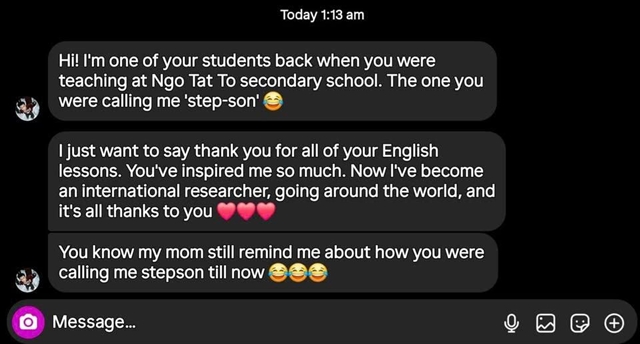
After more than a decade in teaching, I estimate that I have taught English to more than 15,000 young learners in my classes. Almost all of them have vanished into the world, and it is impossible to know if their English skills have taken them on the life journey they dreamed of. However, recently, I awoke to a message on social media that changed my view of what I do.
A student of mine from 10 years ago messaged me around Teachers’ Day in Việt Nam. His words were intensely personal and passionate. For a moment I felt that I did not deserve such acclaim for his victories. But, with a tear in my eye, I sat back and realised the learning system in Việt Nam is not as the critics make it out to be.
You see, this boy went to a Government school in HCM City. He had great Vietnamese English teachers and was given the opportunity to learn with a foreign teacher for just 90 minutes a week from grades 6 to 9. I am sure this continued in his high school years also.

When I realised this young man was now travelling the world and using the skills I had, in a small part, helped him develop, my mind turned to the fact that this was the same school system that so many complain about.
School learning is about the school, not the system.
The school he attended was a very normal school. It had nothing special. There was no Wi-Fi in the classrooms. Most rooms had a TV, some vigorously maintaining the big heavy CRT-style TVs with AV inputs that were impossible to use with a laptop computer.
But that school had dedicated and passionate teachers. They allowed the learners to develop skills from the moment they entered the school to the day they left. They gave young learners a purpose and a standard to learn English, and this provided a platform that has taken this young man all over the world today.
What this really means is that the feeling of helplessness is not really true when you look at the bigger picture. The efforts of passionate and energetic teachers in the public school system create memories and skills that set foundations for lifelong successes in some, if not many, students, even though we teachers may not actually see the result of our commitment.
In my sporting career, I was given some advice that I carried with me all my life. My coach once said that “champions never feel comfortable,” and it is this very same feeling that embraces most foreign English language teachers in Việt Nam. The discomfort and helplessness experienced by some teachers is too much to bear, but for those true champions, the discomfort results in victories. These victories are not your own, but those given to young Vietnamese learners who are looking forward to taking on the world and being successful.
For me, there are many dark days. There are many frustrations in the classroom, and many times I wonder if it is worth the effort to fight and grind my way through an English textbook. But, thanks to my coach back in the day, the champion that he created is the same person that stands in front of 50 children for 90 minutes a week and tries to create their pathway. It may not be comfortable, but it is worth it. Just never give up on the future generation of Việt Nam. VNS
*Ray Riches lives in HCM City and works as a teacher and freelancer. Apart from teaching, he is a keen runner and bicycle adventure rider. After 10 years in Việt Nam, Ray has a love and passion for the smaller things and enjoys sharing his experiences with people all over the world.
