Weather:
- Ha Noi 27oC
- Da Nang 26oC
- Ho Chi Minh 27oC
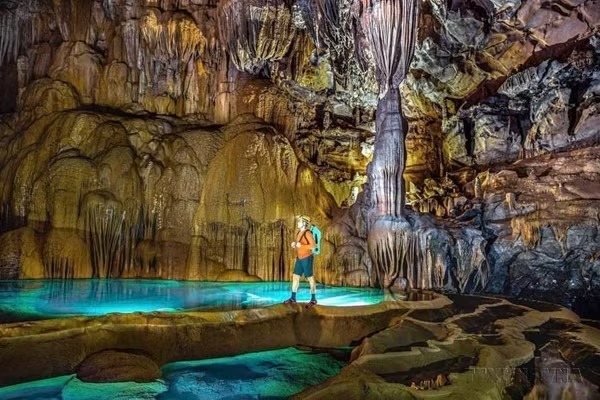
QUẢNG TRỊ — More than three decades after first arriving in Việt Nam, British cave explorers continue to reveal new geological wonders hidden beneath the ancient forests of Phong Nha-Kẻ Bàng National Park.
These reinforce its reputation as one of the world's most remarkable karst landscapes and open fresh opportunities for scientific research and sustainable tourism.
Their latest expedition in early 2026 led to the exploration of Cha Ngheo Cave, a largely untouched vertical cave system that experts believe may form part of an even larger network. The team plans to return in March 2027 to continue the survey.
Decades of exploration
Dr Howard Limbert recalled that his first expedition to Việt Nam took place in 1990, when British experts and scientists from the former Hà Nội General University began surveying caves in what is now Phong Nha-Kẻ Bàng National Park.
During that pioneering expedition, the team explored Phong Nha Cave and Dark Cave, surveying thousands of metres of cave passages.
Even after leaving Phong Nha, Limbert and his colleagues immediately began planning their return. "The caves here have kept my wife and me coming back ever since," he said.
Professor Dr Tạ Hòa Phương of the Việt Nam Institute of Palaeontology said the 1990 expedition marked the beginning of long-term cooperation between Vietnamese scientists and British cave experts, laying the scientific foundation for later geological research in the area.
Their work proved invaluable in preparing the nomination dossier that led UNESCO to recognise Phong Nha-Kẻ Bàng as a Natural World Heritage Site in 2003 under geological and geomorphological criteria, making it Việt Nam's Natural World Heritage after Hạ Long Bay.
Limbert also recalled meeting General Võ Nguyên Giáp in 1992, saying the legendary military leader encouraged the British team to continue exploring Việt Nam's cave systems, giving them added motivation to pursue their research.
One of the expedition's greatest achievements came in 2009 with the discovery of Sơn Đoòng Cave after more than a decade of searching. Local forest ranger Hồ Khánh guided the British team to an entrance he had first spotted in 1990, leading to the exploration of what is now recognised as one of the world's largest known caves.
Stretching more than 6.5 kilometres, Sơn Đoòng ends at a massive limestone wall known as the Great Wall of Việt Nam and has since become an international tourism icon.
Discoveries beneath the forest
Asked about his most memorable recent expedition, Limbert pointed to the exploration of Cha Ngheo Cave in early 2026.
Residents had long reported seeing a cave entrance high on a mountain where a stream disappeared into a deep vertical shaft, but no one had attempted to descend because of the extreme terrain.
In early April, a 13-member expedition team comprising ten foreign specialists and three Vietnamese experts, supported by a logistics team, set out to investigate the cave.
After more than a day trekking through dense forest and crossing streams, the team reached the entrance and camped overnight before beginning the descent the following morning.
The first section dropped nearly 90 metres vertically. Using thousands of metres of climbing rope, the explorers descended in stages, drilling anchor bolts into limestone outcrops before continuing deeper into the cave.
At a depth of around 350 metres, they reached a horizontal passage and then swam nearly 600 metres through an underground river.
Only two members of the team succeeded in reaching the cave's deepest section.
"The cave is extremely cold, and without specialised thermal equipment we could not stay there for long," Limbert said.
He noted that the cave extends well beyond the areas surveyed so far, suggesting it could form part of a much larger underground system.
Strengthening global recognition
According to Phạm Hồng Thái, Director of Phong Nha-Kẻ Bàng National Park, experts have identified seven major cave areas, including the Phong Nha, Vom, and Nước Moọc systems.
To date, researchers have documented 472 caves with a combined surveyed length of more than 254 kilometres, making the park one of the world's richest and most distinctive karst regions and earning it the nickname "Kingdom of Caves."
During the latest survey in early 2026, Limbert's team explored 29 caves, including 26 newly discovered caves and extensions to three previously known caves, mapping more than 13.6 kilometres of underground passages.
Professor Phương said the findings provided valuable scientific evidence supporting studies of the park's geology and geomorphology while strengthening its universal value.
Park authorities believe continued cooperation with international cave experts will not only uncover more geological treasures but also enhance the site's appeal as a world-class destination for adventure tourism, scientific research and nature conservation. — VNA/VNS
