Weather:
- Ha Noi 34oC
- Da Nang 31oC
- Ho Chi Minh 32oC
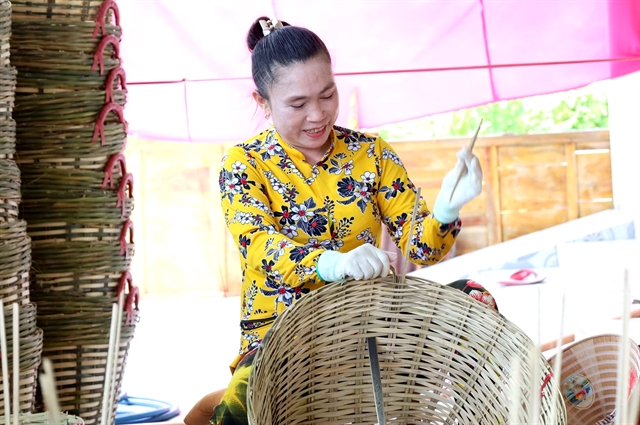
CÀ MAU — For more than a century, the rhythmic weaving of bamboo strips has been part of everyday life in Phước Mỹ Village, Cà Mau Province. Passed down through generations, the craft has sustained local families and shaped the village's cultural identity.
Now, as younger workers leave and traditional products face growing competition, artisans and local authorities are looking to rural tourism to help keep the tradition alive.
The bamboo and rattan weaving craft in Phước Mỹ, Phước Long Commune has a history spanning more than 100 years. Of the more than 900 households in the hamlet, nearly 250 are now directly engaged in the craft.
According to a report from the Phước Long Commune People's Committee, the craft has generated annual revenue of about VNĐ3.4 billion over the past two years, providing an average income of VNĐ4.5 million (US$176) per person per month.
The craft provides regular work for around 500 local residents, particularly women, older people and those with spare time.
The determination of local artisans has helped the craft village survive for generations.
Some families have been practising the craft for three generations, including that of 70-year-old Phạm Đạt, who learned weaving when he was 14 or 15.
Đạt remembers a time when the craft village flourished, when every household grew bamboo, split it into thin strips and prepared the materials, creating a lively atmosphere throughout the hamlet.
Đạt said the village once produced a wide range of items, including bamboo baskets for winnowing and rice storage, trays, cần xé (large woven bamboo baskets), fishing traps and other tools closely associated with the daily lives and agricultural activities of rural residents.
"Traders from across the southern region could not buy enough of the products we made. On average, each family supplied hundreds of items to the market every month. The craft provided a livelihood for countless families and enabled many children to pursue their education," he recalled.
Generations at risk
Today, as many traditional products are gradually being replaced, the craft village has adapted by focusing on cần xé baskets as its main product.
Phước Mỹ cần xé baskets are purchased by traders from provinces across the Mekong Delta at prices ranging from VNĐ40,000 to VNĐ60,000 each and used to transport fruit, seafood and other farm produce.
Lê Thị Thủy, in her 70s, has been engaged in the craft for more than 50 years.
She now runs a large workshop, providing regular employment for more than 10 workers and supplying around 1,000 large baskets to the market each month.
Concerned about passing the heritage on to younger generations, Thủy said many families now regard weaving as a secondary occupation.
Only a few households, including hers, still consider it their main livelihood and maintain larger-scale production.
"Making these products now is enough to make a living, but it is difficult to become well-off. I have kept doing this partly because I want to preserve the traditional craft handed down by our ancestors, retain a part of my childhood memories, pass the skills on to younger generations and help people earn additional income in their spare time," she said.
Although the Phước Mỹ weaving village provides manual workers with an average income of VNĐ140,000 per day, it is facing a number of challenges.
As with many other traditional craft villages, the biggest concern among older artisans in Phước Mỹ is the shrinking pool of people who can carry on the craft.
Income from weaving is not yet attractive enough, prompting many young people to leave their hometowns in search of jobs elsewhere rather than continue their families' traditional occupation.
Đạt said the local authorities had organised several training courses on bamboo and rattan weaving, through which most local residents had acquired basic knowledge of the craft.
However, because income remained low, many people of working age still chose to leave the area for better jobs elsewhere.
He and many other local residents hope that support measures will be introduced for people learning traditional crafts, helping to attract and retain young people in their hometowns.
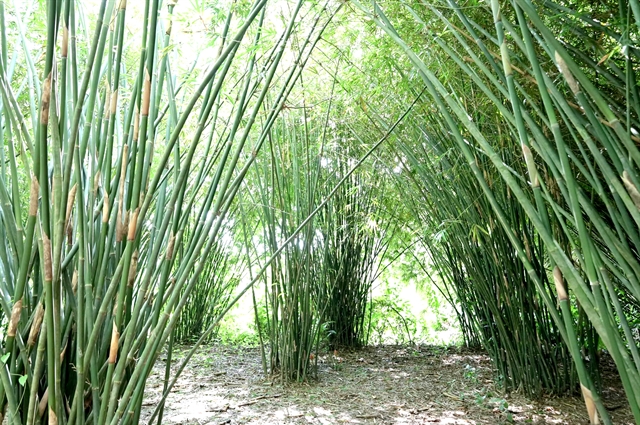
Local households also said bamboo was grown on only about 15 hectares locally, forcing producers to source materials from outside the province and increasing costs.
Product designs remain limited, access to preferential loans is still difficult, and outdated machinery has restricted production capacity and made it harder to fulfil large orders.
Meanwhile, more convenient, mass-produced alternatives have become increasingly popular among consumers, creating additional competition for traditional handicrafts.
Recognising these difficulties, the Phước Long Commune People's Committee is conducting a comprehensive review of local needs for capital, technology and vocational training to develop appropriate solutions.
Craft meets tourism
Alongside expanding craft training courses, the authorities are focusing on connecting producers with markets and exploring models that combine craft villages with rural ecotourism, linking cultural preservation with sustainable new-style rural development.
As part of efforts to preserve the craft village, the authorities provided funding in 2024 to build a 70-square-metre exhibition centre for local products, creating a place for visitors to explore, experience and learn about Cà Mau's distinctive handicraft culture.
Phước Long Commune People's Committee Chairman Nguyễn Tấn Thức reaffirmed the local administration's commitment to supporting residents in preserving the craft.
"If people engaged in traditional crafts lack capital, we will connect them with sources of financial support. If they lack equipment, we will seek additional support from the province. If more training or vocational courses are needed, we will organise them," he said.
The commune is also actively helping residents find markets for their products and studying models from other provinces that combine craft village development with rural tourism and sustainable new-style rural development, while closely linking economic activities with the preservation of traditional cultural values and environmental protection.
With the proactive efforts of the Phước Long authorities and the enduring dedication of Phước Mỹ's artisans, the traditional weaving village is expected to gain a stronger foundation for the future.
For artisans like Đạt and Thủy, the hope is that the familiar rhythm of bamboo weaving will continue to be heard in Phước Mỹ, not only as an echo of the past but as a livelihood for generations to come. — VNS
