
Shaped by rivers, rice fields and communal life, the wet-rice civilisation of the Mekong Delta is facing mounting pressures from climate change and shifting livelihoods, prompting renewed efforts to preserve its distinctive cultural identity while pursuing sustainable development.
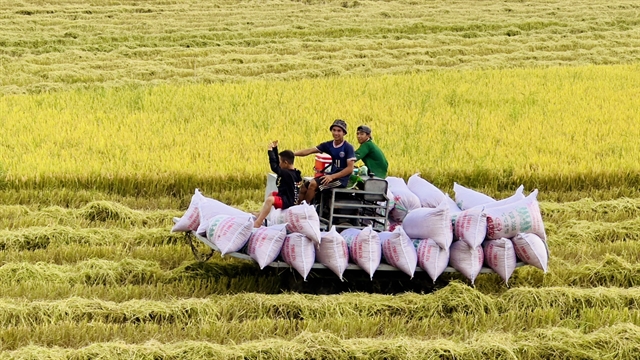
Farmers in the Mekong Delta province of An Giang transport the harvested rice to a drying facility. — VNA/VNS Photo
In the Mekong Delta, life has always followed the rhythm of water. Rivers decide when to plant, canals become roads, and rice fields double as mirrors of the sky. For generations, this wet-rice civilisation has shaped not only livelihoods but a way of living together – open, resilient and deeply rooted in nature.
Now, as rising seas and changing climates alter the delta’s fragile balance, communities are rethinking how to protect the cultural values that flow alongside their rivers.
Riverine memories
According to Prof Chung Hoàng Chương, a Mekong Delta expert, river civilisation is the bedrock shaping the people of the Southwest.
From upstream to downstream, the Mekong not only brings alluvial deposits but also creates a dense network of canals, waterways, trade routes and livelihoods, along with a way of living in harmony with nature accumulated over generations.
“People in the Mekong Delta know how to rely on water, live with water and trade by water,” Chương noted.
This flexible adaptation to water and land has forged a distinctive value system: generous and open-minded, yet resilient and deeply attuned to nature.
Within occupational culture, these values are preserved through craftsmanship and memory.
Boat builder Nguyễn Văn Tốt, who has spent more than half a century building traditional wooden boats in Lai Vung, Đồng Tháp Province, recalled his efforts to keep the craft alive as inland water transport has gradually declined.
From large boats that once crisscrossed the canals and rivers, he shifted to making miniature models as a way to “preserve the soul of river life”.
For Tốt, each miniature boat is not merely a handicraft item for decoration or souvenir, but a fragment of memory from a civilisation slowly receding into the past.
Such memories are also vividly reflected in the story of traditional wet-season rice in the Mekong Delta, as told by engineer Lê Quốc Việt.
He takes listeners back to a time when cultivation was closely linked to tidal cycles, alongside customs of daily life, weddings, festivals and a cultural space shaped by Khmer-Vietnamese-Chinese interaction.
“Preserving wet-season is not only about conserving a seed variety, but about safeguarding an entire system of cultural and social values that once nurtured neighbourly bonds and the spirit of mutual support,” Việt said.
If rivers and rice grains form the material foundation of delta civilisation, literature and folk performance crystallise its spiritual depth.
According to Dr Bùi Trân Phượng, a history researcher, this is clearly expressed in Lục Vân Tiên (The Tale of Lục Vân Tiên) by Nguyễn Đình Chiểu, where southern chivalry is embodied not only by central characters such as Lục Vân Tiên or Kiều Nguyệt Nga, but also by ordinary figures – the innkeeper, the woodcutter, the fisherman and the young attendant – straightforward, righteous people ready to help those in distress without calculation.
This represents the “southern soul” nurtured by riverine life.
The oral performance form Nói Thơ Vân Tiên, combining narration and singing, illustrates how people receive literature as part of community life, where moral philosophy is conveyed in an accessible and enduring way.
This connection extends to other folk performance genres such as Sắc bùa Phú Lễ – a traditional ritual chant in former Bến Tre Province – characterised by lively rhythms and aspirations for peace and good fortune.
Phượng noted that the river environment, where people depend on one another to survive, had fostered a strong sense of community, righteousness and faith in goodness.
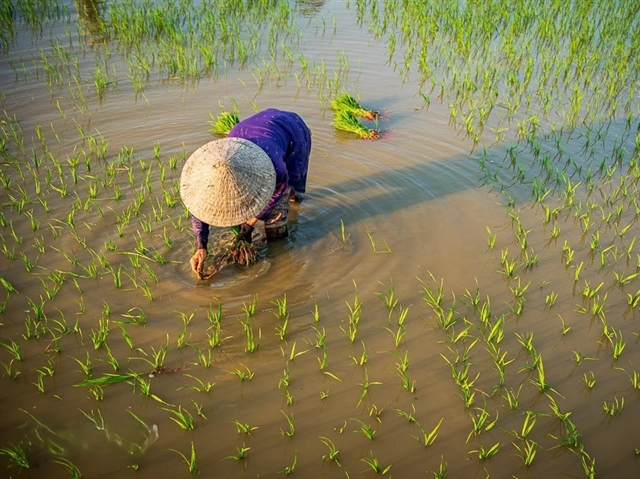
Rice transplanting in the Mekong Delta. Preserving riverine identity cannot be separated from environmental restoration and sustainable livelihood development. — Photo nongnghiepavn.com
Preserving identity
From a scientific perspective, Assoc Prof Lê Anh Tuấn, PhD, analysed the formation history of the delta, highlighting its richness in alluvium and also its growing vulnerability to climate change.
He emphasised the organic relationship between history, ecology, livelihoods and culture, viewing the adaptive capacity of Mekong Delta residents as the essence of a unique civilisation.
Preserving riverine identity, he stressed, could not be separated from environmental restoration and sustainable livelihood development.
The development narrative continues through the story of rice varieties and agricultural science.
For engineer Hồ Quang Cua, it is a journey of breeding high-quality fragrant rice varieties, with ST25 standing as a prominent example of the integration of indigenous knowledge and modern science.
Meanwhile, Đỗ Khắc Thịnh, PhD, and Trần Ngọc Thạch, PhD, underlined the need for long-term investment, from laboratories to fields, to improve productivity while maintaining the qualities of “delicious and clean”, without trading identity for short-term gains.
From an industry development perspective, Assoc Prof Bùi Bá Bổng, PhD, argued that "value chains and branding are the key to going further” for Vietnamese rice.
Sharing this view, Minister of Agriculture and Environment Lê Minh Hoan regards rice as a “cultural memory of the nation”, an essential element in defining Vietnamese identity during the integration process.
The wet-rice civilisation of the Mekong Delta does not exist as a static entity. It is a dynamic cultural-social ecosystem where indigenous knowledge, modern science, livelihoods and communal ethics constantly interact.
As the environment changes, these cultural layers also shift.
The challenge is not to preserve the past in a rigid manner, but to carry forward core values under new conditions.
From wet-season rice grains and boat-building crafts to literature and folk performance, the southern delta emerges as both rich in historical layers and resilient in adaptation.
Perspectives from scientists, farmers and policymakers not only revive memories but also point towards the future: to preserve riverine identity, it is essential to safeguard the environment, livelihoods and community spirit – the very elements that have created the enduring beauty of southern wet-rice civilisation. VNS