Weather:
- Ha Noi 25oC
- Da Nang 26oC
- Ho Chi Minh 28oC
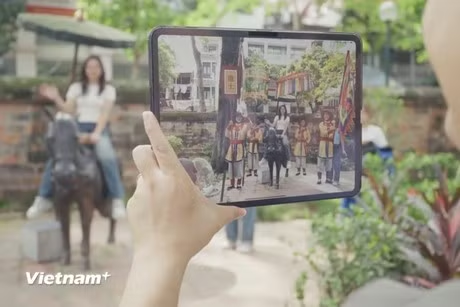
HÀ NỘI — The use of technology has helped preserve cultural values at risk of fading, recreate transformed heritage spaces, and connect scattered materials, bringing cultural heritage closer to the public through more accessible and engaging educational experiences.
Heritage education goes beyond providing knowledge to help learners understand the origins of cultural values, develop a critical mindset and foster a sense of responsibility towards the community.
At many museums and heritage sites, visits and learning programmes are now designed in detail and delivered entirely through digital applications. Learners can access digital maps, heritage records and documents, photos and videos, and ask questions via online platforms.
At heritage sites, mobile devices allow learners to explore and compare surviving relics with reconstructed models, listen to or watch presentations by artisans, and create story maps or presentation videos.
This turns heritage sites into engaging learning environments that connect different academic disciplines. Through such experiences, learners come to understand heritage as a living body of knowledge that evolves through its relationship with society and people.
Integrating technology into heritage preservation and education is a path being pursued in many countries. UNESCO has introduced the "Culture and Digital Technologies” model, using digital data, 3D technologies and online platforms to protect, present and pass on heritage.
Under this initiative, the “Dive into Heritage” platform enables visitors to explore World Heritage sites and related intangible cultural values through a combination of scientific records, spatial imagery, interpretive content and interactive experiences.
In Việt Nam, the Ministry of Culture, Sports and Tourism is also digitising scientific records and developing databases, with a view to building a smart and sustainable heritage education ecosystem.
Several heritage sites in Hà Nội, including the Văn Miếu – Quốc Tử Giám (Temple of Literature - National University), the Thăng Long Imperial Citadel and Hỏa Lò Prison, have adopted the latest technologies to introduce their heritage values and incorporate traditional education for young people. An ecosystem linking schools, museums, heritage sites, and local communities is also gradually taking shape.
However, experts point out that technology-assisted heritage education still faces a number of bottlenecks, including poor data quality and connectivity, inadequate investment in technology and human resources, and unsuitable technological designs. Issues concerning authenticity, cultural rights, and ethics also need to be addressed. — VNA/VNS
