Weather:
- Ha Noi 18oC
- Da Nang 24oC
- Ho Chi Minh 27oC
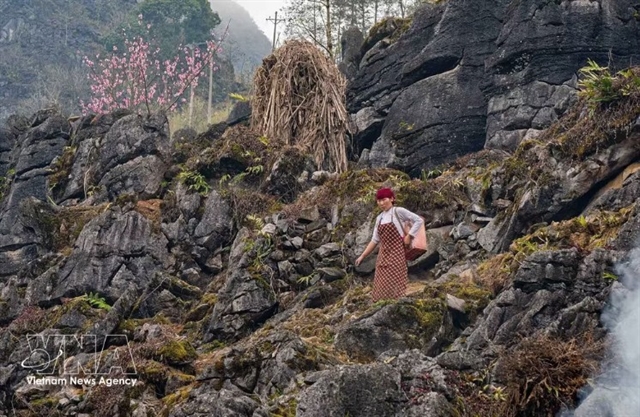
PARIS — The UNESCO Global Geoparks Council has reached a unanimous decision to award a 'Green Card' to Việt Nam's Đồng Văn Karst Plateau, recommending the extension of its designation for another four years, according to the Vietnamese delegation at a recent meeting in Paris, France.
This marks the fourth consecutive time the renowned karst plateau in the northern mountain province of Tuyên Quang has successfully passed re-evaluation to be awarded the Green Card – the highest rating under its periodic revalidation process.
The decision reflects international recognition of Việt Nam's efforts to preserve its geological, natural and cultural heritage while linking conservation with sustainable tourism development and improved livelihoods for locals.
Speaking at the meeting last week, Ambassador Nguyễn Thị Vân Anh, Permanent Representative of Việt Nam to UNESCO, welcomed the unanimous support from council members.
She said the result reflects international recognition of the sustained efforts made by local authorities, relevant sectors and communities to preserve and promote the heritage values of the Đồng Văn Karst Plateau, while advancing sustainable tourism, creating livelihoods and generating jobs, particularly for ethnic minority communities.
According to the ambassador, the recommendation to renew the designation not only confirms the achievements made so far but also recognises the locality's commitment to linking heritage conservation with sustainable development. The result will also help enhance the profile, standing and international competitiveness of tourism in Tuyên Quang Province, while strengthening its position on the country's tourism map.
Assessing the revalidation process, Sophie Justice, Chair of the 11th session of the UNESCO Global Geoparks Council and Director of the Chablais UNESCO Global Geopark in France, said the council has noted significant progress made by geoparks in Việt Nam in recent years.
Regarding the Đồng Văn Karst Plateau, she praised the quality of heritage management, conservation and promotion, particularly local community engagement and attention to linguistic diversity and indigenous cultural elements.
These factors, she said, have given the karst plateau's dossier its distinctive character and persuasive strength. She recommended that the locality maintain its efforts in education, sustainable development, tourism and heritage management, as these are long-term tasks requiring the continued involvement of authorities at all levels and local communities.
Meanwhile, Dr Trịnh Hải Sơn, Director of the Vietnam Institute of Geosciences and Mineral Resources and Chairman of the Việt Nam Subcommittee for UNESCO Global Geoparks, said from a technical perspective, the fourth consecutive renewal recommendation is significant for the locality, particularly in providing further momentum for economic development and improving living standards on the Đồng Văn Karst Plateau.
According to Dr Sơn, Việt Nam has fulfilled three of the five recommendations made during the previous revalidation, while work on the remaining two was ongoing.
Sơn affirmed that Việt Nam will earnestly implement the UNESCO Council’s recommendations and continue its efforts to manage and conserve the Đồng Văn Karst Plateau UNESCO Global Geopark. Furthermore, he said, Việt Nam is ready to share and exchange experiences with other members of the UNESCO Global Geoparks Network.
The UNESCO Global Geopark Đồng Văn Karst Plateau, located in Tuyên Quang Province, was last year honoured as Asia’s Leading Cultural Destination 2025 by the World Travel Awards (WTA).
Previously, the Đồng Văn Karst Plateau received WTA recognition for two consecutive years: Asia’s Leading Emerging Tourism Destination 2023 and Asia’s Leading Cultural Destination 2024. In 2010, it became Việt Nam’s first UNESCO Global Geopark and the second in Southeast Asia.
Spanning over 2,350 square kilometres, the geopark features more than 70 per cent limestone terrain, with dramatic landscapes of soaring peaks and deep gorges. Highlights include Mạc Vạc, the highest summit at 1,971 metres, and Tu Sản Gorge, Southeast Asia’s deepest canyon, with cliff walls plunging over 700 metres.
Geologically, the plateau dates back to the Cambrian period, around 550 million years ago, and has undergone seven distinct geological eras. Visitors can explore fossil sites, stratigraphy, karst formations, caves and fault lines that reveal Earth’s ancient history, including evidence of two major mass extinction events: the Late Devonian (364 million years ago) and the Permian-Triassic (251 million years ago), the latter wiping out 90 per cent of marine species. — VNS
