Weather:
- Ha Noi 29oC
- Da Nang 30oC
- Ho Chi Minh 32oC
Thu Trang
THANH HOÁ — Đan Nhi, a student at Luận Thành Junior Secondary School, now feels much more confident while accessing the internet.
Previously, she used to worry often.
“The internet helps us connect, but it also carries many risks. After joining the school’s safe internet club, I’ve learnt how to stay safe and protect myself,” she said.
Nhi hopes that she and her friends have gained the knowledge and skills to prevent online risks.
“I’ll continue working with my friends to raise awareness so everyone knows how to protect themselves,” she said.
Lieutenant Colonel Lê Công Chính, deputy head of the Luận Thành Commune Police, said that Việt Nam was stepping into a new era of the digital age.
“Cybersecurity issues are a concern for the entire world, and our country is no exception. Việt Nam is significantly affected by cybersecurity problems such as fraud, enticement, psychological manipulation and intertwined cyber threats that harm societal morale, causing damage to finances and health," he said.
Targets can include anyone — students, workers and others. Recently, the Thanh Hoá Police and police forces from several other provinces have tackled a number of cyber fraud cases.
Perpetrators are not individuals or small groups, but large organisations often consisting of hundreds or thousands of people. They are equipped with advanced technology like Starlink satellites, high-speed computers and numerous high-tech phones.
“Recently, these perpetrators have been focused on targeting youth, especially students, teenagers, female students and young adults, employing psychological tactics remotely,” he said.
Most of the victims were aged 14 to 22, mainly students away from home, and could suffer financial and severe psychological harm.
Working to protect children
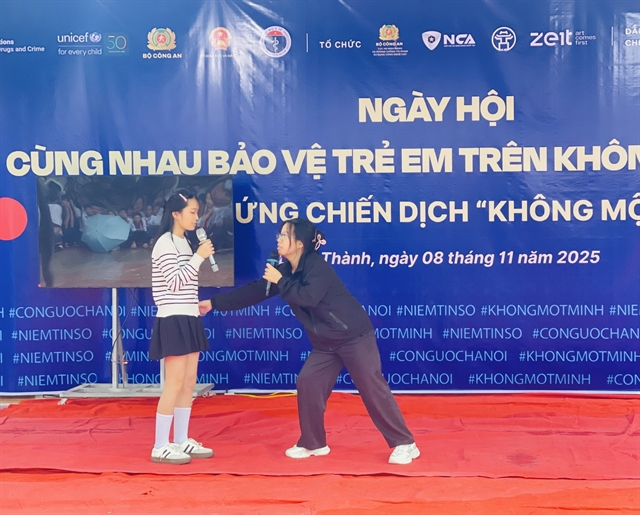
In response to these challenges, the 'Safer Internet – Safer Childhood' (SISC) project was launched with the goal of equipping children, parents and communities with the knowledge, skills and protective mechanisms needed for children to grow up safely, confidently and creatively in the digital space.
The project is funded by the Safe Online Fund under UNICEF's Ending Violence Against Children Fund, and is implemented by World Vision in Việt Nam in four communes in Thanh Hoá Province: Luận Thành, Tân Thành, Thường Xuân and Lương Sơn.
It has been running since October 2023 and will finish at the end of this year, with a total budget of more than US$420,000.
More than 36,300 people are beneficiaries of the project, including more than 10,200 children and more than 20,600 parents as well as caregivers.
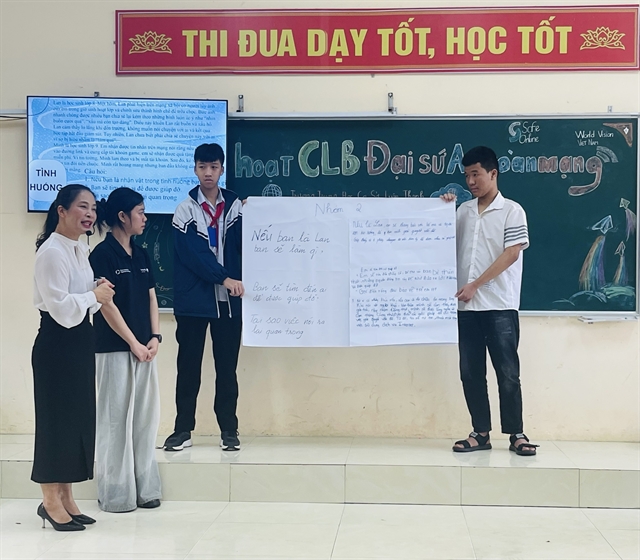
According to project head Nguyễn Thị Hà, the initiative was structured around four key pillars of intervention.
The first one is empowering children, providing them with the knowledge and skills to protect themselves online through creative, school-based and community-based activities.
Another involves engaging parents and caregivers, strengthening family connection and dialogue to help parents become trusted guides for their children on their digital journey.
The third pillar is building a sustainable protection ecosystem, promoting local child protection networks by enhancing reporting, referral and psychosocial support mechanisms across schools, families and local authorities.
Finally, the last pillar involves advocating at the national level, collaborating with government and professional agencies to help effectively implement the National Programme on Child Protection and Support for Healthy and Creative Interaction in the online environment.
“In this project, the online safety ambassadors are children themselves – those who participate, learn and then become key agents in spreading knowledge within their communities. They do not learn just for themselves, but also share what they know with friends, families and even their villages,” said Hà.
“Through them, the message of a safer online environment is carried from classrooms to entire communities,” she added.
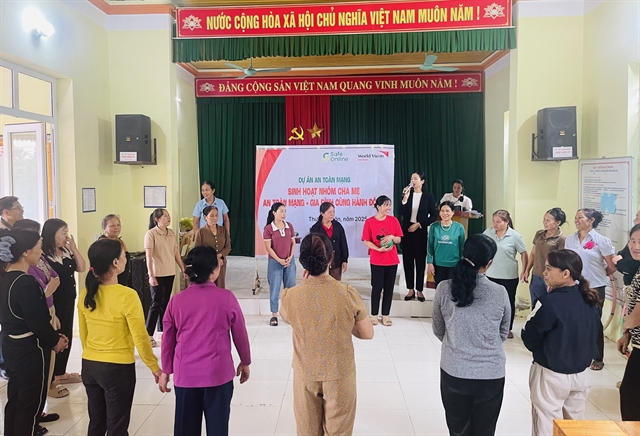
And it's not just children who participate. Many parents have also become true ambassadors after attending the project’s training sessions.
Vy, a mother who wanted to be known only by her first name, said that she used to scold her child whenever she saw them using a phone.
After the training, she changed her approach, learning to ask gently, understand what her child was watching or playing and help guide them with care.
“When I became my child’s friend, they felt more comfortable and started sharing with me more openly,” she said.
Looking ahead
Phạm Văn Thực, principal of the Luận Thành Junior Secondary School in Thanh Hoá Province, said that the SISC project was officially deployed in schools in March this year.
Thus far, the project had introduced many meaningful and practical activities aimed at protecting the online environment and ensuring the mental safety of students at the school.
“During the engaging activities, students are passionate and proactive. Most importantly, the project has helped many students confidently voice issues they encounter. They can learn how to protect themselves and avoid online dangers,” he said.
The school established the 'Online Safety Ambassadors' club, with assigned responsibilities. Each class has at least 25 ambassadors responsible for actively observing, supervising and supporting peers.
Due to the club's activities, messages about internet safety are conveyed very effectively among the students.
“We also regularly organise training sessions for school safety and digital safety skills, protection skills and appropriate response methods when encountering risky situations online,” said Thực.
A very meaningful part of this model is the Psychological Counselling Room, which helps members promptly detect issues and intervene for students and parents who show signs of sadness, anxiety or stress about social media, relationships or academic matters.
“This is also a place where students can talk, vent or even cry if needed, instead of enduring negative emotions alone and potentially seeking risky solutions. In this space, teachers are present as companions, listening, guiding and helping students find solutions to questions about social and digital issues,” said the principal.
To make safe internet usage more lively and engaging, the school, with support from the project, regularly organises many experiential and fun activities for students.
For example, during 'Safe Internet Week' and the online event 'The road to the safe internet', students have the opportunity to exchange knowledge, participate in fun social media challenges and interact directly with experts.
“With SISC, we have witnessed a clear change in students' perception and behaviour. Many students have proactively expressed risky issues to teachers or parents,” he said.
“We would also like to thank parents and families for always taking the time to accompany their children and for always maintaining communication with the school. Their concern and cooperation are what help the school and project have a positive impact on students. I hope that the safe internet programme will continue to spread and bring even more practical value to students in the future,” said Thực.
Hà said that SISC was more than a project. For her and many others, it marked a journey of connection and transformation.
“Through this journey, we have learned to listen to children, to accompany rather than control and to build a sustainable protection network linking families, schools and local authorities,” she said.
Today, local children are more confident in navigating the digital world. Parents have found a way to become trusted companions. And each community has one shared commitment: that all children deserve to grow up safe, confident and full of hope in the digital age.
“It is the beginning of a lasting future, where the seeds we plant today will blossom into a generation that is strong, compassionate and fully protected,” said Hà. — VNS
