Weather:
- Ha Noi 25oC
- Da Nang 25oC
- Ho Chi Minh 27oC
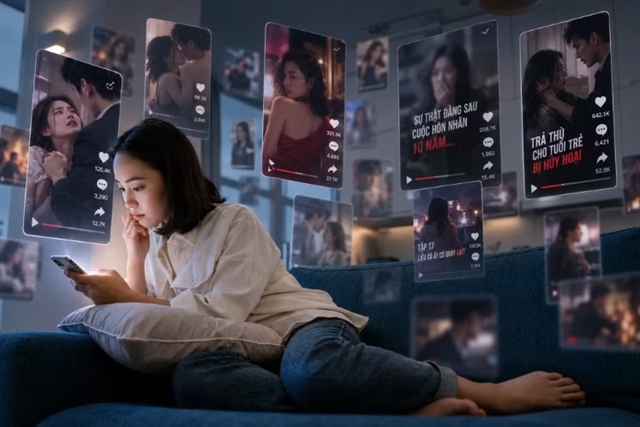
HÀ NỘI — Artificial intelligence (AI) has helped expand cinema's creative 'amplitude', cutting production time and costs while generating increasingly eye-catching visuals and scenarios.
However, experts believe it also brings a troubling downside for the industry.
Many AI-driven films chase sensational or harmful content to hook audiences, while authenticity, psychological depth, and humanistic values – the core elements that give art its vitality – risk being relegated to the background.
HCM City University of Theatre and Cinema Associate Professor Trần Yến Chi, who is also head of the jury for a student short film festival themed Góc Nhìn Trẻ 2026 - Nguồn Sáng Rực Rỡ (Young Perspective 2026 – Brilliant Light Source), told Báo Văn Hóa (Culture Newspaper) that AI is developing rapidly and becoming increasingly prominent in the cinema world.
One 'visible' trend is the boom in rapidly produced short films and videos. AI-generated films easily captivate viewers with eye-catching visuals, a constant stream of suspenseful scenarios, and a fast-paced narrative.
"However, the very way these videos sweep viewers from one situation to the next can lead to passive content consumption," Chi said, adding that, “Our brains will be seriously affected if we keep watching movies without having time to think.”

From a professional standpoint, Chi believed filmmakers could learn from AI’s ability to craft stories, accelerate narrative pacing, and suggest directions for script development. However, human-made cinema retains a unique advantage, namely the capacity to delve deep into the human psyche and express emotions that defy easy description.
These manifestations are sometimes fleeting, appearing in a character's eyes, gestures, or minute reactions, yet they embody a wealth of emotion and lived experience, according to Chi.
In her view, while AI can produce refined details, capturing moments of true "subtlety" remains significantly hard.
She also believes the issue is not eliminating AI from cinematic creation. "Technology is already present and will continue to develop. The problem is what value the filmmaker uses it for their creations," said Chi.
Meanwhile, film director and 'People's Artist' Đào Bá Sơn views AI through a fundamental requirement of cinema: authenticity.
In his view, AI can help reduce production costs while enabling the creation of large-scale scenes that previously demanded extensive manpower and resources.

"For professional filmmakers, the traces of artificiality in many AI products remain easily discernible," he spoke to Báo Văn Hóa.
According to the artist, cinema must, above all, make the audience believe in the characters' genuine emotions. In film acting training, an actor's key priority is not merely to portray the character's outward situation correctly, but also to truly touch on his/her inner emotion.
"Technology can generate a tear on screen, yet it is very hard to replace the lived experiences and emotional resonances unique to human beings," he said.
Other experts said that without a production crew, much time, or a large investment, AI can quickly generate a multitude of videos and short films, leading viewers from curiosity to excitement and leaving them eager for the next episode.
Alongside entertaining and educational content, this technology is being alarmingly abused to create videos that mislead, inflame, offend, or promote negative behaviours.
When consuming such content on social media becomes a hard-to-break cycle, it seriously impacts viewers' psychology, emotions, and perceptions.
Discussing the consequences of AI-generated drama films that explore toxic themes and promote psychological abuse and extreme revenge, writer Lê Thanh Ngân said in Hà Nội Mới (New Hà Nội) newspaper that the genre's appeal lies in its relentless pacing.
A constant succession of misunderstandings, grievances, and betrayals propels the audience from one dramatic climax to the next, she said.
AI-generated films can 'condense' emotions into a short timeframe, constantly pushing viewers through cycles from frustration to gratification and back to frustration, creating a 'stimulating loop'. Once accustomed to this pace, viewers may find it difficult to remain patient with slower-paced content, according to Ngân.
Another consequence is the impact on real-life attention spans and patience. Getting used to AI's sensational scenes and fast-paced content can make it harder for viewers to stay patient with books, slow-paced films, or tasks that don't yield immediate results.
Meritorious Artist Hạnh Thúy said that she watched many AI-generated films and found some fascinating due to their beautiful visuals and the nuanced, varied rendering of acting – capturing everything from the look in the eyes to the slightest movements. But the rapid advancement of the technology also leaves her feeling anxious. "At some point, AI will replace humans," Thúy said.
According to the artist, AI still has limitations, particularly regarding human emotion and creativity. What concerns her more is the type of content being disseminated through AI-generated films.
“At some point, people might view AI-generated films as a form of entertainment. However, in the long run, it is crucial to recognise that not every AI product is optimal, as in many cases, human elements and societal ethical values have not been given due regard,” she said.
The artist is concerned that when toxic or negative content appears too often, its impact can go beyond entertainment.
"If we watch them too much, they will unintentionally affect our thinking, our emotions, and our brain," she shared.
The issue goes beyond the mere appeal of AI-generated films since they consume viewers' time and money, pose alarmingly risks to mental health, and other harmful elements.
A survey conducted by the Ministry of Culture, Sports and Tourism's Cinema Department in Hà Nội and HCM City found that 39.3 per cent of surveyed audiences chose to watch movies online, while 35.6 per cent watched on television and 24.8 per cent in theatres.
Behind their ability to hook audiences, they use formulas familiar to traditional television products and social media content such as those about wealthy figures posing as paupers, powerful individuals facing disrespect, underdogs enduring hardship before exacting revenge, characters suffering betrayal only to turn the tables, and themes of time travel and reincarnation.
According to director Trịnh Đình Lê Minh, AI-generated series are proliferating on platforms like Reels, increasingly displacing the previously popular vertical-format videos with real actors.
Many of these stories rely on extreme situations and unique character backgrounds, constantly delivering plot twists to keep viewers engaged. Such motifs were not invented by AI.
Differences of ability to replicate them at greater speed and scale are key issues. Once a formula proves effective at retaining viewers, AI can help generate multiple variations – altering characters, settings, dialogue, and situations – while preserving the underlying structure. High-performing content keeps coming. Successful formulas are adapted and reintroduced to the market. — VNS
