
Voices from within the wrestling community and from cultural experts converge on one point: safety must be non-negotiable.
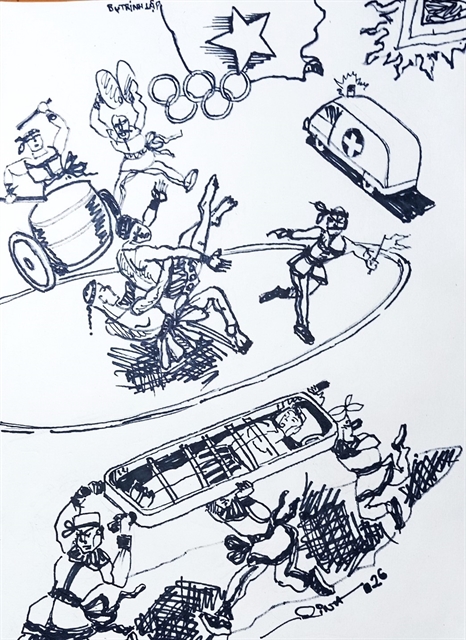
Illustration by Trịnh Lập
By Thanh Nga
The recent death of a wrestler at the spring festival in Kim Anh Commune on the outskirts of Hà Nội has turned what should have been a joyful communal ritual into a tragedy that reverberates beyond one family.
The loss forces a difficult but necessary question: can we continue to stage traditional wrestling contests as they have been run for generations, while the very real risks they carry remain unchecked?
Across many villages, wrestling remains organised in a loose folk style: matches take place on hard-packed earth, there are no weight classes or strict age divisions and pairings are often informal. This atmosphere can make the sport feel like harmless pageantry, but the reality is far harsher.
Wrestling is a full-contact combat sport. A single mistimed throw can channel a competitor’s entire weight onto another person’s head or neck, producing catastrophic spinal or brain injury. When the force of collisions approaches that of regulated sports but the event’s structure remains improvised, accidents are not merely possible – they become predictable.
Voices from within the wrestling community and from cultural experts converge on one point: safety must be non-negotiable. Professional wrestlers such as Đào Hồng Sơn and Hà Văn Hiếu have publicly emphasised that participants need to understand their physical limits and acquire basic technique before entering the arena.
An expert in intangible cultural heritage has also warned that sentimental attachment to tradition cannot stand in for carefully designed technical rules and protective measures. Preserving heritage means nothing if it costs lives.
We can learn from other countries that have balanced cultural preservation with athlete protection. Sumo in Japan and Ssireum in South Korea remain powerful cultural symbols, yet both operate under sporting frameworks that regulate weight classes, prohibit dangerous techniques to the head and neck, train referees rigorously and keep medical professionals on site during competitions.
These practices do not dilute cultural meaning, they safeguard the people who embody it. That balance – respectful of identity but uncompromising on safety – ought to inform how we run village wrestling today.
Two systemic problems make change urgent. First, many local organisers lack the resources, technical knowledge and medical preparedness needed to safely stage contact sports. Second, there is no mandatory national legal framework that sets minimum safety standards for amateur traditional wrestling.
Left to local custom alone, festivals default to informal arrangements that can overlook essential precautions such as health screening, appropriate pairings or emergency response plans. The result is a patchwork of practices that leaves participants exposed to unnecessary danger.
Addressing this does not mean erasing the cultural forms people cherish. Rather, it requires targeted policy and technical interventions that allow tradition to continue under safer conditions.
A national regulatory framework should be developed to set minimum standards for amateur competitions: mandatory weight and age categories, a list of prohibited techniques that pose heightened risk to the head and neck, referee training and licensing, clear emergency-stoppage rules and required medical staffing at events. Venues must be improved with shock-absorbing surfaces, safety barriers and designated spectator areas; competitions should not be staged on hard-packed earth.
Additionally, tailored technical rules for traditional wrestling should be written to respect local styles while aligning safety protocols with modern sports medicine. Basic training programmes, pre-competition health checks and skills assessments would help ensure that participants compete within their capability.
A robust public awareness campaign would further shift attitudes, helping communities understand that these measures strengthen rather than weaken their festivals by making them sustainable.
Ultimately, the question is not whether to keep or discard a folk game; it is about where we place human life in our hierarchy of values. Allowing communities to make life-or-death decisions without technical guidance or legal backing is no longer acceptable in an era when participation in these events brings real collision forces and real medical risk.
Introducing safety standards is not an attack on tradition – it is the condition for its survival. When organisers, authorities and communities work together to adopt sensible regulations and invest in safer infrastructure, village wrestling can once again be what it was meant to be: a space of shared joy, cultural pride and mutual care, not a site of preventable tragedy. — VNS