Weather:
- Ha Noi 27oC
- Da Nang 26oC
- Ho Chi Minh 28oC
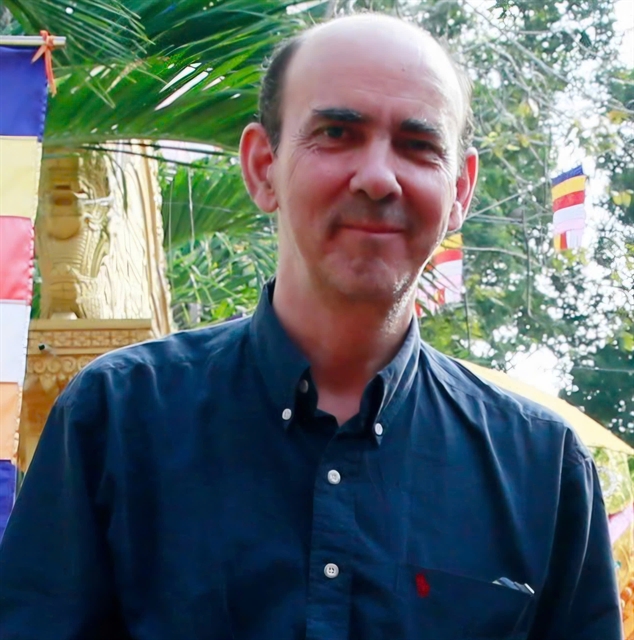
French reporter and photographer Nicolas Cornet has published several photo books exploring Việt Nam. His Chùa Việt Nam (Pagodas) has been republished in bilingual Vietnamese – English and Vietnamese – French editions.
Việt Nam News reporter Nguyễn Bình interviewed Cornet about his books.
You have published five photo books about Việt Nam, while your work in other Asian countries has resulted in only two books, one on Cambodia and one on Thailand. Why has Việt Nam become such a prominent focus of your work?
When you spend more time living in a country, opportunities present themselves. It takes a lot of good photos to put together a photo book. Since Western magazines commissioned me to do a lot of photo essays in those countries, it’s easier to produce books.
I have a lot of photos from India and China, but those countries are vast and practically impossible for a single photographer to cover in their entirety. I’ve proposed books based on specific itineraries, such as Gandhi’s India, since I’d done several photo essays on that subject, but when it comes to coffee table books, publishers are very cautious and often publish only very general works.
What role does photography play for you, both professionally and personally?
For me, photography serves several purposes. Professionally, it allows me to make a living from this art, particularly through travel, which is sort of my trademark and also my passion.
Personally, photography allows me to express myself, to write with images. Through this form of storytelling, I can create photographic narratives; my wanderings take shape in images.
When I worked for magazines, I would propose story ideas for subjects that I would then go on to photograph. We’d present a subject or a community, or focus on an event.
For the German magazine Mare, I featured places and the people living there, all connected to the sea: a floating village in Hạ Long Bay, a neighborhood built on stilts in Manila Bay and a giant shipyard on an island in South Korea.
Niko Gelpke, the editor-in-chief of that magazine, once told me: “Nicolas, your photographic style is literary!” I try not to stick to journalistic description, but rather to aim for a more evocative form of photography that opens the viewer’s eyes to more personal associations.
In my latest book, Pagodas, the perspective is different. The idea is, on the one hand, to compile an inventory of pagodas, like a list of architectural heritage. Then, within that framework, I also explore people’s lives and how they use the pagoda as a social and spiritual space.
Another example: last June, I created a photo essay along the Red River. You could call it a river story, just as we also talk about road stories. Since the photography commission was broad in scope for an exhibition, alongside the documentary elements (depicting the river and the people living along its banks), I wanted to include much more personal images.
They reflect my mental and emotional state; I can let myself dream and take photos that evoke poetry. They also reflect people’s lives and their states of mind. I plan to publish small books on each of the rivers I’ve worked on: the Red River, the Perfume River, the Sài Gòn River, the Thị Nại Lagoon and eventually the Mekong, if I can secure the necessary funding.
Your book Vietnam – A Sense of Place was published in Europe with a print run of 30,000 copies. Could you tell us more about the book and how it was received?
It’s very rare to achieve this level of sales with a photo book about a country. In Europe, and particularly in France, readers have shown genuine curiosity about Việt Nam.
I’ve received letters from readers, and during exhibitions I’ve read many compliments in the guest book, as well as many questions about a country that people know little about.
The media were also very interested in learning about the country. It’s important to note that many Vietnamese expatriates live in France; there is also a large mixed heritage population that has been growing for several generations.
There is a real demand for cultural products related to Việt Nam, films, documentaries, music albums, theatre and dance performances, books, photo exhibitions and comic books. Tens of thousands of people follow every cultural event related to Việt Nam.
One of your books, Pagodas (with a bilingual English-French edition published by Vietnam News Agency Publishing House), received the Second Prize at Việt Nam's National External Information Service Awards in 2018. Did receiving the award come as a surprise to you?
On the one hand, I was surprised and happy, because it was a reward for a very long project into which I had poured a great deal of energy and dedication – not only into the photos but also into the text.
Few foreign authors delve deeply into cultural topics in Việt Nam. Receiving this award is a form of recognition.
Of all the photo books you have published about Việt Nam, which one are you most satisfied with, and why?
The book Pagodas is the most rewarding, because it’s the only one I’ve managed to publish in Vietnamese. It gives me great satisfaction to be able to share images and stories with the Vietnamese public.
I hope to publish more, but I must admit that, for a foreigner, publishing in Vietnamese is a journey fraught with obstacles – some of which are difficult to accept as an author.
Is there a particular subject or theme that has consistently drawn your interest as a photographer?
My interests have varied over the years and with my ideas. Travel is also a passion of mine. When I set out in the morning, I don’t know where I’ll be sleeping that night.
I focus on thinking about the images, searching for locations and enjoying the encounters I have. Photography is there to capture moments, but I also realise how difficult it is to create good images. It takes time, energy and determination.
Once the photos are taken, I can write articles, organise exhibitions and publish books. It’s all these interests linked to photography that are my creative driving force.
You once said "Photographing the life of a country is not a duty or a responsibility. Above all, it is an opportunity." Could you elaborate on what you mean by that?
It’s a great privilege to be able to travel through a country regularly, exploring topics I set for myself. I don’t know France as well as I know Việt Nam. I’ve travelled through every province in Việt Nam several times, visiting the major sites, the entire coastline from north to south, the rivers, the countryside and the forests.
Not many people have the chance to travel so intensely, comprehensively and deeply. By meeting people everywhere, you get a different perspective on the country; you take its pulse, just like doctors take a patient’s blood pressure.
During my reporting, Vietnamese people talk to me a lot. They tell me their family histories and share details about their lives and daily routines. It’s fascinating. — VNS
