Weather:
- Ha Noi 24oC
- Da Nang 29oC
- Ho Chi Minh 31oC

Living in Việt Nam during the COVID-19 pandemic changed how children’s writer Roby Bellemans views art, education and possibility. In this Q&A with Việt Nam News , he discusses founding the Art for Children Gallery and his evolving relationship with Vietnamese culture.
Why did you choose Việt Nam?
I was born in what is now Antwerp, Belgium, in the first half of the last century, back when there was no television yet. We lived near a forest, and my father was a visual artist and opera singer. At one point, he had more children than he sold paintings, so he started working for Unilever, designing packaging and typefaces.
After a few years, I started my own bookstore gallery, and pretty soon, a visiting girl asked me where the children's art was. And then I thought ... yes, where is the children's art? Museums are full of them, but there's hardly any work that's actually made for children.
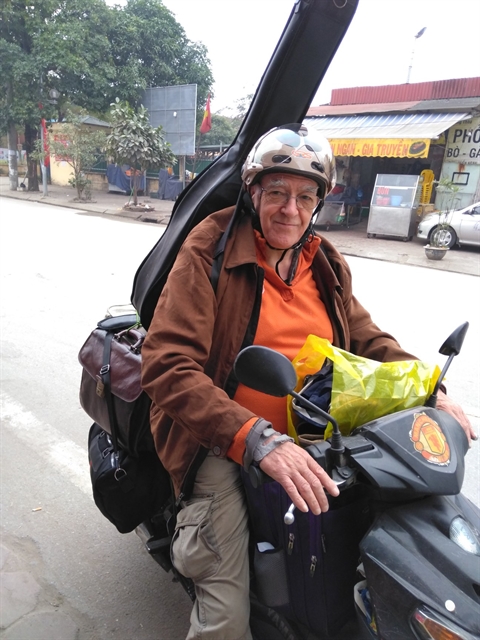
I had been in contact with artists in Việt Nam for a while, actually for a long time. I was also in Paris in May 1968. I had written about the first major Vietnamese exhibition in Brussels and about the first visit of the Hà Nội Water Puppet Theatre to Antwerp.
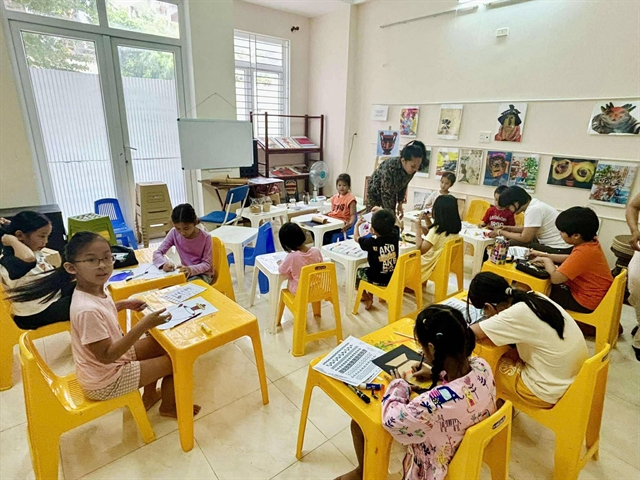
The job in Amsterdam paid very well, and then I thought it would be nice to visit Việt Nam. I'd already seen so many countries in Asia by then.
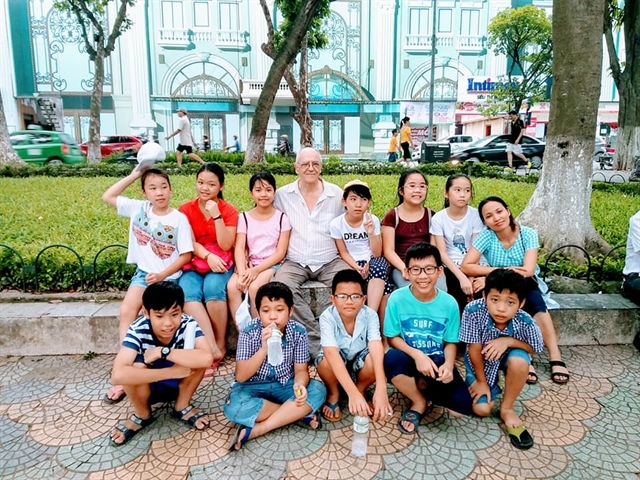
Vietnamese people are very friendly if they like you; otherwise, they ignore you. In Việt Nam, they're primarily interested in learning from you.
What do you see happening in the future for children who want to practice the arts?
What children enjoy learning most of all is how to seek possibilities. Some children already know what they want to learn and they take a course. Other children don't know it yet, and we develop weekly activities for them so they learn all sorts of things.
Our approach is based on the half-full or half-empty glass premise. One person sees the glass as half empty, while another sees it as half full, even if it's the same glass.
Many problems arise because we think what we see is correct. And it is, only the other way around is also correct. The best part is when we can see the same thing through someone else's eyes. We can do that because artists show what they see when they see the same thing as we do.
Different artists all see things differently, and it's interesting to see the same thing from all these perspectives. Because not only do we learn that everyone sees something different, but what we see becomes increasingly interesting, and we learn more and more about it.
Do you have another plan for the future in Việt Nam?
Due to personal circumstances, I've been a tourist in my own life my whole life. Things are always happening, and because of that, I've seen how different people solve the same problems differently, and I've learned a great deal.
But for some reason, young people like Oanh, who founded the Đà Nẵng Art for Children gallery, and Gulya, who runs the activities, find it interesting that I'm involved.
My most important contribution is convincing people that they have good ideas, and I can often help them remove their insecurities. Sometimes I act primarily as a catalyst; someone who doesn't do anything, but makes things possible.
Việt Nam is developing rapidly, but not everyone is keeping up with this development, and that often causes problems. For example, the fact that girls weren't allowed to study in the past, but now they are.
Many think they're not smart enough and work incredibly hard, while boys are convinced of their superiority. And you see that all over the world now: girls are outperforming boys everywhere, and that inevitably causes problems.
Việt Nam is also opening its doors more and more, which also causes or will cause problems along with many good things. But you already see that in old tourist areas, the locals want to get rid of the tourists. That's not yet the case in Việt Nam, but with the recent enormous growth, it's good that it's being looked at.
The advantage of getting older is that you can sometimes make good comparisons. I sometimes see situations I remember from my youth, and on the other hand, situations I can only just grasp. There's a deep divide between different population groups, and that exists everywhere -- only often in different ways.
There's a very simple explanation for this situation: Việt Nam has a country to build, and investing time and money in developing Vietnamese language courses for tourists isn't a high priority. There are a lot of prejudices and sensitive aspects at play. VNS
