Weather:
- Ha Noi 26oC
- Da Nang 25oC
- Ho Chi Minh 25oC
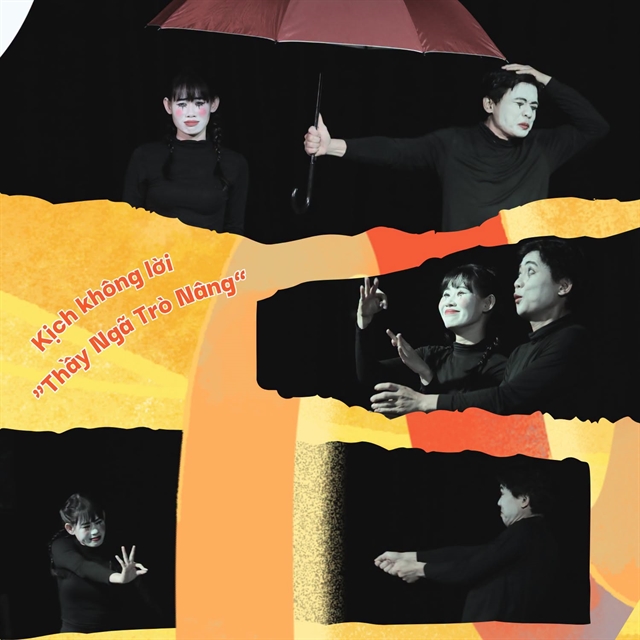
HÀ NỘI — A festival of theatre and performing arts organised by the European Union National Institutes for Culture in Vietnam (EUNIC Vietnam) takes place in Hà Nội from October 20 - 25.
The festival themed Every Body in Motion aims at seeking, supporting and creating performance opportunities for individuals and groups practising theatre and performing arts in Việt Nam.
The festival strives to be a bridge that transforms theatre in particular and the arts in general into spaces of creation and enjoyment for the widest possible range of artists and audiences.
Over the course of six days, disabled and non-disabled artists from Việt Nam, Austria, Italy, Germany, South Korea and the United Kingdom will together present the different possibilities of the stage when the spirit of diversity and inclusion are placed at centre.
At the festival, audiences will find themselves wandering through mysterious and fantastical realms, at once familiar and strange, in classic works such as Shakespeare's A Midsummer Night's Dream and Maurice Maeterlinck's The Blind.
Stepping into contemporary life, audiences will encounter Lắng Nghe Điểm Chạm – a work premiering for the first time and performance Bến Tằm.
Alongside these, contemporary tales of the quest for Wonders in the work of the same name, and reflections on identity, belonging and the borders that divide people – told through the musical language of artist Wonhee Shin will leave audiences deeply moved.
The works take audiences on a journey of discovery, from dreams of a fantastical world and hope in enduring humanistic values to the turmoil of separation and disconnection, a quiet pause at a crossroads, and finally, a confrontation with one’s own sense of being lost.
Written around 1595, A Midsummer Night's Dream is one of Shakespeare's best-loved and most frequently staged comedies.
In this production, Shakespeare's stage opens to more bodies and more ways of expression. Each actor's difference is not hidden but becomes part of how the story is told.
"This is a stage where diversity of body and expression is not a barrier, but a source of creativity," said director Beverly Blankenship.
The production is a collaboration between Blankenship and the Hà Nội Academy of Theatre and Cinema. The cast brings together students of the Academy and disabled actors invited from outside the school.
Throughout the rehearsal process, they have learned to work with one another, listen to one another, and find a shared stage language.
"Our production is a normal production including people with special needs, lovingly included, and in a way, they are the stars of our production, because that's why we're doing the production," said Blankenship.
"All of our people with special needs are some fairy or animal, and they have quite a few movement scenes. It's a fascinating process because suddenly, one of the boys with special needs, is performing as the lion and the monkey."
One of the highlights will be inclusive singing workshop led by Italian mezzo-soprano Valentina Volpe Andreazza and pianist Francesco Morettini.
The workshop embodies this spirit, bringing people together to talk, sing, listen and improvise, connecting different voices and perspectives through music.
Participants will learn and rehearse selected songs from Valentina’s concert programme, pieces chosen to build a small bridge between Italian and Vietnamese musical traditions. Participants will also have the opportunity to perform alongside Valentina on the stage of Chuông Vang Theatre as part of the festival programme on October 24.
"We will also have workshop singing with the two choirs, so we are really excited about that," said Andreazza. "In Italy, I used to have to perform, but I used to work with people with disabilities, specifically people who are paralysed, or have a disability in the brain, for example, Alzheimer's.
But music is an instrument to connect people. And so, we go over the boundaries, the differences, because everyone of us has a boundary, but we are stronger together."
Under the art director Nguyễn Hoàng Điệp and coordinated by Goethe-Institute Hanoi and British Council Vietnam together with EUNIC member organisations, the festival includes film screenings, panel discussions, and especially workshops and performances. — VNS
