Weather:
- Ha Noi 27oC
- Da Nang 27oC
- Ho Chi Minh 31oC
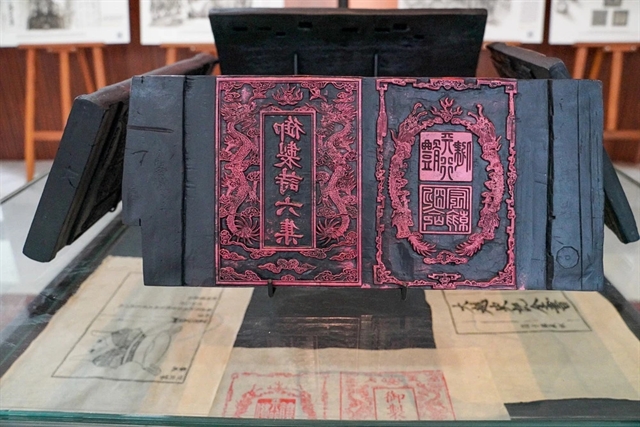
HÀ NỘI — Launched in early 2026, the Việt Nam World Documentary Heritage and National Archives Exhibition Space, run by the Hà Nội-based State Records and Archives Department, is quickly turning into a “visual classroom” that makes the Politburo’s Resolution 80-NQ/TW on Vietnamese cultural development feel real and exciting for today’s youth.
Bringing history to life
Right from the first days of warm spring, the spot has been pulling in big crowds of locals and tourists eager to dive into its star attraction: “Admiring imperial annotations – Preserving woodblock imprints".
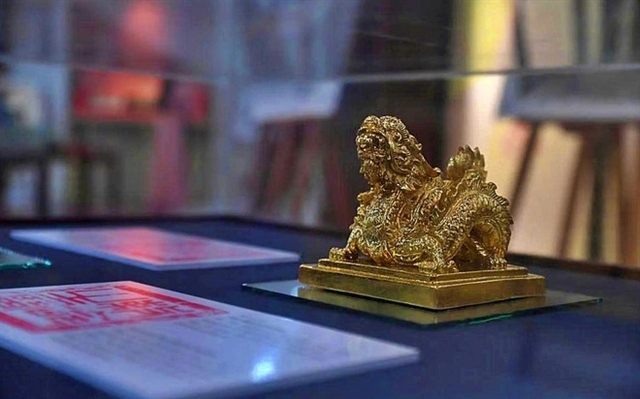
In the “Admiring imperial annotations” zone, Đỗ Thu Bảo Khanh, a student in the Faculty of Cultural Industries and Heritage at the School of Interdisciplinary Sciences and Arts, jumped right into stamping royal imperial seals onto New Year greeting cards featuring lucky messages penned by Nguyễn Dynasty emperors. Showing up bright and early, Khanh watched every move like a hawk, jotted down notes, and got her hands dirty with the fun activity.
Over at the woodblock printing area, 23-year-old Lê Tuấn Hưng from Hà Nội’s Long Biên Ward was rolling ink onto the block, carefully placing the traditional “dó” paper and pressing down to create a perfect print.
Surprise, thrill, and wide-eyed curiosity are seen on the faces of hundreds of young visitors pouring through the doors every day. The department is keeping more than 30km (shelf length) of priceless national archival documents, a treasure trove of original records that trace Việt Nam’s history, rich culture, social changes, fight for sovereignty, how the state was run, and what everyday life looked like through the ages.
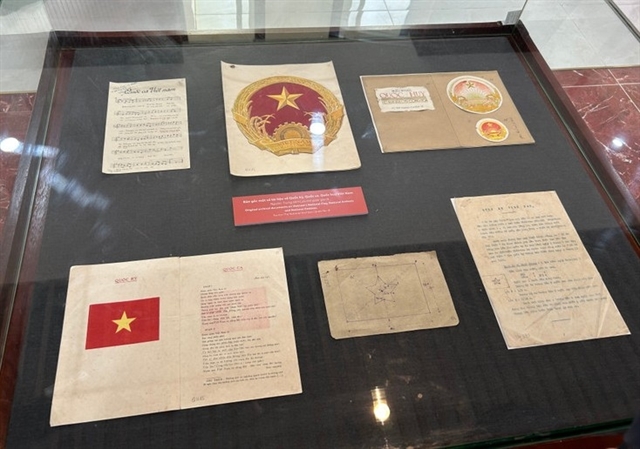
Highlights include two collections recognised on UNESCO’s Memory of the World Register: the Nguyễn Dynasty imperial archives (châu bản) and the renowned Nguyễn Dynasty woodblocks. Adding to these are materials from the French colonial period, the resistance wars, and a wealth of documents and photos connected to President Hồ Chí Minh, gathered from both domestic and international sources. Together, they weave a vivid, multi-layered narrative that brings the nation’s history to life instead of leaving it flat in a textbook.
Realising Resolution 80’s vision
The Politburo’s Resolution 80-NQ/TW on Vietnamese cultural development explicitly directs that “all pupils and students in the national education system should have regular and effective access to art and cultural heritage education activities”.
Such a mandate assigns clear responsibilities to heritage agencies, including the national archives system. Making the entire exhibition space free removed the biggest hurdle for students eager to get up close and personal with authentic historical artefacts.
Đặng Thanh Tùng, the department’s Director General, pledged to continue collaborating with schools and universities in Hà Nội and nationwide, bringing accurate historical content directly into lesson plans through digital platforms like documentary films and official websites.
The department plans to urge the Ministry of Home Affairs and the Ministry of Education and Training to create a well-organised plan that offers quality historical learning materials sourced directly from the national documentary heritage archives.
The resolution highlights the importance of updating cultural governance to a more supportive and focused approach, while leveraging science, technology, innovation, and digital transformation to drive meaningful progress in the cultural landscape.
The exhibition space exemplifies this shift. Far from a conventional static display, it operates as a lively visual history classroom and an open learning hub that mixes cutting-edge digital tools, multimedia shows, and modern interactive formats to hook every visitor who walks in. — VNA/VNS
