Weather:
- Ha Noi 18oC
- Da Nang 24oC
- Ho Chi Minh 27oC
Mạnh Khánh - Lương Hương
For centuries, the stone steles of Phố Hiến in Hưng Yên Province have silently preserved the story of a once-thriving trading port, bearing witness to its prosperous past and vibrant cultural exchanges.
The steles have recently come into the spotlight after being inscribed on UNESCO's Memory of the World Regional Register for Asia and the Pacific on November 5. The recognition has brought immense joy and pride to local authorities and residents, as well as people across Việt Nam.
Glorious Past
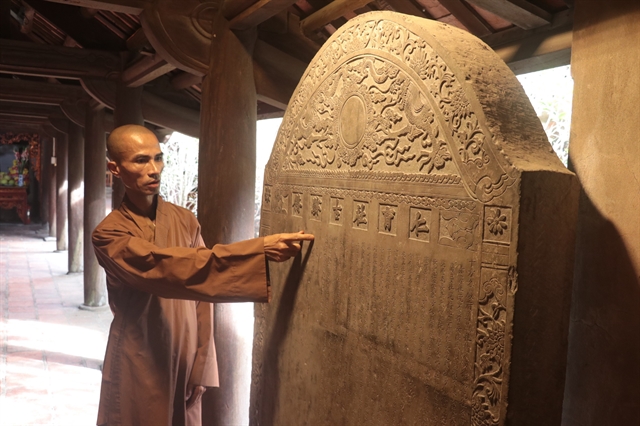
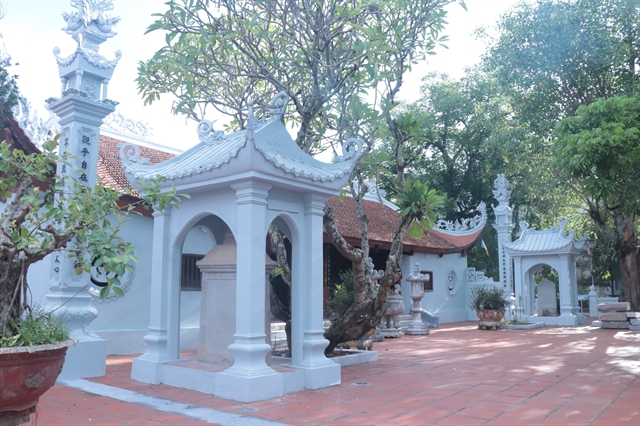
According to Đỗ Hữu Nhân, Director of the Hưng Yên Department of Culture, Sports and Tourism, the Phố Hiến Stone Steles comprise 41 steles bearing inscriptions in Chinese and Nôm (Vietnamese demotic script) scripts, dating from the 17th century to the early 20th century. They are preserved at historical sites within the special national relic complex of Phố Hiến in Hưng Yên Province.
The collection is an exceptionally well-preserved and authentic documentary heritage, maintained in its original condition by local communities over centuries. It serves as a vivid historical record of Phố Hiến during its heyday as a prominent international trading port in Asia.
Phố Hiến emerged and developed from the 16th century, reaching its prosperity in the 17th century, when it became one of Việt Nam’s major cultural and commercial centres and an important trading hub for Southeast Asia and East Asia.
Over successive historical periods, the area saw the formation and growth of commercial quarters, attracting foreign merchants, including Chinese and Japanese traders. Dutch, Portuguese and British traders also established a presence there from the second half of the 17th century.
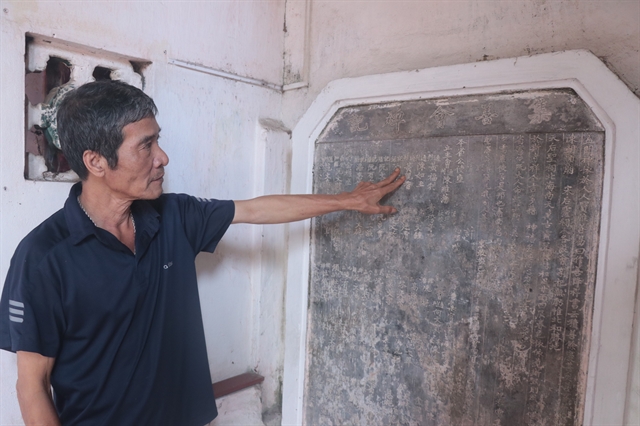
The Phố Hiến Stone Steles reflect four major themes. First, they serve as authentic historical records of Phố Hiến as an early-developed port city and one of the region’s major trading centres in the 17th and 18th centuries. They also document the cultural exchanges and acculturation that took place in this international trading hub during the same period.
In addition, the inscriptions reflect the harmonious coexistence and interaction of different religions and beliefs in the cultural and social life of local communities. They also embody the spirit and longstanding tradition of valuing education among the people of Hưng Yên.
The Director of the Hưng Yên Department of Culture, Sports and Tourism particularly highlighted the historical and cultural value of inscriptions on two steles at Hiến Pagoda, dating from the seventh year of the Vĩnh Tộ reign (1625) and the fifth year of the Vĩnh Thịnh reign (1709), as well as a stele at Chuông Pagoda, dating from the 11th year of the Vĩnh Thịnh reign (1711).
These inscriptions record that, from the early 17th to the early 18th centuries, Phố Hiến had as many as 25 commercial quarters and markets, dealing mainly in traditional handicrafts and essential goods. These included dyed goods, earthenware pots, bowls, wooden beds and fresh fish.
This provides clear evidence of the formation and growth of Phố Hiến as a port city and an important economic centre of the country at the time.
The inscriptions also reveal that, beyond serving as a regional trading port, Phố Hiến was a major centre of migration and settlement, attracting people from different regions.
Its development was closely linked to the capital of Thăng Long and to numerous economic centres, handicraft villages and raw-material supply hubs across Việt Nam and the wider region.
The stele at Chuông Pagoda, erected in the 11th year of the Vĩnh Thịnh reign (1711), describes a long, busy thoroughfare passing the pagoda. This may have been the route connecting Phố Hiến with the former capital of Thăng Long.
Notably, the inscription on the stele at Hiến Pagoda, dating from the seventh year of the Vĩnh Tộ reign (1625), is an important historical source proving that commerce in Phố Hiến was already flourishing before 1625, predating the arrival of the Dutch trading post – a commercial establishment comprising offices and warehouses operated by Western trading companies.
“This shows that a commodity-based economy had taken shape in Phố Hiến even before the arrival of foreign merchants, particularly those from the West,” Nhân said.
“Later, driven by the expansion of global trade, the local economy flourished and became increasingly integrated into international trading networks.”
Unique heritage
According to Associate Professor and Doctor Tống Trung Tín, Chairman of the Vietnam Archaeological Association, the Phố Hiến relic complex is one of Hưng Yên’s key heritage sites, preserving a wealth of the nation’s historical and cultural documentary heritage.
The Phố Hiến Stone Steles are an important component of this historical and cultural complex, connecting the town with its past as an economic hub and a centre of cultural activities. They also bear witness to the formation of an international business culture under the rule of the Lê lords in Đàng Ngoài (northern Việt Nam).
He commended Hưng Yên Province for its efforts to preserve and protect the collection and compile a scientific dossier on the Phố Hiến Stone Steles, helping safeguard and promote their documentary heritage value for future generations.
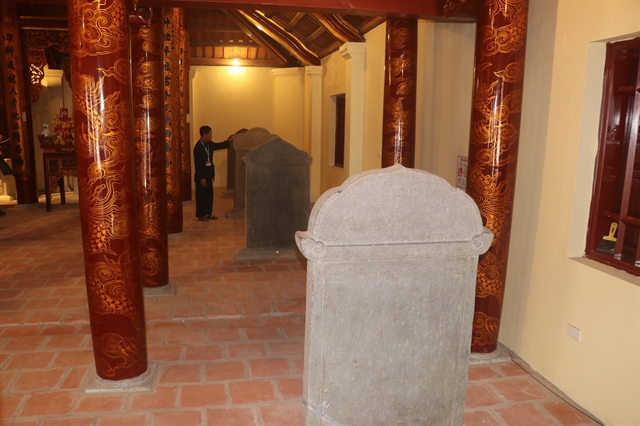
All 41 stone steles have remained relatively intact over the centuries. Each is an original, one-of-a-kind artefact that has been preserved and maintained in relatively good condition at its original location, with decorative motifs and inscriptions still legible.
Local officials and residents of Hưng Yên have expressed great joy and pride in their homeland, whose stone steles have been inscribed on UNESCO’s Memory of the World Regional Register for Asia and the Pacific.
Nguyễn Phương Lan, 47, who lives on Phố Hiến Street in Hồng Châu Ward, said she used to visited the historical sites and admire the stone steles bearing Chinese inscriptions when she was young. At the time, she did not fully understand their meaning and importance.
After learning that the Phố Hiến Stone Steles had been inscribed on UNESCO’s Memory of the World Regional Register for Asia and the Pacific, she looked into their history and discovered a wealth of useful information.
“The more I learned about the steles, the deeper my love and pride for my hometown of Phố Hiến grew,” she said.
An enthusiast of Phố Hiến’s culture, Nguyễn Văn Thắng, from Đông Ngạc Ward, Hà Nội, said the Phố Hiến Stone Steles vary in shape, size, stone material and decorative motifs. Most are traditional flat steles with curved foreheads and arched tops.
Their diverse decorations reflect the development of sculptural art, offering insights into the evolution of Vietnamese fine arts through different historical periods. The collection is vivid evidence of the intellectual creativity and exquisite craftsmanship of artisans of the time.
“The stone steles are truly one-of-a-kind, representing Việt Nam’s distinctive cultural and historical heritage,” he said. VNS
