Weather:
- Ha Noi 27oC
- Da Nang 25oC
- Ho Chi Minh 26oC
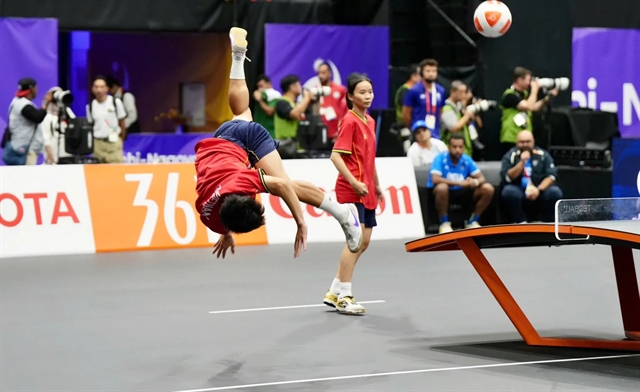
HÀ NỘI — Winning a bronze medal may not be the biggest target for Việt Nam's sports delegation at the 20th Asian Games (ASIAD) in Japan, but it has special meaning for the country's teqball team.
The medal won by Nguyễn Hoàng Minh Tân and Trịnh Gia Nghi in the mixed doubles on Sunday was Việt Nam's first in teqball at the Asian Games and also the first medal for the Vietnamese delegation.
For a sport still relatively new in Việt Nam, the result was a reward for the efforts of a young team making its Asian Games debut.
Việt Nam sent four athletes to compete in three teqball events. Tân and Gia Nghi defeated India's Dsouza Quimcy Joaquim and Beg Mohamed Anas Imran 2-0 (12-9, 12-6) to take the bronze.
The men's doubles pair of Bá Trường Giang and Lê Anh Khoa also came close to a medal.
The Vietnamese players faced some of Asia's established teqball teams and showed that they could compete with them. Japan, India, South Korea, Iraq and Lebanon have all developed strong teams in the sport, while Việt Nam has only recently begun building its programme.
"I am very happy to win the bronze medal with Nghi and collect the first medal for Việt Nam at ASIAD 20," Tân said.
"Although this was my first major Games, I told myself that I had to keep trying and working hard. We spent time studying our opponents and tried to stay focused.
"There were times when we were nervous and made mistakes. But we managed to overcome the pressure together and were able to get this result."
The team's progress has also been seen in recent competitions. The gap between Việt Nam and Thailand has narrowed since the SEA Games late last year, followed by the Asian Beach Games in April and now the Asian Games.
Teqball requires players to combine ball control, quick reactions and tactical awareness. The sport has elements of football, table tennis, sepak takraw and other ball games, and requires players to have both physical fitness and good technical skills.
Team leader Trần Duy Khâm said the bronze medal was not the team's final goal.
"Although we exceeded our target, honestly, this bronze medal is not our final destination. It could be the starting point for the next stage," Khâm said.
"We see this as a push for the future and want to turn the result in Aichi-Nagoya into more stable results later."
The team plan to expand the sport at grassroots level, identify and train young players, improve coaching and increase the number of international competitions for its athletes.
"If the players compete regularly, they will be able to see their weaknesses and work on them. They can also gain more experience and improve their confidence and ability to deal with pressure," Khâm said.
The development of teqball in Việt Nam has been supported largely through socialised resources. HCM City, where the sport has developed strongly, has provided training equipment for sports centres and local units.
The city's Department of Culture and Sports has also worked with Hoa Lư Sports Centre to invite Hungarian expert Milan Szabo and Thai coach Pornthep Wapisiri to help train local players.
The HCM City Open Teqball Tournament in 2025, which featured 12 teams, also gave Vietnamese players more competition experience before the Asian Games.
Việt Nam's head of delegation at ASIAD 20, Nguyễn Hồng Minh said the result reflected co-operation between State agencies and social resources in developing high-performance sport, particularly in a relatively new discipline.
Before the Asian event, expectations for the Vietnamese team were modest. Coach Lê Quang Khang said before the tournament that the players would try their best and hoped to win one or two matches.
Instead, the Vietnamese athletes produced several strong results, beating Japan and South Korea in the group stage before Tân and Gia Nghi secured the bronze.
The Vietnamese teqball team will have two more international opportunities before the end of the year, with the World Series in Thailand in late October and the Asian Indoor and Martial Arts Games in Saudi Arabia in December.
"If we take part in these competitions, the team will certainly have more opportunities to improve," Khang said.
The bronze medal in Japan has given Vietnamese teqball valuable experience at the continental level. The next task will be to maintain the momentum through regular training and international competition. — VNS
