Weather:
- Ha Noi 27oC
- Da Nang 26oC
- Ho Chi Minh 27oC
It is not emotional distance, but rather a language barrier that prevents children from fully expressing their feelings toward their families.
Many parents have recognised this reality and believe that teaching Vietnamese is more than just language instruction; for them, it is about preserving family bonds, memories of the homeland and cultural identity for the younger generation.
These heartfelt sentiments were shared by parents at a series of seminars on promoting Vietnamese language and culture overseas, where their stories regarding the language gap between children and their grandparents during visits to Việt Nam deeply touched attendees.
More than a means of communication
According to Ngô Thị Thanh Mai, vice chairwoman of the Ministry of Foreign Affairs’ State Committee for Overseas Vietnamese Affairs, preserving and promoting the Vietnamese language within the overseas Vietnamese community is not only a cultural necessity, but also a vital foundation for strengthening national identity and community cohesion across generations.
Given this reality, she emphasised the need for innovative approaches, including accelerating the application of technology, developing flexible learning models that combine online and in-person instruction, and digitising educational materials to provide the community with practical and effective support.
Deputy Head of the Commission for External Relations of the Vietnam Fatherland Front Central Committee Đặng Thanh Phương agreed, stating that Vietnamese is more than a means of communication.
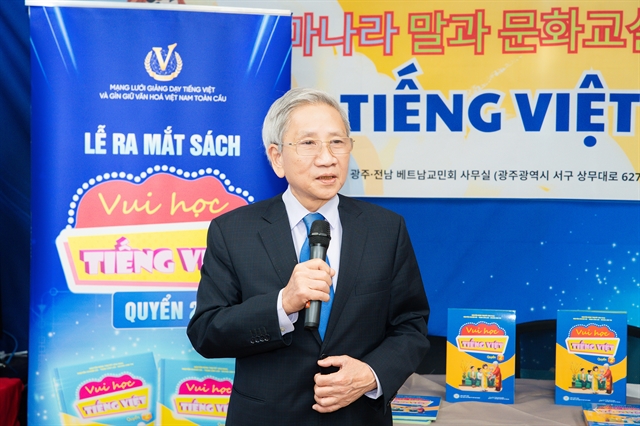
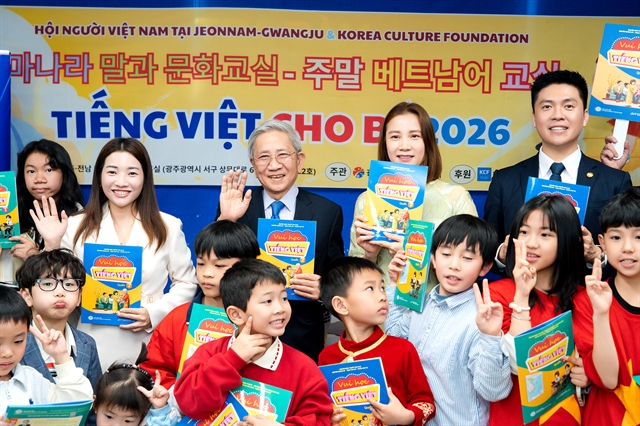
“It is a cultural bridge and a key factor in maintaining the bond between the overseas Vietnamese community and their homeland,” he told participants at a seminar titled 'Reality and Solutions for Promoting Vietnamese Language and Culture in the Vietnamese Community in South Korea' held in Gwangju, South Korea on Sunday.
“The preservation of the Vietnamese language should be regarded as a collective social responsibility, requiring the concerted involvement of associations, families and representative missions.”
Community-based approach
Nguyễn Duy Anh, member of the Vietnam Fatherland Front Central Committee, honourary president of the Vietnamese Association in Fukuoka and General Secretary of the Global Network for Vietnamese Language and Culture Teaching, delivered remarks at a seminar in Taiwan (China) on April 11.
He said: “Vietnamese is not just a tool of communication. Vietnamese is the origin – it is memory, it is family, it is homeland, and it is the sacred bond connecting generations of Vietnamese people around the world.”
According to Anh, preserving and promoting Vietnamese in overseas Vietnamese communities should be regarded as a shared responsibility, requiring the coordinated participation of the State, representative agencies, associations, teachers, parents and the students themselves.
“Starting a Vietnamese class is not too difficult, but maintaining that class sustainably, with quality, with students returning, with parents accompanying and with influence spreading throughout the community – that is the real challenge,” he said.
From a teacher’s perspective, opinions focus on the difficulties of maintaining classes: a lack of suitable learning materials for multilingual children, a lack of specialised teaching methods and a lack of connectivity between different community classes.
Currently, many classes still operate based on individual volunteerism and passion, lacking a systematic foundation for long-term development.
At the seminars, direct questions were raised on how to keep children interested in learning Vietnamese, the role of the family in language maintenance and ways to create an environment for using Vietnamese in daily life.
These exchanges were not merely theoretical, but were tied to real-life issues, including when children are more accustomed to using the local language of their host country, when parents lack the time to support their children or when classes cannot be sustained long-term.
Out of these discussions, a common realisation emerged: preserving the Vietnamese language requires more than just relying solely on the classroom. It must begin with the family and the community.
Highlighting the role of community connection, president of the Vietnam Innovation Network in Taiwan (China) Võ Đức Thắng said: "We hope that through this programme, a network of Vietnamese language teachers in Taiwan will gradually take shape – where teachers can share experiences and learning materials and support one another."
“The network will serve as a bridge between the community here and Vietnamese teaching networks both regionally and globally, contributing to the spread of effective models,” he told attendees at the seminar held in Taiwan.
Innovating methods
At the seminars, experts emphasised that teaching Vietnamese to children abroad would require a change in approach, shifting from pure language instruction to creating learning experiences.
Vietnamese language should be integrated into activities like storytelling, games and cultural events, helping children approach the language more naturally and with greater interest.
At the same time, the application of technology, the development of digital learning materials and the networking of classes were identified as key solutions to improve teaching effectiveness.
According to Professor Dr Nguyễn Minh Thuyết, Editor-in-Chief of the 2018 General Education Programme and chief editor of the Vui học tiếng Việt (Enjoy Learning Vietnamese) book series, teaching Vietnamese in a multilingual context cannot follow traditional methods. Instead, it must shift toward a flexible, learner-centred approach that connects language with experience and culture.
“Instead of placing heavy emphasis on literacy and grammar, it is essential to create an environment where children can listen, speak and interact naturally through storytelling, games and community activities, thus fostering a sustainable love for the Vietnamese language,” he said.
Towards a Vietnamese ecosystem
According to Anh, the seminar reached a consensus that for the Vietnamese language to develop sustainably, a 'living' ecosystem must be built – one in which Vietnamese exists not just in the classroom, but also in the daily life of the community.
Key factors include collaboration and connection between State policies, representative agencies, community associations, teachers, parents and students. When these elements are closely linked, the Vietnamese language will not only be preserved, but will also thrive across future generations.
The seminar series will continue in Japan, Laos and Thailand in April, Singapore in May and Malaysia in June, before heading to Europe and Australia.
The seminar series was organised by the Global Network for Vietnamese Language and Culture Teaching in coordination with Vietnamese organisations and Vietnamese representative offices in the host countries.
Representatives from the Vietnam Fatherland Front Central Committee and the State Committee for Overseas Vietnamese Affairs will be in attendance.
Launched in September 2025, the network has rapidly expanded across more than 15 regions, connecting hundreds of teachers and experts from over 130 countries and territories.
Aside from holding seminars and workshops, training Vietnamese language teachers and disseminating learning materials, the network has built community models like 'Vietnamese Bookcases' and cultural spaces.
At the same time, the network is promoting digital transformation with initiatives like its Global Map of Vietnamese Classes, a data system connecting teachers and parents and a shared online repository of learning materials. VNS
