Weather:
- Ha Noi 29oC
- Da Nang 31oC
- Ho Chi Minh 33oC

AN GIANG Scattered across the Bảy Núi region of An Giang Province, Khmer pagodas rise amid the landscape with their multi-tiered roofs, soaring towers and intricate motifs, bearing the distinctive imprint of Theravada Buddhism and Angkorian art.
Yet these pagodas are far more than striking architectural landmarks. For generations, they have stood at the heart of the local Khmer community, serving as places of worship and vibrant cultural centres where language, customs, festivals and traditions continue to be preserved and passed on.
An Giang is home to dozens of Khmer pagodas, concentrated mainly in Tri Tôn, Ô Lâm and Tịnh Biên communes, including Tà Pạ, Koh Kas, Xvay Ton, Krăng Krốch and Soài So pagodas.
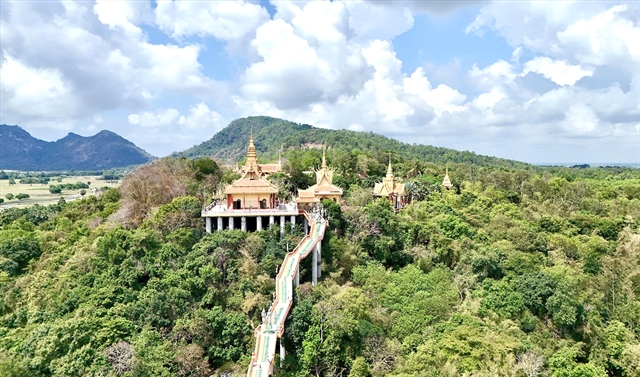
Khmer pagoda architecture in An Giang bears the distinctive imprint of Khmer Theravada Buddhism and the influences of Angkorian art.
It is characterised by multi-tiered curved roofs, soaring pointed towers and intricate decorative motifs.
Images of dragons, the sacred Naga serpent and the mythical Krud bird, as well as bas-reliefs and Buddha statues, are widely used, giving Khmer pagodas a distinctive appearance amid the cultural landscape of the Bảy Núi (Seven Mountains) region.
Each pagoda has its own layout and architectural character, but all display the fundamental features of Khmer pagoda architecture in southern Việt Nam.
Multi-tiered roofs, graceful curved lines and religiously significant decorative motifs are harmoniously combined to create spaces that are both solemn and rich in artistic value.
Located in the centre of Tri Tôn Commune, Xvay Ton Pagoda is one of the oldest Khmer pagodas in the area, with significant historical, architectural and cultural value.
Meanwhile, Tà Pạ Pagoda impresses visitors with its hilltop location, offering panoramic views over the vast plains below.
Soài So Pagoda is also an attractive destination for visitors to the Bảy Núi region. The pagoda stands out with its characteristic Khmer Theravada architecture, along with vibrant murals, bas-reliefs and decorative patterns that contribute to its distinctive cultural atmosphere.
Particularly notable is Prochum Meáp Chhưm Kiriram Pagoda, also known as Krăng Krốch Pagoda, renowned for its avenue of ancient longan trees stretching from the entrance deep into the pagoda grounds.
Standing out amid the greenery is the main worship hall, with its distinctive pink colour and decorative details that strongly reflect Khmer architectural style.
Living heritage
Beyond their architectural value, Khmer pagodas play an important role in the spiritual and community life of the Khmer people.
They host traditional festivals such as Chol Chnam Thmay (Khmer New Year), Sene Dolta (the Ancestor Worship Festival) and Ok Om Bok (the Moon Worship Festival), while also serving as places where younger generations learn the Khmer language, customs, traditions and cultural values.
Speaking to the Tin tức và Dân tộc newspaper, Phạm Thị Kiều Oanh, head of the Culture and Social Affairs Division of Tri Tôn Commune, An Giang Province, said the Khmer pagoda system serves not only as a network of places of religious practice but also as a centre for preserving and transmitting the cultural identity of the Khmer community.
According to Oanh, through festivals, spiritual rituals and community activities held at the pagodas, younger generations have opportunities to learn more about their roots, customs, language and traditional cultural values.
Therefore, preserving the pagodas also means protecting the distinctive cultural spaces of the local Khmer community.
To preserve their architectural value, local authorities are working with monks and pagoda management boards to survey and assess the condition of the structures and gradually develop plans to repair and restore deteriorating components.
Conservation efforts are guided by the principle of retaining as many original elements as possible while respecting the historical, architectural and cultural values of each structure.
Preserving pagodas
However, the conservation of Khmer pagodas still faces many challenges, particularly limited funding, as many structures are old and regularly exposed to harsh weather and natural hazards.
In addition, there is a shortage of personnel with expertise in the conservation of historic architecture and traditional techniques, while inappropriate restoration methods could compromise the authenticity of the structures.
Local authorities maintain regular contact with monks and pagoda management boards to discuss and agree on restoration plans, while raising awareness and encouraging the Khmer community to participate in preserving and promoting its heritage.
Mobilising resources from the State, communities, social organisations and benefactors has also been identified as an important way to help meet conservation needs.
According to Oanh, in the coming period, Tri Tôn Commune plans to develop cultural tourism in combination with community-based tourism, with the Khmer pagoda system serving as a network of distinctive attractions.
Tourism development will focus on introducing the architectural, historical and cultural values of the pagodas, while incorporating traditional festivals and folk cultural activities to give visitors opportunities to experience the cultural life of the Khmer community.

“Tourism development must go hand in hand with cultural preservation, avoiding excessive commercialisation that could undermine the original values of the pagodas.
"The locality will coordinate the organisation and promotion of traditional festivals such as Ok Om Bok and Chol Chnam Thmay, while developing information boards and materials introducing the history, architecture and culture of the pagodas,” Oanh said.
Another priority is the digitisation of records on pagodas with outstanding architectural and historical value.
Images, videos and related materials are being digitised and shared through digital platforms, social media and tourism promotion channels.
This will help preserve valuable records while expanding public access, particularly among young people and domestic and international visitors.
The locality also aims to link heritage conservation with tourism development and community livelihoods.
When architectural and cultural values are properly preserved and promoted, the Khmer pagoda system can not only help safeguard the community’s identity but also become a resource for local socio-economic development.
To achieve this goal, Oanh said it was necessary to strengthen professional training in heritage conservation and management for cultural officials and relevant stakeholders, develop systematic tourism promotion plans and enhance coordination with specialised agencies to mobilise resources for conservation and promote the area’s image.
With their distinctive architectural, historical and cultural values, the Khmer pagodas in An Giang are an important part of the cultural landscape of the Bảy Núi region.
Proper conservation, responsible tourism development and greater community involvement will help make the Khmer pagodas prominent cultural attractions, while promoting the image of Tri Tôn and An Giang as a whole to domestic and international visitors. — VNS
