Weather:
- Ha Noi 24oC
- Da Nang 26oC
- Ho Chi Minh 27oC
Anh Đức
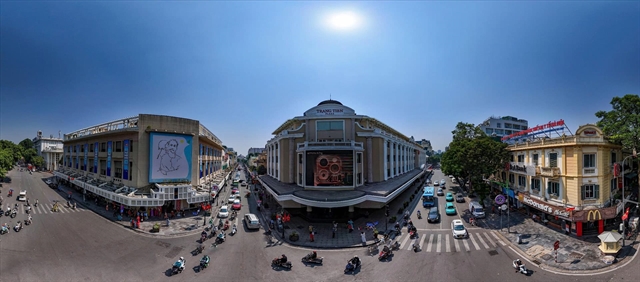
HÀ NỘI — The five-letter name at the beginning of this article, designating the place where it was written, was coined in 1831 by Emperor Minh Mạng of the Nguyễn Dynasty, and bears a simple but nowadays sophisticated meaning: "inside the rivers" (Hà Nội).
For centuries, the capital of Việt Nam has had its limits drawn by water and dykes. Nowadays, after its 2008 expansion, it spans more than 3,300 sq. km and is home to around 8.8 million people across 126 wards and communes. Surrounding the City of Peace now is not just the flow of water but investment, transportation, information and public services that are bringing about a new wave of changes in the city itself.
This change is possible thanks to three policy pillars pointing in the same direction for the first time: the Politburo's Resolution 02 on building and developing the capital, the 2026 Capital Law, and the Capital Master Plan with a 100-year vision. Together, they set targets that reach far beyond new streets, into growth, technology, and residents' daily lives.
The policies' cooperation is expected to yield strong results for the city. In June, Hà Nội People's Committee Chairman Vũ Đại Thắng described the Capital Law and its new mechanisms as "one of the very strong drivers" of high growth.
Flow of investment
And the promised double-digit growth did eventually come in the third quarter of 2026, as Hà Nội's gross regional domestic product (GRDP) grew 10.2 per cent year-on-year in the third quarter, the first double-digit quarter of 2026, lifting nine-month growth to 8.85 per cent, up from 7.92 per cent in the same period last year.
However, this is not the end of the road, as the city is still aiming higher, targeting growth of 11 per cent or more in 2026, with the master plan setting an average annual gain of 11 per cent through 2045. By 2035, it expects GRDP of about US$200 billion, with GRDP per capita above $18,800.
To facilitate those expected changes, the capital city needs capital. And lots of it came in the form of foreign direct investment, which totalled more than US$4 billion, a gain of 5.9 per cent year-over-year. And more than half of this amount went into professional, scientific and technological activities. Total development investment, meanwhile, rose by 19 per cent to VNĐ451.4 trillion ($17.2 billion).
To keep that momentum, the city is openly courting investors. At a conference in June, held alongside the formal announcement of the master plan, it offered 276 projects and signed 50 memoranda with partners including Samsung, FPT, BIDV, the Japan External Trade Organisation, and more.
Culture has an economic role too: building on Hà Nội's status as a UNESCO Creative City of Design, cultural industries are expected to contribute 10 per cent of GRDP by 2035.
The pace, however, is not yet where the city wants it. Nine-month growth remains slightly below the 9.73 per cent set in the city's own scenario, so leaders have broken down the remaining target by department, ward and commune for the final quarter.
The city's own modelling suggests the goal is still within reach. In July, Nguyễn Việt Hùng, director of the Hà Nội Institute for Socio-Economic Development Studies, told city leaders that simulations of each sector's contribution put 2026 growth at about 11.14 per cent, making the target feasible if the Capital Law's new mechanisms are used effectively.
Economists add that investment quality matters as much as its scale. Ngô Trí Long, a former deputy director of the Ministry of Finance's Institute of Market and Price Research, said to the VNA that if transport planning is linked with urban, commercial and service planning, "these projects can open up new growth poles".
New ring roads, bridges and metro lines, in other words, would deliver most when they are planned as part of the city's economic future rather than as a facelift.
Flow of transportation
Nowhere is that link being tested more directly than underground. In June, the city broke ground on five metro lines at once, stretching more than 300km and costing around $50 billion. Due to be largely complete by 2030, they will connect Nội Bài International Airport, Hà Nội Railway Station and Hòa Lạc with the new urban areas in between.
Chairman Thắng called it the largest urban rail programme in the city's history, marking a shift from building single lines to building a network for the whole city. The master plan depends on that shift: about 500km of urban rail by 2035 and the full 979km by 2045, compared with one complete line and the elevated section of a second in service today.
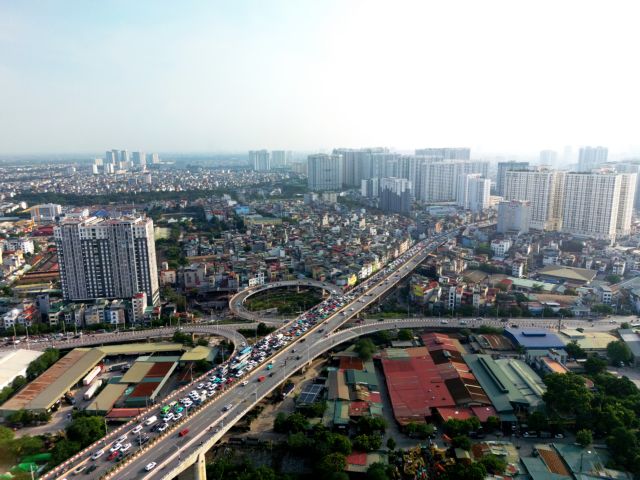
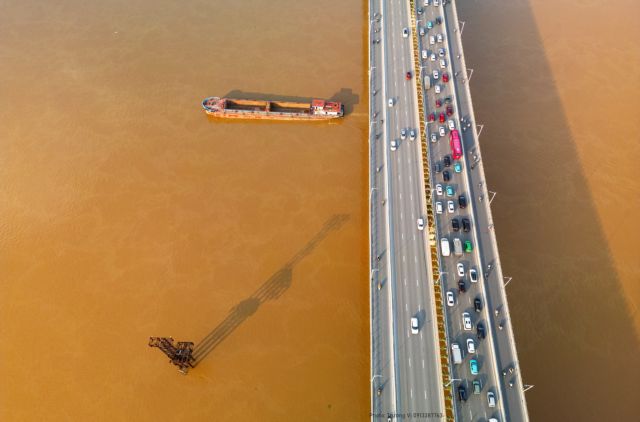
On the ground, seven new bridges are being built across the Red River. The city aims to have 28 bridges across the Red River, and four across the Đà River by 2035. The long-awaited Ring Road 1 and Ring Road 3.5 projects are close to completion and aim to solve the city's traffic problems and accommodate its population.
"I am very glad that this road is being built," said Trần Xuân Khang, a resident at Ô Chợ Dừa Street who has been living there for 50 years, "It will relieve the stresses on the old Đê La Thành Road, especially for the National Children's Hospital and the Obstetrics and Gynaecology Hospital at the end of the road."
One more ring road, which circles the wider capital region, aims to finish its expressway before Việt Nam hosts APEC in 2027, the same target set for the ongoing seven bridges currently in construction across the Red River.
Along Hà Nội's longest and most iconic river, the city is also planning a $28 billion landscape boulevard, to be built from 2026 to 2038 through 16 communes and wards.
It is not just the water or the ground: the sky is also opening up. This is no sci-fi: Hà Nội is serious about a 'flying taxi' initiative in its 100-year plan and is proposing to explore electric vertical take-off and landing vehicles for transportation in the skies.

Flow of information
If rails carry people, data increasingly carries the city's decisions. "The city has made a clear shift from an administrative management model to enabling, development-oriented governance," Deputy Chairman of Hà Nội People's Committee Nguyễn Xuân Lưu said in January.
The change is clearest at the city's junctions. Since December 2025, nearly 1,900 AI cameras at almost 200 junctions have been adjusting traffic lights to real-time flows, raising junction capacity by 4 to 18 per cent and flagging more than 33,000 violations in the first half of this year. Police are preparing to expand the network to nearly 5,000 cameras.
Residents feed the system too. More than 6.2 million accounts have been opened on the iHanoi app, where people report problems on their street, flag slow paperwork and book meetings with officials. The city wants every civil servant to have an AI assistant by the end of this year.
The bigger aim is to turn information into an industry. The digital economy comprised an estimated 16.7 per cent of GRDP in the first half of this year; the city wants 22 per cent by December and about 40 per cent by 2030. Under Plan 370, issued in September, it aims for 10 innovation centres and one or two billion-dollar start-ups by 2030, and it has set aside 4 per cent of this year's budget for science, technology and digital transformation.
The Capital Law also lets Hà Nội test what existing rules do not yet cover. In August, the city listed priority fields for these controlled trials, from AI and big data to drones and urban rail, and the aforementioned pilotless air taxis will be trialled at Hòa Lạc from this month.
The results are immediately apparent. On October 4, the capital topped the national Provincial Innovation Index for the fourth consecutive year. Along with investment in science and technology, the future for Hà Nội is seeing the flow of information and the flow of investment tied together to propel the capital and the nation forward.
But without its citizens, there would be no city. All of the flows have been, and are coming together to make the people living among them more prosperous.
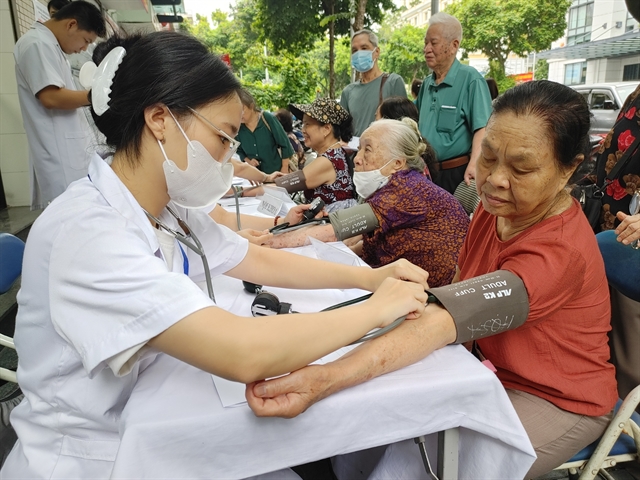
Public health is the number one concern for the city leaders. And from July 1, Hà Nội began offering free annual health checks to 9.2 million people, including temporary residents registered for at least a year, with results stored in electronic health records. Residents of the 16 riverside communes and wards on the boulevard's route were among the first to be called.
"The programme helps us prevent and detect illnesses early so that treatment can begin sooner, reducing the financial burden that often comes when diseases are only discovered at an advanced stage," said 77-year-old Trần Bích Nga, from Vĩnh Thanh, one of the 16 riverside communes in Hà Nội.
The commune residents are also the people with most at stake. Almost 280,000 people live along the 40km corridor studied for the landscape boulevard, though not all of them will have to move. Under the city's proposals, eight traditional village clusters, including the pottery village of Bát Tràng, will be kept and selectively renovated, while a handful of areas, among them parts of Võng La, Hải Bối and Bắc Cầu, are earmarked for relocation.
For those who must move, the city has set out its terms. About 265 hectares of land in the same or neighbouring communes and wards have been set aside for resettlement, land is to be compensated at twice the standard rate, and no one is to be moved before a new home is ready for them.
That principle matches what planners have long urged. "In large-scale urban renovation projects, resettlement must go one step ahead," said Đào Ngọc Nghiêm, vice president of the Vietnam Urban Planning and Development Association, in March.
Residents have been making their own case. When the plans went on display in Ô Diên Commune in September, Đỗ Văn Thinh, who has lived in Bồng Lai Village for nearly 80 years, said, "This is a project like no other."
He added that residents hoped the Party and the State would "create conditions for us to be resettled on site". Ô Diên is among the communes with land set aside for exactly that, about 11 hectares.
Inside the old city, change will come more slowly. The city's Department of Planning and Architecture has said there is no policy of large-scale relocation from the inner city; renewal there will be gradual, adding public space, parking and underground infrastructure to ease the pressure on crowded streets.
Other capitals offer both encouragement and warnings. Seoul's Cheonggyecheon, a stream uncovered when an elevated highway was torn down, became one of Asia's best-known public spaces, yet some redeveloped neighbourhoods grew too expensive for their original residents to return. Beijing has also moved universities, research centres and offices to Xiong'an, more than 100km away, so the new city offers jobs rather than just homes, although the shift has been slower than hoped.
Hà Nội's plan, which keeps resettlement close to home and builds new centres such as Hòa Lạc, reflects both lessons.
Nearly two centuries ago, "inside the rivers" described where Hà Nội stopped. Today, new currents of money, trains and data run through it, and the plan's success will depend on how well they carry the people who live inside them. — VNS
