Weather:
- Ha Noi 28oC
- Da Nang 27oC
- Ho Chi Minh 29oC
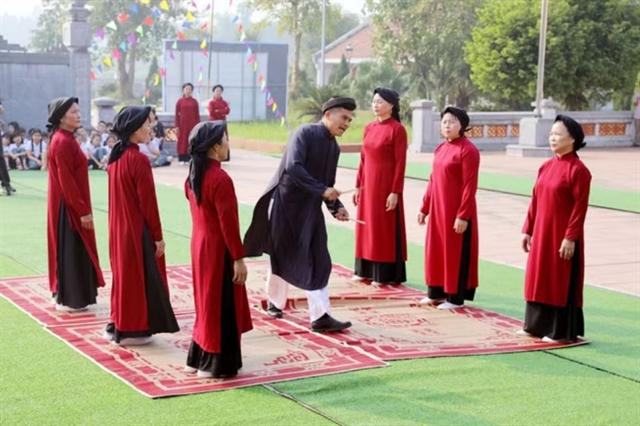
PHÚ THỌ — Resolution No 80-NQ/TW of the Politburo on Việt Nam’s cultural development has left a clear mark on how heritage is approached - shifting from simple preservation to promoting heritage values, and from preservation alone to creative development, so that heritage can truly 'live' in modern life.
Implementation in many localities has shown positive results. Cultural values are no longer confined to static spaces, instead, they are being revived and presented in flexible ways that fit new contexts.
In Nông Trang Ward, Phú Thọ Province, the concretisation of Resolution 80 has been carried out in a systematic manner, in association with promoting the historical and cultural value of relics in the area.
Đinh Ngọc Tiến, Deputy Head of the Relic Management Board of Nông Trang, Phú Thọ, said this is an ancient land dating back to the Hùng Kings’ era, rich in cultural layers of midland villages. However, the urbanisation process has affected some cultural institutions, leading to the disappearance of certain historical traces.
The communal house relic of Nông Trang - where King Đinh Tiên Hoàng and Princess Hùng Duệ Nương Thị Xuân are worshiped - has long served as the spiritual and cultural centre of local residents.
In recent years, with the attention of relevant authorities and the cooperation of the community, the communal house has been renovated and embellished. Its original value has been gradually restored, while the ecological space has been expanded to host larger-scale cultural activities.
The restoration of traditional rituals such as the palanquin procession, Xoan singing, lion dance and the drum-opening festival has helped enliven the relic space. This has attracted a growing number of people and tourists to participate.
Thanks to its location on the road leading to the Hùng Temple Historical Relic Area, Nông Trang Communal House also has the opportunity to connect with spiritual tourism routes, creating prospects for service development and contributing to local economic growth.
Not only the Nông Trang communal house, but many relic clusters in the area have also been restored and their value promoted. Traditional religious activities and festivals are being recreated, expanding ecological spaces, strengthening connections between relic sites and contributing to the formation of a diverse cultural activity system rooted in community participation.
In Thanh Hóa, the national special historical and artistic relic Bà Triệu continues to attract visitors. The Bà Triệu Festival featrues formal traditional rituals, combined with tourism promotion activities and introductions of typical local products - creating more varied experiences for participants.
The application of modern technologies such as 3D projection, digitisation of historical documents, and interactive space design has made heritage more vivid and accessible, especially for young people and international tourists. As a result, heritage is no longer limited to the festival framework, but is increasingly integrated into community life.
According to the Management Board of the Hồ Dynasty Citadel Relics and key relic sites in Thanh Hóa Province, in the coming time the locality will continue promoting the restoration and embellishment of monuments associated with digitisation and standardisation of data.
At the same time, it will strengthen links with schools and travel businesses to bring heritage into education and tourism development - opening new creative spaces, improving the effectiveness of promoting local images, and supporting socio-economic development in a modern and professional direction in line with the orientation set out in Resolution 80.
From practical implementation, it can be seen that Resolution 80 has established a comprehensive approach to cultural heritage. Heritage is not only the crystallisation of history, but also an important endogenous resource that contributes to building national soft power in the development process.
In accordance with the spirit of the Resolution, heritage preservation must be associated with promoting values in modern life, ensuring harmony between tradition and development. Heritage is closely connected with education and social life, especially by expanding young people’s access, thereby nurturing cultural identity.
Investment in heritage is integrated with environmental, economic, and social sustainable development goals, linked to community livelihoods. This approach helps build heritage-oriented urban models and develop 'heritage economies'. Ultimately, it strengthens cultural values while creating new momentum for growth.
Looking at practices in Phú Thọ and Thanh Hóa, it is clear that heritage is gradually 'living' in contemporary life - becoming a bridge between generations and laying a foundation for sustainable local development in the future. — VNS
