Weather:
- Ha Noi 27oC
- Da Nang 26oC
- Ho Chi Minh 28oC
Nguyễn Mỹ Hà
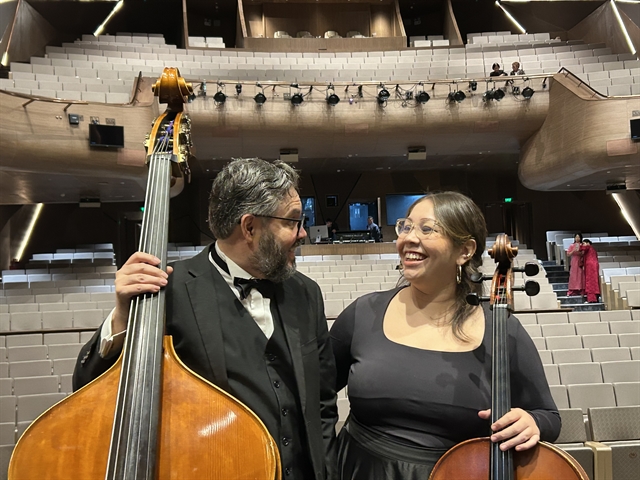
Maria José Carero and David Carpio never expected they would one day settle down to play music in Việt Nam. The couple was living and working, playing and teaching music in Mexico City when they came across a request for online auditions from the Sun Symphony Orchestra. So they sent in their work, and shortly afterwards they were packing up to move to Hà Nội.
"When we first arrived in 2018, we found an apartment near the Music Academy, and I remember one of the first problems was I couldn't cross the street because so many motorbikes were passing in front of me. I had to wait for so long," Carero recalled of her first culture shock with the capital's notorious traffic.
She was speaking during a recent interview at their new home base in Hà Nội's Tây Hồ Ward.
But like many other long and in-depth relationships, the first impression could have been deceiving. After slowly settling into local life, they found out that the people are warmer, more welcoming and helpful than they may have first appeared.
"The longer we live here, the more I like it here," Carero said.
Music a way of life
Both Carero and Carpio are from Venezuela, children of the country's world-famous El Sistema music programme. The pair came to Hà Nội to work for the Sun Symphony Orchestra, which held its debut concert in 2018.
That year was also a year of destiny, when El Sistema founder and Carpio's close mentor José Antonio Abreu died. As they usually say, when one door closes, another opens. For the two El Sistema graduates, this time it opened into a distant country, halfway around the world in Asia.
El Sistema is a renowned publicly funded music education programme started in Venezuela in 1975 by Abreu, a Venezuelan orchestra conductor, pianist, economist, educator, social activist and politician with a lasting legacy. He was honoured with the 2009 Latin Grammy Trustees Award by the Latin Academy of Recording Arts and Sciences.
He designed El Sistema to provide intensive and free musical training – both orchestral and choral – as a tool for social development and youth empowerment, particularly for disadvantaged youth. The programme uses music to teach discipline and foster community among children whose education may have been limited.
With only 11 students in a garage at the beginning, Abreu wanted to create social change through music, using ensemble playing from an early age, fostering camaraderie, discipline and high artistic expectations.
Hundreds of thousands of children received music education through the programme, which helped prevent the kids from falling prey to crime or drug abuse.
Perhaps the most recognisable face of El Sistema worldwide is its alumnus Gustavo Dudamel, the music director of the Simón Bolívar Symphony Orchestra and the Los Angeles Philharmonic. This year, he is set to become the Music and Artistic Director of the New York Philharmonic.
El Sistema continues to operate as a major social force in Venezuela, celebrating more than half a century of fostering social action through music.
In Việt Nam, Carero and Carpio have continued their musical journey with large concerts and smaller gigs, teaching local children along the way to play the cello, double bass, electric bass, harmonica and even the cuatro, a Venezuelan folk instrument. They have travelled to Đà Nẵng and Sa Pa to play music.
"If I get to choose a place to settle, I'd love to stay in Đà Nẵng, because I love the beach city and weather, as I was born in a similar place in Venezuela," Carero said.
Born in Puerto Cabello, Carero first started her musical career in a choir, where her father was a conductor. She also studied the violin, but hated it so much that practising was hard for her.
One year later, at El Sistema, she heard her first cello. It was love at first sight. At 15 years old, she decided to study music. Three years later, she moved to Caracas, where she met Carpio and their journey intertwined. Carpio both composes and arranges music, and he can also play several instruments.
The Venezuelan version of the cuatro has four strings, as cuatro means four in Spanish. Derived from the Spanish guitar family, the instrument's number of strings can vary, with different versions in places like Colombia, Puerto Rico and others. In Venezuela, the cuatro is an ensemble instrument for secular and religious music and enlivens parties and other traditional gatherings.
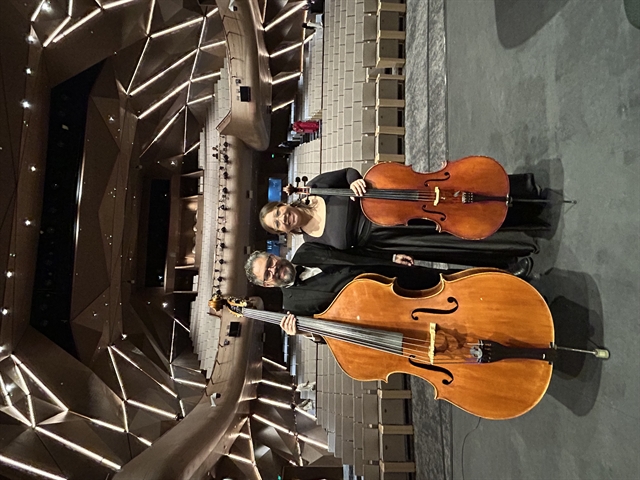
Carpio was 10 years old when he started getting into music. As a child he loved listening to the bass. He joined El Sistema at 16, and played with the orchestra at 17.
While playing with the Simón Bolívar Symphony Orchestra, he toured in Finland, Germany and Spain before heading to South America with his mentor and El Sistema founder Abreu to start a youth orchestra.
But then an accident happened, a life-changing experience for Carpio: he fell asleep while driving.
Carpio was in hospital for two weeks, but the total healing process took two years.
"He had to slowly start playing music again," Carero said.
"It's hard to stop and get back to it, because it's like climbing up a hill. Once you let yourself get down the hill, you'll have to trek up again."
He said he feels very fortunate for surviving the car crash and being able to play what he loves once again.
"Everyone can study music," Carpio said over his coffee. "You just need to have good teachers."
"David has had so many students who didn't show talent at first," Carero noted.
"But over time, the more they study, the more mature they become, and they love it more."
Of his former students, one currently plays in the Vienna Conservatory Orchestra, another plays in an orchestra in Germany and one is a freelancer in Switzerland.
Making music in Việt Nam
"As a musician, you need to focus on playing and enjoying music," Carero said. "Every day we hold three rounds of rehearsals."
Carero said she wants to set up a cello ensemble this year, with around 12 cellos playing together onstage.
"Once you choose music, you need to like it a lot," she noted. "Never stop practising. Throughout your whole life, you cannot stop."
"Playing music is not a job, it's a way of life. If you choose to do it, then you'll have to dedicate all your life," she added.
A job may have landed them in Việt Nam, but their lifelong love for music binds them to this land.
"Even if you don't become a pro, you need to study music," she said. "It's very important for humanity. Music is not just the notes."
Carero and Carpio have said they love Trịnh Công Sơn and Phạm Duy, two giants of Vietnamese music.
"Their repertoires are beautiful," Carero said.
They have also played other Vietnamese music, including Thanh Tùng's Một Mình (All alone) and Đừng bỏ em một mình (Don't leave me alone), a song by Phạm Duy sung by Lệ Thu before 1975.
Apart from their classical music repertoire with the Sun Symphony Orchestra, the couple performs smaller gigs at a local music venue, the Diego Chula Cultural Garden in Tây Hồ. VNS
