Weather:
- Ha Noi 26oC
- Da Nang 24oC
- Ho Chi Minh 27oC
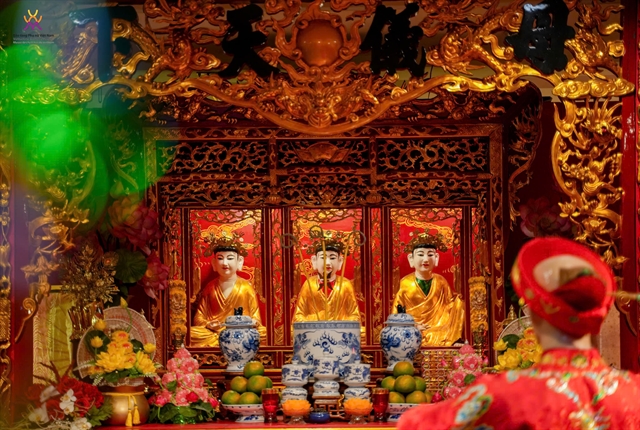
HÀ NỘI — The ongoing exhibition 'Worshipping Mother Goddess: Mother – Pure Heart – Beauty – Joy' at the Vietnamese Women’s Museum explores a centuries-old folk belief and the communities, rituals and traditional arts that have helped preserve it in contemporary Vietnamese life.
Worshipping Mother Goddess is an ancient folk belief system that has evolved, been passed down and continuously adapted to society. Rather than focusing solely on colourful rituals, the exhibition at the Vietnamese Women’s Museum places people and the communities who practise this heritage at its heart.
Through the stories, experiences and beliefs of male and female mediums (ông đồng, bà đồng), their followers and worshippers of the Mother Goddess, visitors can gain a deeper understanding of why this belief system continues to have such vitality in contemporary life.
To organise the exhibition, the museum conducted research, collected artefacts and interviewed hundreds of cultural practitioners in Hà Nội and various localities, including Nam Định, Bắc Ninh, Hưng Yên, Thanh Hóa and Lào Cai.
Through the voices of the practitioners themselves, Mother Goddess worship emerges not as a distant or mysterious world, but as a spiritual anchor connected to everyday hopes and aspirations – good health, peace, prosperity, family happiness and success in their careers.
A journey through the four palaces
The exhibition is organised around four themes – Mother, Pure Heart, Beauty and Joy. These themes correspond to the four characteristic colours of the Four Palaces (Tứ Phủ): red for the Palace of Heaven (Thiên phủ); white for the Palace of Water (Thoải phủ); yellow for the Palace of Earth (Địa phủ); and green for the Palace of Mountains and Forests (Nhạc phủ).
Beginning with the theme of 'Mother', visitors learn about folk beliefs surrounding the Mother Goddess, a revered spiritual maternal figure who protects and supports people through life’s hardships. Images of the solemn altar of the Mother Goddess, with statues, candle stands and ritual offerings, together with the ritual space, give visitors an insight into the setting where the faith’s most important rituals take place.
Moving to the theme of 'Pure Heart', the exhibition sheds light on the spiritual life of Mother Goddess worshippers. Many turn to the Mother Goddess in search of peace, inner calm and renewed faith, as well as a commitment to living with compassion and integrity. Through the sincere accounts of practitioners, Mother Goddess worship is also shown to be linked to the moral principle of “remembering the source when drinking water” – a reverence for ancestors whose sacrifices made the present possible and a commitment to living virtuously.
If 'Pure Heart' reveals the spiritual depth of the tradition, 'Beauty' celebrates its artistry. Elaborately embroidered and bejewelled ceremonial robes and headscarves, an array of glittering jewellery and ritual objects, and the arrangement of altars alongside votive paper offerings showcase the skills of artisans and traditional craft villages. Each colour, motif and design are linked to a specific deity, a specific spirit possession ceremony (giá hầu) and a specific realm within the world of the Four Palaces.
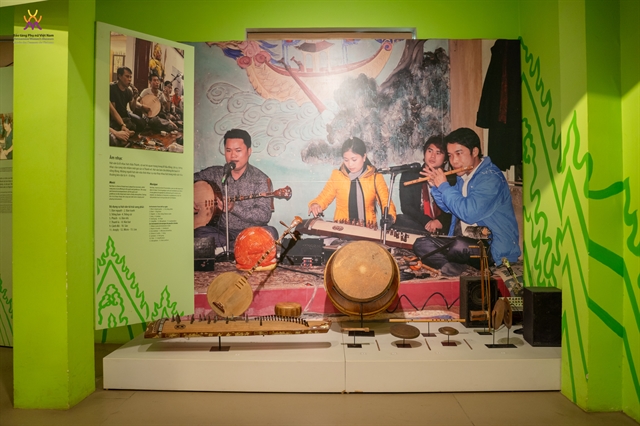
The theme of 'Joy' immerses visitors in the vibrant atmosphere of the ritual through the haunting melodies of hát văn (ceremonial singing), accompanied by the moon lute, drums and wooden clappers, together with graceful dance movements performed during spirit possession ceremonies. Here, music not only evokes emotion but also guides the ritual itself, recounting legends and praising the merits of the Mother Goddess.
Heritage rooted in community life
A highlight of the exhibition is its combination of artefacts, images, soundscapes, research materials and personal testimonies. Craft villages that carve statues, make ceremonial costumes, create ritual objects and produce votive paper offerings, together with the art of ritual singing (hát văn) and festival activities, are all presented as integral parts of a rich cultural landscape.
Through this multifaceted approach, visitors can appreciate that Mother Goddess worship does not exist in isolation within temples and shrines but is deeply woven into daily life. It helps sustain traditional handicrafts, artistic performances and the livelihoods of many artisans and practitioners. These indigenous cultural values have contributed to the belief system’s enduring vitality within the flow of society.
For international visitors, the exhibition offers an accessible way to explore Vietnamese culture. Despite differences in history and ritual forms, many can recognise universal values such as reverence for motherhood, respect for one’s roots, the preservation of traditions and the aspiration for a peaceful and happy life.
“This visit felt like an eye-opening journey, helping a young person like me learn so much more than what textbooks or social media have ever fully covered," said John William, a visitor from India.
"It really takes seeing it with your own eyes to fully appreciate the sheer level of craftsmanship.”
He highlighted the intricately embroidered and beaded ceremonial robes and attire (khăn chầu áo ngự) worn during mediumship rituals (giá đồng), as well as the distinctive instruments used by cung văn (ritual musicians), including the đàn nguyệt (moon lute), trống ban (small ritual drum) and phách (wooden clappers).
He was also impressed by the display of votive paper offerings, from horses and boats to miniature shrines for the Holy Maidens and Holy Princes (lầu cô, lầu cậu), describing their vivid colours and meticulous detail as having strong aesthetic appeal.
“Everything exudes an indescribable sacred atmosphere and soul,” he said.
The exhibition’s exploration of Mother Goddess worship and the sacred practice of spirit possession rituals was previously introduced by the Vietnamese Women’s Museum to the people of Jeju Island, South Korea, helping to strengthen cultural exchange and mutual understanding between the two countries.
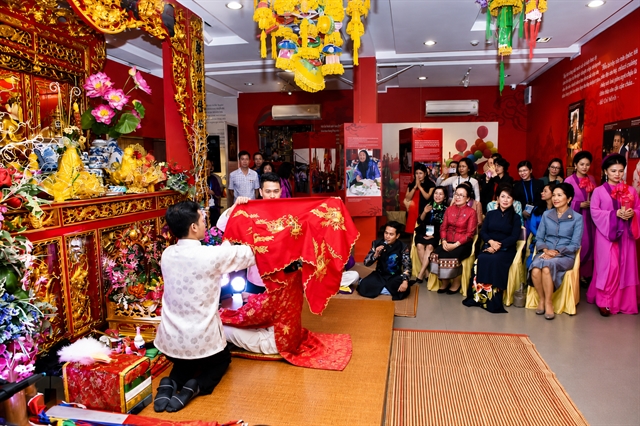
The Worshipping Mother Goddess exhibition has also attracted the attention of numerous first ladies and diplomatic representatives during their visits to Việt Nam. They have left with impressions of a heritage that continues to be preserved and practised as a meaningful part of contemporary life.
In the heart of Hà Nội, the exhibition brings together the beliefs, rituals, music, crafts and personal stories associated with Mother Goddess worship. Seen through these everyday cultural practices, the tradition appears not only as a part of Việt Nam’s spiritual heritage but also as something that continues to be practised and experienced in contemporary life. — VNS
