Weather:
- Ha Noi 27oC
- Da Nang 26oC
- Ho Chi Minh 28oC
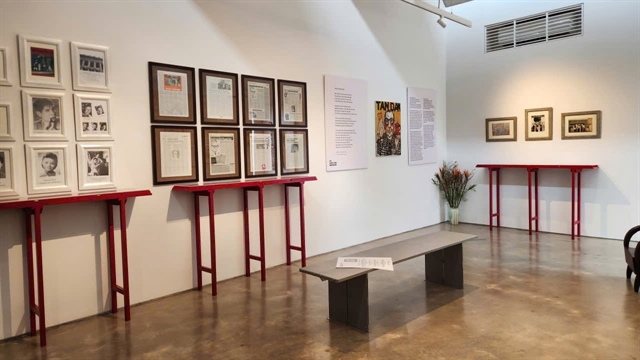
HÀ NỘI — The open studio From Manuscript to Stage: Celebrating the Vũ Đình Long Archive and Legacy has launched a new multidisciplinary event series exploring the enduring relationship between text, image and theatre.
Held at the Vũ Dân Tân Museum in Long Biên, Hà Nội, the programme brings together art, theatre, music and literature to honour the legacy of Vũ Đình Long (1896–1960), widely recognised as the 'father' of Vietnamese spoken theatre.
“History recognises Long as a pioneer,” said Natalia Kraevskaia, director of the museum.
“By writing Chén Thuốc Độc (A Cup of Poison) in 1921, he gave birth to modern Vietnamese spoken theatre; as a publisher, he shaped the intellectual currents of his time.
“Today, his expansive creative life invites deeper and more rigorous academic exploration.”
The archives on display go beyond preserving history, offering a lens through which Long’s contributions and the evolution of Vietnamese drama are examined.
The opening also marks the launch of the Vũ Đình Long Room, a specialised research space envisioned as a crossroads where history, literature and visual art meet.
Designed as a 'living laboratory', the room invites scholars, artists and the public to engage with Long’s legacy through contemporary perspectives.
Organised by the Vũ Dân Tân Museum with support from Goethe-Institut Hanoi, the programme included a seminar on Sunday discussing Long’s multifaceted career as a writer and translator, as well as his contributions to Vietnamese drama, publishing and journalism.
The seminar also examined the activities of Tân Dân Publishing House, which Long founded and ran from 1925 to 1945.
The Vũ Đình Long Room will be open to visitors during the museum’s regular opening hours at 443 Ngọc Thụy Street. — VNS
