Weather:
- Ha Noi 16oC
- Da Nang 23oC
- Ho Chi Minh 28oC
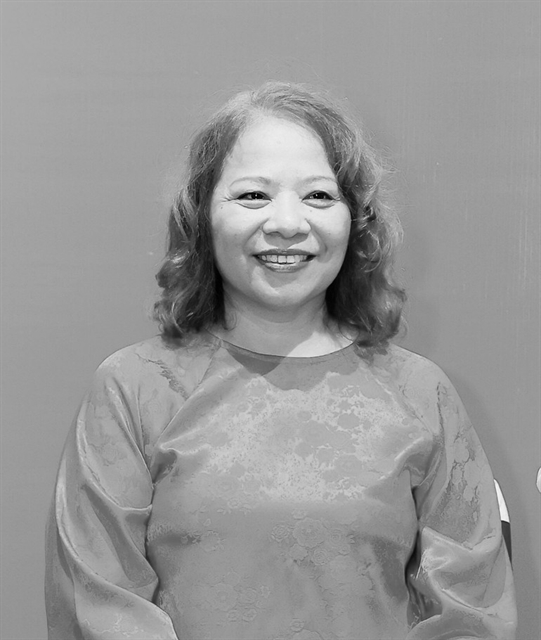
After years of careful preparation, veteran photographer Đỗ Lan Hương has completed a photo book celebrating the elegance of Vietnamese women in the traditional áo dài, telling the stories of 50 women from different generations and professions.
Huyền Thoại Áo Dài Việt Nam (The Legend of the Vietnamese Áo Dài) is a bilingual Vietnamese–English publication recently released by the Fine Arts Publishing House.
Đỗ Lan Hương spoke to the media about the book.
Your book entitled 'The Legend of the Vietnamese Áo Dài' is not about the history of the traditional dress, but rather a collection of portraits of 50 women wearing it. What inspired you to make the book?
It is difficult to pinpoint exactly where the idea originated, as it is the result of many years of my long engagement with photography and Vietnamese fashion. However, I would like to speak about my deep admiration for my mother.
She was an ordinary woman, like so many mothers and grandmothers we encounter in everyday life. She had nine children. My father was constantly away for work and she single-handedly took care of everything in our household and extended family. She was also an excellent cook. Even now, I often ask myself how such a small and unassuming woman could possess the strength to manage everything so thoroughly: every chore, every child and every grandchild.
Life and professional experiences gradually gave me a clearer understanding of the qualities of Vietnamese women. They are talented. More importantly, their resilience and willingness to shoulder responsibilities, both in society and within the family, are invaluable. These qualities create their graceful beauty, and when combined with the áo dài, that beauty becomes truly singular. That was when I decided to turn my pride in Vietnamese women into a photo book.
How did you select the 50 women who represent Vietnamese women in this book?
I went through many experiments. I took some of my characters abroad for street photography, and their appearance in áo dài consistently drew looks of surprise and admiration from passersby. I also photographed foreign women, talented and admirable in their own right, wearing our áo dài. Some foreign women, after seeing my photographs of Vietnamese women in áo dài, even asked to be photographed in áo dài themselves.
It should also be noted that Vietnamese women generally have slightly sloping shoulders and a petite, soft and graceful physique, which harmonises naturally with the áo dài. Western women, by contrast, often have broader, squared shoulders, a stronger presence and more angular features, making it less easy for them to blend seamlessly with the áo dài.
Among the women featured in the book are high-ranking leaders and well-known public figures, as well as those who quietly contribute scientific research or business achievements to the country’s development.
Others lead more modest lives as teachers, architects, ceramic artisans, fish sauce producers, accountants and so on. Yet all of them inspire me with their ability to balance social responsibilities and family life, fulfilling every role they undertake.
What are the most memorable moments for you during the photo shoots?
Most of the women in the book were not people I knew beforehand. Only after forming the idea did I begin searching for characters to ensure the widest possible diversity of professions. I researched them through different sources, and it was my admiration for their character that ultimately led me to invite them to participate.
Some agreed after hearing my proposal but could only spare me 15 minutes for the shoot because of their demanding schedules. I had no choice but to accept and hastily arrange flights across the country for those precious 15 minutes.
Fortunately, during my research, I had already envisioned how they would appear through my lens and reality almost perfectly matched my imagination. Once I choose a character, I immerse myself in learning about them to the point that their presence in the project becomes almost an obsession.
There was one particularly interesting case. Painter Nguyễn Thị Hiền told me she had never worn an áo dài, believing her body shape was unsuitable. I told her to simply choose an áo dài she liked in terms of colour and design, the rest would be my responsibility. When she later saw the photographs, she exclaimed with a laugh and said to me, "so I don’t actually look that bad in an áo dài, do I?"
In some of the black-and-white photos, the characters you captured appear very different from how they are in real life. Is this an intention or something that emerged naturally during the shoot?
Alongside the colourful áo dài chosen according to each character’s preference, I also suggested a classic white áo dài. If the character owned one and felt interested, I would set aside time specifically for this style.
For me, black-and-white photography offers the greatest creative freedom. The contrast present yet seemingly absent, clear yet dreamlike, has a unique power. I wanted not only to portray my characters, but also to create photographic works for myself. Regardless of how they appear in the images, those looks reflect their personalities and qualities. Their quiet, priceless beauty simply finds its moment to emerge.
I use Photoshop only to refine the space when the shooting environment is less than ideal. Otherwise, I rely on lighting to gently address the marks of time and age that may obscure the beauty of women who are already beautiful.
How did you feel about the women after shooting them?
I studied and researched each of them carefully before meeting them in person. I myself have entered a more contemplative phase of life, travelling more, experiencing more, thinking more and gaining a deeper understanding of the role of Vietnamese women in both family and society.
Most of my characters are not professional models. Through my photos, I hope to reveal their beauty and inner strength so that when the photos are displayed, they themselves, their families and viewers alike can see that beauty shine through.
All it takes is a little more care, a little time devoted to oneself and a touch of art. If everyone could spend just a little more time appreciating the women in their lives, that would be enough.
Do you have any upcoming projects?
I have been researching yếm đào, a traditional bodice worn by women that conveys an extraordinary sense of sensuality in photography. I began exploring this theme nearly 30 years ago and I am still waiting for the right moment, when everything feels mature enough to create something meaningful from it. VNS
