Weather:
- Ha Noi 24oC
- Da Nang 26oC
- Ho Chi Minh 27oC
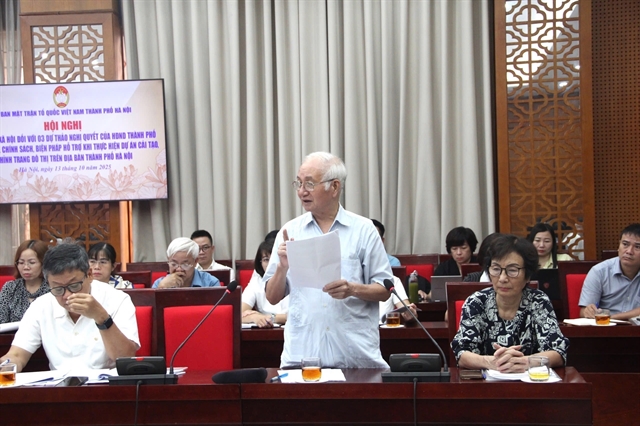
Hà Nội now stands at a new turning point with a 100-year planning vision for the capital. Dr. Đào Ngọc Nghiêm, Vice President of the Việt Nam Urban Development Planning Association and former Director of the Hà Nội Department of Planning and Architecture, explains how the latest plan demands greater resources, urban renewal and a better quality of life for residents.
Looking back at the capital's development, how significant is this round of planning in the history of planning the city?
Right after peace was restored, planning the capital received special attention. President Hồ Chí Minh personally reviewed the plan drawn up in 1961 and instructed that planning must go one step ahead, to avoid building something only to tear it down and start again.
Since then, Hà Nội has been through nine rounds of planning. Each round was never simply a matter of organising space but always involved two parallel elements: the economic development orientation of Việt Nam, the north and Hà Nội in each period, and changes in the capital's boundaries and scale.
The 1973 plan, for instance, was drawn up as the country prepared for reunification, when Hà Nội had to serve as the solid home front with a stable economy. By the 1998 plan, amid the city's expanding links with the north and the Red River Delta, Hà Nội shifted towards developing both banks of the Red River. In 2003, Long Biên District was established, the first time the central urban area crossed the river to the north.
A crucial feature of the current 100-year vision is the integration of the economic, cultural and social fields into a single unified whole. Hà Nội is leading the country in this integrated approach. On that basis, it must give the plan concrete form through 81 further plans, including an underground space plan, zoning plans and sectoral plans.
What notable new points does this plan have in terms of vision and development model?
First, it has a 100-year vision, whereas previous plans looked ahead only 40 or 50 years. To ensure feasibility, the vision is divided into stages: short-term to 2035, medium-term to 2065 and then the long term.
The second and critical innovation is the development structure. Whereas Hà Nội previously developed as a cluster of the central city, satellite towns and eco-towns, this time the model is multi-polar, multi-centre and multi-tier. It takes shape as nine economic growth poles, nine centres and three tiers – not only above ground but also underground and elevated space – with an emphasis on transit-oriented development and special economic zones.
In the past, satellite towns still depended on the central city. This time, under the multi-polar model, the growth poles can be more proactive and independent. The plan also places greater emphasis on urban renewal and positions Hà Nội in relation to the Capital Region, the Red River Delta and the Northern Key Economic Region.
How will the multi-tier model be reflected in the use of underground and elevated space?
Hà Nội leads the way in researching underground space. As far back as the French colonial period, many public works and villas had basements. After peace was restored, use developed step by step, and in 2022 the city raised the matter of tapping underground space to a depth of about 15 metres. The important point now is that underground works must form an interconnected system serving not only transport but also economic, service and commercial development.
There have also been significant changes in elevated space. Whereas Hà Nội's tallest colonial-era building was about seven storeys, there later appeared 11-storey and then 44-storey buildings, with orientations towards even taller works. So when we speak of multi-tier development, we cannot look at Hà Nội only at ground level.
How does the role of the Red River this time differ from previous plans?
The Red River has always drawn attention as a distinctive landscape axis of the capital. Since the 1990s there have been many studies, and Hà Nội worked with the city of Seoul in South Korea on an approved plan for both banks. Given the river's great appeal, nearly 20 countries have had research projects on it, including the United States, Italy, China and the Netherlands.
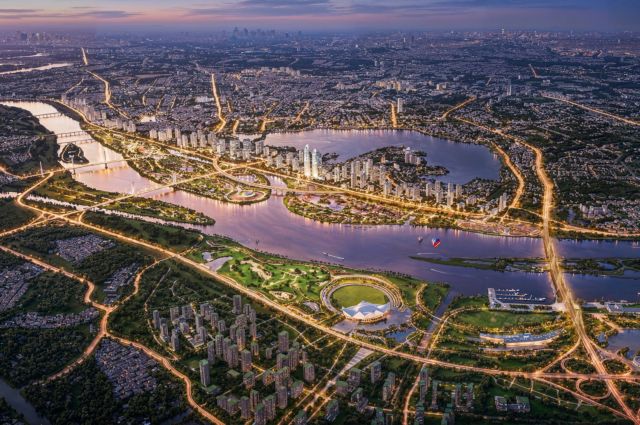
Whereas previous plans defined the river as a central axis, the city is now finalising the project for implementation, aiming to make both banks the central landscape axis and a symbol of the capital's development, tied to many major projects. This is a very notable new orientation.
Reorganising development space on a larger scale also sets new requirements for regional links and resources. How should these be viewed?
Hà Nội must be viewed in relation to both the Red River Delta and the Northern Key Economic Region, which requires the synchronous development of technical and social infrastructure and hubs connecting with the whole region.
Population is another issue. Under the 100-year vision, Hà Nội's population is forecast to reach 14 or 15 million, which requires reorganising its distribution to ease pressure on the central area. The city must also take into account population ageing; as early as 2009, the proportion of people over 60 in Hà Nội was higher than the national average.
To raise its competitiveness, Hà Nội needs projects of national scale, such as multi-purpose urban areas, the Northern Smart City and sports facilities capable of hosting international events. But for the new model to become reality, planning alone is not enough; it must be accompanied by specific mechanisms.
Hà Nội was early in having such mechanisms, from the Ordinance on the Capital to the Laws on the Capital, and the policy system now includes more than 190 distinct, superior powers. The requirement is to make effective use of them, with timely issuance and specific guidance.
Only then will they truly become a driving force. With this vision, we have grounds to expect Hà Nội to create a new stage of development in which the economy achieves double-digit growth.
What issues need particular attention during implementation and renewal?
Implementing the multi-polar, multi-centre model requires policies suited to each growth pole, including to attract talent. For example, the plan orients Hòa Lạc to become a science city, but realising that goal needs policies strong enough to attract suitable personnel.
Another issue is the Red River space, where the orientation is to gradually turn riverside wharves and mid-river areas into large-scale parks and green spaces. Hà Nội also needs to develop tourism tied to conserving its heritage, from historical and architectural relics to sites recognised by UNESCO such as the Imperial Citadel of Thăng Long, as well as its rich system of craft villages. When creating a new development space, we must first recognise the value of our heritage and only then draw on international experience.
Renewal means not only new construction but also renovating and upgrading existing areas. One priority is the nearly 2,000 old apartment blocks. Their renovation was raised back in 2000 but has yet to achieve what was hoped, so this plan and the Law on the Capital both continue to address it.
This is not simply a housing question but is directly linked to the city's appearance and residents' quality of life. A modern Hà Nội aiming to match the world cannot still have areas with a low quality of life. The requirement, therefore, is to build anew to reach international standards while renovating the existing fabric to improve people's lives.
How do you hope Hà Nội will take shape in the future?
The most impressive thing is the shift from an urban cluster to a multi-polar, multi-centre structure, alongside the task of developing new infrastructure while making use of the natural landscape, especially the Red River, and building works of international stature.
But to match the world, we must pay great attention to residents' lives. Resettlement in the Red River area, the renovation of old apartment blocks and improving living space must be resolved at the same time as building new areas. Hà Nội must also promote its own values, continuing to raise the profile of Cổ Loa, the Old Quarter and its conserved heritage.
A Hà Nội that is modern yet retains its historical depth and cultural identity, while creating a better living space for its people – those are the values that will allow it to build its stature and draw the world's attention. – VNS
