Weather:
- Ha Noi 28oC
- Da Nang 27oC
- Ho Chi Minh 28oC
HÀ NỘI — The Vietnam Education Publishing House has played an active and substantive role in efforts to preserve and promote the Vietnamese language amid the continued growth of Vietnamese communities overseas.
Working in coordination with the State Committee for Overseas Vietnamese Affairs under the Ministry of Foreign Affairs, the publisher has carried out a range of activities as part of a Government project to spread the Vietnamese language in communities abroad.
Over the past year, the publishing house and committee have focused on building effectiveness and sustainability. The partnership centres on hands-on activities to improve the quality of Vietnamese language teaching and learning, helping reinforce cultural identity and strengthen ties among Vietnamese communities around the world.
One of the most notable initiatives is a series of training courses on Vietnamese language teaching methodologies for Vietnamese teachers abroad.
Recognising teachers as key figures in inspiring a love of the Vietnamese language, the publishing house has worked with the committee and its partners to organise professional development courses in various locations, both in Việt Nam and overseas.
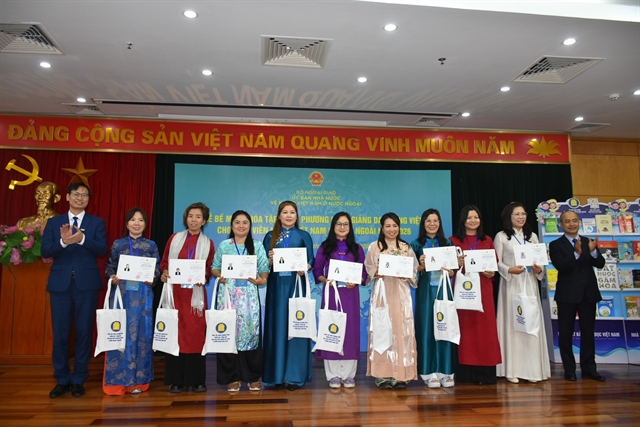
As part of a 2026 ceremony for the Day Honouring the Vietnamese Language on August 12, a training course for 50 teachers from 14 countries and territories was officially launched.
The course was jointly organised by the committee, the University of Social Sciences and Humanities under Việt Nam National University Hà Nội and the publishing house.
It reflects continued efforts to enhance the professional capacity of Vietnamese language teachers and meet the increasingly demanding requirements of teaching Vietnamese overseas.
With 21 sessions of classroom learning, activities and lesson observations lasting more than two weeks, the course combined professional knowledge with teaching methodologies and experiences related to Vietnamese culture and history.
The course also incorporated Việt Nam’s culture, history, land and people into lessons focused on teaching pronunciation, vocabulary and writing, classroom management and assessments.
Activities at historical sites, museums and educational institutions provided participants with additional materials, experiences and inspiration to incorporate into their teaching.
After completing the course, participants spoke highly of its practical value and the cultural experiences it offered.
Đào Thị Ánh Tuyết, an overseas Vietnamese teacher living in the Republic of Korea, said returning to Việt Nam enabled teachers not only to strengthen their teaching methodologies, but also to gain a deeper understanding of the country’s culture, history and people.
Experiences at the Hồ Chí Minh Mausoleum, the Temple of Literature, Tam Chúc Pagoda, Đô Temple and the Đình Bảng communal house, as well as Quan họ folk singing activities in the northern province of Bắc Ninh, provided valuable material for use in the classroom.
Phạm Thị Linh, an overseas Vietnamese teacher living in Taiwan (China), highlighted the course’s role in fostering connections.
All 50 participants from different countries and territories shared teaching methods, materials, initiatives and experience, with the understanding that every Vietnamese language class, cultural activity and effort to help children born overseas speak Vietnamese with their families represents a way of "keeping the flame" of the language alive, she said.
Nguyễn Thị Liên, an overseas Vietnamese teacher who lives in Malaysia, said the lessons delivered by nearly 20 lecturers taught participants about fundamental concepts and practical issues encountered in Vietnamese language classes overseas, while also helping address many teaching challenges.
Beyond classroom learning, cultural activities, performance rehearsals, lotus tea-making and the compilation of a yearbook created memorable experiences and fostered strong bonds among the participants.
Training courses have not been limited to Việt Nam. They have also been delivered both online and in person in areas with large Vietnamese communities, including in northeastern Thailand and the Republic of Korea.
The programmes have received positive feedback from teachers and education managers, who have regarded them as a valuable way to preserve and spread Vietnamese in overseas communities.
Vietnamese book collections
Building collections of books in Vietnamese is another successful initiative undertaken by the partnership, creating meaningful cultural spaces within overseas Vietnamese communities.
This year, the initiative was further expanded, with four Vietnamese-language book collections successfully established in Thailand, Singapore and Brunei.
Nearly 5,000 books and Vietnamese language teaching and learning materials were also provided to communities in various locations around the world. According to reports, the number of books and book collections delivered under the initiative significantly exceeded set targets.
Each book collection represents more than a place where learning materials are stored. For Vietnamese communities in different countries, it can also serve as a venue for meeting, reading, learning and cultural activities, creating an environment in which Vietnamese can become a regular part of community life.
Bringing Vietnamese-language books closer to overseas Vietnamese also responds to the needs of Vietnamese language classes abroad, which require materials suitable for learners of different ages and levels.
They will help ensure that Vietnamese language teaching and learning can be maintained consistently and sustainably over the long term.
Alongside these two key activities, the publishing house and the committee have also developed a digital learning ecosystem and introduced free electronic textbooks, helping create a digital learning environment for Vietnamese and enabling the community to access learning materials conveniently.
The publishing house has also worked with VTV4, the Vietnam Television channel specialising in external affairs, to produce Vietnamese language programmes such as Chào tiếng Việt (Hello Vietnamese) and Tiếng Việt diệu kỳ (Wonderful Vietnamese).
Combining educational resources with television-based delivery methods gives learners more options, particularly for children and teenagers in overseas Vietnamese communities.
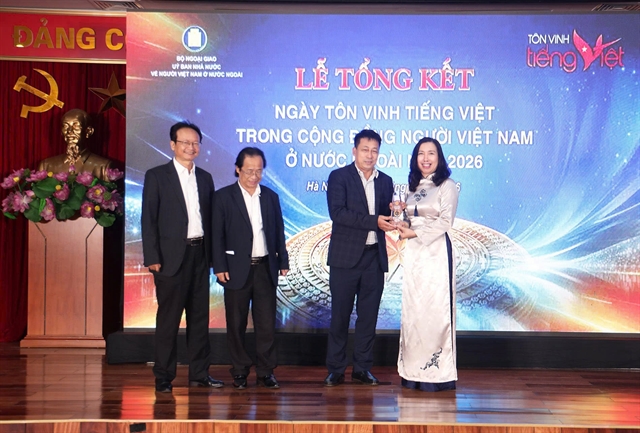
In recognition of these contributions, Deputy Minister of Foreign Affairs Lê Thị Thu Hằng presented the publishing house with a commemorative medal at the review ceremony, honouring its outstanding efforts and contributions to preserving and promoting the Vietnamese language.
Building on its achievements, the publisher plans to further strengthen cooperation with the committee and other partners in the next few years, with a view to developing a modern, multi-platform Vietnamese-language ecosystem capable of achieving strong and sustainable outreach among overseas Vietnamese communities.
The initiative also aims to help carry out Politburo Resolution 23 on overseas Vietnamese affairs.
Preserving Vietnamese overseas is a long-term undertaking that requires perseverance and the collective efforts of many stakeholders.
With its strengths in publishing, education and learning resource development, the publisher plans to continue these initiatives, from supporting teachers and providing books and teaching materials to expanding ways for people to learn Vietnamese.
Every book delivered, every class maintained and every new way of learning Vietnamese developed helps ensure that the language remains present in community life.
In this way, Vietnamese can be passed down from one generation to the next, serving as a lasting bond connecting Vietnamese people living far from home with their culture and homeland. — VNS
