Weather:
- Ha Noi 26oC
- Da Nang 29oC
- Ho Chi Minh 32oC
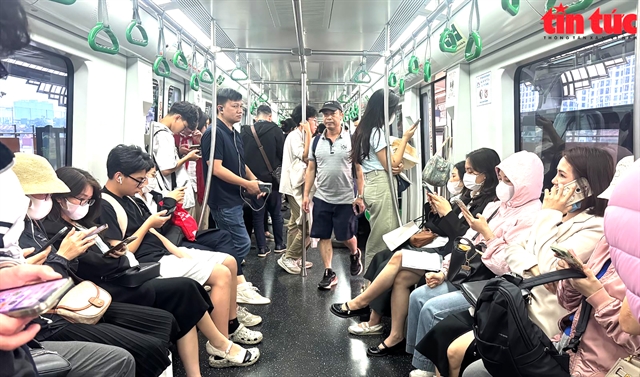
HÀ NỘI — Rising fuel prices are nudging commuters in Việt Nam’s two largest cities onto urban rail, with packed carriages and longer queues signalling a shift that could ease both household budgets and chronic congestion.
Amid recent fluctuations in petrol prices, many residents in Hà Nội and HCM City have begun changing their commuting habits, turning to metro services to save money and reduce daily financial pressure.
Along the Nhổn–Hà Nội Station and Cát Linh–Hà Đông lines in the capital, passenger numbers have risen in recent days, according to the Vietnam News Agency.
During morning rush hours, commuters queue at ticket gates while trains are often crowded with standing passengers, mainly office workers and students.
Many passengers say they are considering using the metro more frequently due to its stable costs and freedom from traffic jams.
Trịnh Thị Bích Diệp, a 20-year-old student, said she has relied on the metro since her first year at university.
“Compared with using a motorbike, metro travel makes transportation costs easier to manage,” she said.
She previously spent a considerable amount on fuel each month but switched to a monthly metro pass costing around VNĐ140,000 (about US$5.5), significantly reducing her commuting expenses.
Nguyễn Hoài Thương, 21, who lives in Hà Đông Ward, said she used to commute mainly by motorbike but has recently tried the metro.
“My home is not far from the Cát Linh–Hà Đông station, so I’ve tried using the metro these past few days. With a motorbike, I have to refuel every week, not to mention the time lost in traffic jams. The metro is clearly cheaper and I don’t have to worry about rising fuel prices,” she said.
Office workers are also making the switch. Nguyễn Thị Thu Hà, 40, said travelling by private vehicle is both costly and vulnerable to congestion.
“My home and workplace are both near stations on the Nhổn–Hà Nội Station line, so taking the metro is very convenient. Compared with using a motorbike, it’s more affordable, especially as fuel prices are rising. It also saves time since I don’t have to deal with rush-hour traffic,” she said.
Hanoi Metro Company Limited said ridership on the city’s two lines, Cát Linh–Hà Đông (Line 2A) and Nhổn–Hà Nội Station (Line 3.1), has increased notably as higher fuel prices push more people towards public transport.
On March 11, total ridership on both lines rose by more than 7 per cent compared with the start of the month.
On the Cát Linh–Hà Đông line, daily passenger numbers climbed from 20,916 on March 1 to 45,750 on March 11, an increase of nearly 25,000, with an average of about 39,000 passengers a day over the period.
Meanwhile, the Nhổn–Hà Nội Station line recorded an increase from 14,890 to 34,237 daily passengers, up by more than 19,000, with an average of around 27,000 per day.
Between March 9 and 11, both lines saw their highest passenger volumes, reflecting a growing preference for metro travel to cut costs and reduce pressure on roads.
In response, the operator said services are running at full capacity to meet demand.
The company has also introduced smart ticket gates integrating electronic authentication and biometric technology, allowing passengers to pay using the Hanoi Metro app, international Visa cards, e-wallets and selected domestic banking services.
Metro stations are linked with bus and electric bus networks, enabling smoother transfers and improving overall connectivity.
These upgrades are expected to enhance the commuting experience and further encourage the use of public transport.
In HCM City, metro travel is also emerging as a preferred option for office workers and students seeking to manage rising living costs.
At around 8am at Bến Thành–Suối Tiên station, a commuter named Duy Hậu chose the metro over his usual motorbike ride to work.
“In the past, every morning was a struggle, dealing with traffic jams and finding parking under the heat,” he said.
Switching from private vehicles not only cuts fuel and parking costs but also helps commuters better manage their time.
“Rising prices have affected my daily life. I decided to try the metro for a while. I won’t give up my motorbike entirely, but using the metro helps save money and time. It’s more comfortable,” he told the Voice of Vietnam.
Data from the operator of Metro Line 1 Bến Thành–Suối Tiên show ridership has steadily increased throughout the week, particularly among younger commuters.
Another passenger, Đào Thiện, said: “For students like me, every expense counts. The metro is not just a modern means of transport but also a practical way to manage spending.” — VNS
