Weather:
- Ha Noi 32oC
- Da Nang 30oC
- Ho Chi Minh 27oC
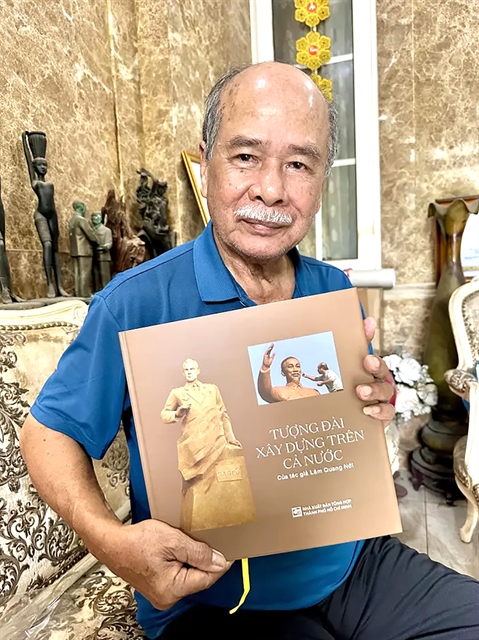
To mark the 45th anniversary of the HCM City Photography Association (November 1981–November 2026), the association has proposed installing a sculpture of photographer Lâm Tấn Tài (1935–2001) at Chi Lăng Park in the city's Sài Gòn Ward. Tài was the association’s first general secretary and a prominent figure in revolutionary Vietnamese photography.
The piece was created by sculptor Lâm Quang Nới, whose work includes nearly 70 monuments across Việt Nam. Over the course of his career, he has helped shape public spaces while capturing the nation’s history, people and spirit.
Nới spoke to the media about his work.
If the association’s proposal is approved, your sculpture would become a distinctive cultural and photographic landmark in the heart of the city. How does that make you feel?
The city had previously planned to establish a sculpture garden honouring prominent figures from performing arts, cinema, photography, fine arts and other fields. The association also proposed placing a sculpture of photographer Lâm Tấn Tài there, but the project has yet to be implemented.
As the city is developing a photography space along Đồng Khởi Street and renovating Chi Lăng Park, the association sees that site as a more suitable location. Placing a sculpture of a prominent photographer in a space dedicated to photography exhibitions, creative work and community activities would create a natural connection between the individual and the city’s collective memory.
The Chi Lăng Park project is being funded through social mobilisation, with contributions from artists, organisations and individuals. Drawing on my expertise and experience, I volunteered to create the sculpture and donate the artwork to the association.
I see this work as a gift to our shared home, expressing a member’s affection and sense of responsibility towards those who came before us, as well as towards the city’s photographic community.
After completing nearly 70 sculpture projects, what principle has guided your creative journey?
An artist must understand history not just to depict a figure accurately, but to capture the essence of an event, its ideas and the spirit of the era. The Bình Giã Victory Monument in Ngãi Giao Commune, HCM City, is a good example. Rather than depicting specific people, I use symbolic forms to convey the story.
In the design competition, the art council shortlisted three proposals but could not reach a final decision. The models were later displayed at a scientific seminar, where many leaders agreed to select my design. It was a memorable milestone.
I often say this half-jokingly, but I mean it very seriously: a work should reach the point where the sculpture 'disappears within the sculpture'. In other words, viewers should no longer see the stone, bronze or concrete, but instead sense the history, spirit and ideas embodied in the material.
What advice would you give young artists creating sculptures and monuments honouring historical figures and national history?
I have four guiding principles: a good idea, strong artistic expression, a clear explanation and a convincing defence of the concept.
A good idea is not enough without a compelling artistic form. A beautiful sketch is not enough if the artist lacks an understanding of history, cannot explain their choices or defend their design before a professional panel.
A monument can take three to five years to complete, or even more than a decade. Behind the inauguration ceremony lies an arduous process.
To create a monument, a sculptor has to study archival materials, survey the site, build and revise models, enlarge the design and oversee the construction. It is an extremely demanding process.
Creating a monument is a challenge that requires more than artistic talent. It demands character, perseverance and a strong sense of social responsibility.
I have not had much time for formal teaching, but many of my students, artisans and young craftsmen have learned directly from me in the studio and on construction sites. It is a form of hands-on training, passing on the craft through every block of clay, every proportion, every stage of scaling up and even the way unexpected problems are handled during construction.
With the rapid development of artificial intelligence, how do you view the current state of sculpture?
In my view, technology is only a means to an end. Cameras, software and artificial intelligence cannot replace an artist’s ideas, life experience or sense of responsibility. Without a strong concept and cultural depth, even a visually striking work can ultimately feel empty and soulless.
What worries me is not only our growing dependence on technology, but also the increasing risk of copyright infringement.
There are still gaps in our legal framework, while enforcement is sometimes inadequate, making artworks vulnerable to copying and infringement.
As for me, if a locality wants to use one of my sculpture designs, follows the proper procedures and ensures the work meets the required artistic standards, I am willing to donate it. — VNS
