Weather:
- Ha Noi 24oC
- Da Nang 26oC
- Ho Chi Minh 27oC
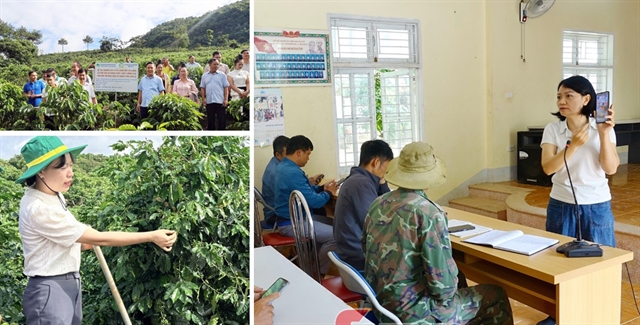
SƠN LA — Sơn La Province is building a digital database of coffee-growing areas to improve traceability, production management and the quality of its coffee.
The provincial Department of Agriculture and Environment is holding 50 training courses in 27 communes and wards from October 5 to 16 to survey, collect and update information for a database of coffee-growing areas.
The training will help the province complete a review of all its coffee-growing areas before December 30, supporting origin traceability and preparations for compliance with the European Union Deforestation Regulation.
Participants are learning to use Open Foris Ground software to update information on land users, locations, growing areas and production conditions. The training also covers mapping plot boundaries, recording coordinates, taking field photographs and synchronising data with the management system.
After the courses, local authorities will review and update growing-area data, and identify coffee plantations on forestry land for management and guidance on suitable crop conversion.
The work is part of a broader effort to bring science and technology into coffee production in Sơn La. Standardising growing areas is not only important for accessing the EU market, but also helps shift production from reliance on farming experience towards data-based management.
Once the location, area, current conditions and production history of each growing area are clearly recorded, quality control and traceability become easier, while links between farmers and businesses can be better organised.
Sơn La has more than 33,600ha of coffee, nearly 20,000ha of which are bearing fruit, with annual output exceeding 37,700 tonnes of green coffee beans. The provincial Department of Science and Technology has carried out various initiatives to improve quality and competitiveness, covering seed selection, cultivation, genetic resource conservation, digital mapping of growing areas, preliminary processing, storage and processing.
The Northwest Agriculture and Forestry Research and Development Centre has conducted research to select high-yield, high-quality Arabica coffee varieties suited to local natural conditions. The work aims to provide planting material for replanting ageing coffee areas and develop more sustainable production procedures.
VietGAP and organic-oriented farming practices are also being expanded, alongside more appropriate use of agricultural inputs and improved techniques for crop care, irrigation, fertilisation and pest control.
In Mường Chanh Commune, coffee covers more than 2,837ha. Over 50 per cent of coffee-growing households participate in sustainable development programmes and have links with cooperatives and businesses. With improved farming techniques, average yields reach around 12 tonnes of fresh coffee fruit per hectare, while well-managed plots can produce 15–18 tonnes.
Cooperatives are an important link in bringing these advances to farmers, particularly in areas with large ethnic minority populations. Coffee production is spread across small household plots, and farmers have different levels of access to technology. Cooperatives can help connect them with research institutions, businesses and markets through training, technical guidance, quality control and shared agricultural services.
They can also organise services requiring substantial investment, including preliminary processing, drying, storage, testing and packaging. By gathering output, agreeing on harvesting and processing standards and checking the quality of each batch, cooperatives can supply processors with more consistent raw materials without requiring every household to invest in its own facilities.
This approach also reflects the objectives of Politburo Resolution 57-NQ/TW, issued on December 22, 2024, on breakthroughs in science and technology development, innovation and national digital transformation. In Sơn La’s coffee sector, the task is to make research and digital tools useful at the production level, helping farmers and cooperatives apply technical advances, improve traceability and raise the value of their coffee. — VNS
