Weather:
- Ha Noi 20oC
- Da Nang 24oC
- Ho Chi Minh 28oC
Ray Riches*
Street vendors in Hồ Chí Minh City: tradition vs modernisation
For visiting tourists to Việt Nam’s biggest city, street vendors are an iconic symbol woven into the fabric of Vietnamese culture. Yet as this community grows with more people and more global companies, for some, simple street vendors are turning into footpath thieves who appear to have no legal right to sell their wares on public land. Street sellers are something we photograph and find fascinating and, now that Hà Nội is making changes to footpath access, it is time that HCM City follows to prepare for more global business development.
They are convenient for passing drivers and the cheapest option for a good-value meal. For decades, street vendors have had their own unwritten law and code of ethics in HCM City, selling everything from cà phê to sweet food and staple meals to anyone wanting a cheap option without even getting off their motorbikes.
Street vendors – a part of history
In Phan Thiết City in the south of the country, on a street corner not far from the central boulevard, sits an old lady cooking bánh bèo. Sitting on the corner with her, this old woman started a conversation as we bought her food for dinner. She went on to say she had been there since the American War and recalled, with a smile, selling the very same food to US soldiers stationed in the province in the last months of the conflict.
At the time it seemed like an amazing story of history, but it is so much more. It is a story of culture and the code of street selling in Việt Nam. She, at that time, had few options to survive the brutal environment of war. To survive, she started cooking bánh bèo for anyone who wanted cheap and tasty food.
Her position was cemented not by law or agreement but by the fact that the space was unused and she was there. And this is the story all over the country, with people finding any free space to sell goods often at half the price of local businesses.
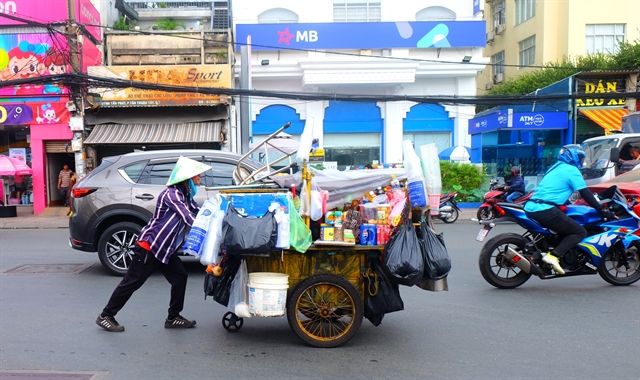
In HCM City, there is not a main road free of street sellers. From small stalls to carts, walkers and more advanced setups, tourists do not have to go far to experience something quintessentially Việt Nam. Motorbike commuters never have to enter a shop to get their cà phê (coffee) and breakfast on the way to work. Those travelling home in the afternoon can even buy a whole gà nướng (BBQ chicken) or vịt quay (BBQ duck) without leaving their motorbike seat.
On the other side, countless local businesses lose trade because vendors set up outside or near their shops. It is logical that a commuter would purchase food from the street if it is 30 to 50 per cent cheaper rather than buying from a shop.
But as the city and country grow, is it time to say no to street vendors in HCM City and bring in a new culture that improves traffic flow, fair trade and technological advancement?
Street vendors block pavements. Nobody can argue that motorbike parking and street sellers are two major factors choking arterial roads in HCM City. Apart from forcing pedestrians onto the road, all it takes is one car or motorbike stopping for a bánh mì (bread roll) to cause traffic chaos. Cars block motorcycle movement, creating dangerous situations with angry commuters doing things that are sometimes unlawful to get through bottlenecks created by vendors.
Local authorities do try to move unlawful sellers on, even confiscating equipment from those failing to follow regulations. Yet as soon as the police leave, vendors return to the same location to continue their trade. This is not only unlawful but against the spirit of community because they use the pavement without paying taxes or leasing fees.
No selling streets are needed
No selling streets would improve traffic and the feel of the city.
It is simple logic. HCM City has grown significantly over the past half century. In 1975, the population was estimated at around 2.3 million. By 2025, the city carries a population of around 10 million. More people means more movement on streets that have changed very little over this time.
Street quality has improved, but roads such as Pasteur, Võ Văn Tần and Hai Bà Trưng have all seen exponential growth in traffic with only minimal increases in capacity. Removal of street vendors on these important streets, for example, would radically change the landscape. This is the very landscape that currently clings to past history and needs to decide what direction it wants to take in the future.
Becoming an international financial centre
It is clear that HCM City is moving towards becoming a global centre of Southeast Asia, valued globally for its location, talent pools and financial opportunities. But no global centre supports the clogging of main roads with small street vendors. As an example, many cities in Western Asia have similar potential but never realised it, partly due to the lack of infrastructure development.
So, where is HCM City heading? Holding onto traditional practices like street vendors filling arterial roads may stop development. There is no question that global importance and prioritisation of better transport routes is needed to facilitate growth to take the city to an international financial centre.
In this change, there is no need to eliminate all street vendors. They are an important part of the city’s foundation. However, limiting their locations would go a long way towards balancing historical culture with future development.
For me, this is an important aspect. Việt Nam is built on the key building blocks of its culture: family, food and friendships. These have created the country we love today. But with 12 million people in one city and a vision of future excellence, I see benefit in separating development and culture to allow smoother access to global markets and, ultimately, better living standards for all in HCM City.
*Ray Riches lives in HCM City and works as a teacher and freelancer. Apart from teaching, he is a keen runner and bicycle adventure rider. After ten years in Việt Nam, Ray has a love and passion for the smaller things and enjoys sharing his experiences with people all over the world.
