Weather:
- Ha Noi 31oC
- Da Nang 27oC
- Ho Chi Minh 35oC
HÀ NỘI — The use of technology is opening up new creative avenues in the performing arts, from stage design to production and audience engagement.
However, experts say that to maximise its benefits, organisers should select appropriate technologies, invest in human resources and use each art form's core values as a foundation for innovation.
The editor-in-chief of Culture and Arts magazine, Hoàng Hà, stressed that digital transformation and the use of digital technology are inevitable trends in society, and the performing arts are no exception.
Many theatres under the Ministry of Culture, Sports and Tourism have successfully combined technology with national cultural identity to innovate in their artistic productions.
However, Hà said: "The use of digital technology in the performing arts in our country currently faces difficulties related to investment costs and infrastructure; performing arts organisations still lack modern technological equipment that meets international standards; and the workforce lacks the skills to use technology effectively and apply it to artistic creation."
According to Trung Hiếu, director of the Hà Nội Drama Theatre, the use of technology in the performing arts needs to be linked to "in-depth investment", primarily in human resources.
"Funding is crucial, but to transform resources into artistic quality, it is essential to have a team with sufficient creative capacity, production management skills and the ability to use technology effectively," he said
Investing in talent
In recent years, Hà Nội has focused on supporting artists through training and professional development, improving their benefits and encouraging them to pursue their careers. Besides offering contracts for annual shows, the city also supports the development and submission of projects and programmes aimed at advancing the cultural industry.
"This provides an opportunity for theatres to proactively strengthen their creative activities and develop new products," Hiếu said.
However, Hiếu said, substantial investment does not necessarily guarantee artistic quality. What is crucial is the creative capacity to use resources to create artistic value.
"Therefore, in addition to investing in equipment, a systematic training strategy is needed for writers, directors, actors, artists, musicians, sound and lighting crews, as well as those involved in theatre management, operations, communications and marketing," he added.
Meanwhile, Nguyễn Tiến Dũng, director of the Việt Nam Puppet Theatre, stressed that the use of technology in the performing arts should reflect the distinctive characteristics of each art form.
"For puppetry, if the projected images are too large or the effects too strong, technology can overshadow the subtle beauty and unique appeal of the puppets," Dũng said.
"Puppetry has its own expressive language and aesthetic requirements. Audiences come to the theatre primarily to enjoy the unique beauty and characteristics of puppets and the artistry of puppeteers. Thus, technological elements must be used in moderation to support and highlight the core values of this art form.
Art before technology
"Choosing how to use technology in a production must be based on the work's content, message and characteristics. Some programmes require technology to expand expressive possibilities, while others are better suited to stage performances using sets, scenery and symbolic movements.
“The unique feature of puppetry is the combination of the artist and puppets, where puppets play a central expressive role, while artists breathe life and emotion into the characters. Therefore, no matter how innovative the staging methods or how much technology is applied, preserving the unique identity and language of the art must always be prioritised.”
Sharing this view, Trần Ly Ly of the Việt Nam Dance Academy said the use of digital technology in the performing arts needed to be considered throughout the entire process, from creation and production to distribution, management and public outreach.
According to Ly, the use of technology has, first and foremost, changed creative thinking.
"With such new means of expression, artists must find ways to combine art and technology appropriately. This also leads to changes in the composition of production crews, production methods and ways of bringing works to audiences," she said.
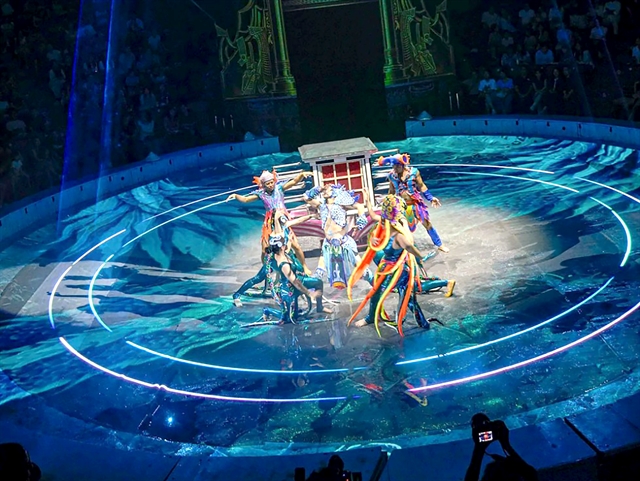
However, each art form and performance space requires its own specific technological conditions. For circus arts, a circular stage, high dome and spacious area allow technology to expand the setting, build layers of imagery and effectively support the performance, while puppetry, with its small, delicate movements, requires appropriate technological applications to enhance the puppets' beauty and expressive language.
Therefore, Ly said, the same approach cannot be applied to all art forms. It is important to understand each art form's characteristics, identify the values to be preserved and choose technology to serve the creative intent.
Ly suggested that the Ministry of Culture, Sports and Tourism assign a unit to develop a set of criteria and identify priority projects for digital transformation in the performing arts.
Performing arts organisations and organisers also need to proactively take stock of their resources, review their infrastructure and identify needs and areas requiring investment, she said.
Long-term cooperation
Based on research into the experiences of the US, China and South Korea, and domestic surveys, Trần Thị Minh Thu from the Việt Nam Institute of Culture, Arts, Sports and Tourism identified three bottlenecks: human resources, infrastructure and finance.
According to Thu, international developments such as online performances, immersive theatre, AI, the integration of multiple technologies in live performances and investment in digital infrastructure for cultural institutions raise many issues for Việt Nam.
Implementation requires the State's supportive role, business participation and proactive engagement from performing arts organisations.
Thu urged artists to understand technology's capabilities and limitations so they can choose appropriate tools for their creative work, while technology engineers should also learn about the arts and their aesthetic language.
If these two groups lack mutual understanding, achieving effective artistic results will be difficult, the expert said.
Thu added that obstacles to cooperation between the State, theatres and businesses need to be removed.
"The State should create the mechanisms, theatres should develop content and ensure professionalism, and businesses should provide technology and experts for implementation," Thu said. — VNS
