Weather:
- Ha Noi 36oC
- Da Nang 32oC
- Ho Chi Minh 34oC
by Bảo Long
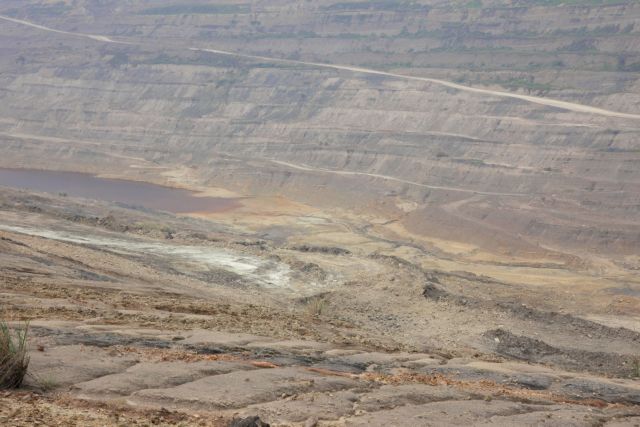
The night before, Nguyễn Thế Vĩnh dreamed once again that he had unearthed a crocodile.
Not just scattered bones, but a nearly complete skeleton, perfectly preserved, resting beneath the earth of the Na Dương Basin for more than 30 million years. In his dream, he gently brushed away layers of soil and carefully lifted the fossilised skull with both hands.
The next morning, the dream still lingered as he and his colleague, Nguyễn Minh Chuyển, both palaeontologists from Lạng Sơn Provincial Museum, set off on their old motorbike toward the Na Dương coal mine.
The road snakes through slopes coated in grey coal dust. In the sweltering summer heat, layers of red and yellow earth reveal a geological record stretching back millions of years. No crocodile awaited them that day, but only the quiet hope that a fresh excavation or recent downpour might reveal creatures long hidden from the sun.
It is a hope that keeps drawing them back.
"In the palaeontology community, the Na Dương Basin is considered one of Southeast Asia's richest fossil sites," Chuyển said.
"The late Eocene sediments here preserve an entire ecosystem from 35 to 40 million years ago, a vast landscape of lakes, swamps and forests teeming with crocodiles, turtles, coal beasts (anthracotheres) and diverse plant life."
Chuyển's assessment is echoed by international researchers who have spent years studying the basin. In a landmark review of the site, Prof. Madelaine Böhme, a German palaeontologist and terrestrial palaeoclimatologist at the University of Tübingen, described Na Dương as "one of the few localities in Southeast Asia allowing for multi-focused investigation" of Eocene ecosystems, citing its extraordinary diversity of vertebrate, invertebrate and plant fossils.
For Vĩnh and Chuyển, every expedition is more than a search for museum specimens. Each fossil is a potential piece in reconstructing a vanished world.
Into the mine
Mining has made many of Na Dương’s fossil discoveries possible by exposing sedimentary layers that would otherwise remain buried. Yet it is also steadily erasing the landscape in which those fossils have survived for millions of years. With limited personnel, equipment and time, palaeontologists must reach each newly exposed section before machinery, rain and exposure to the air destroy the evidence it contains.
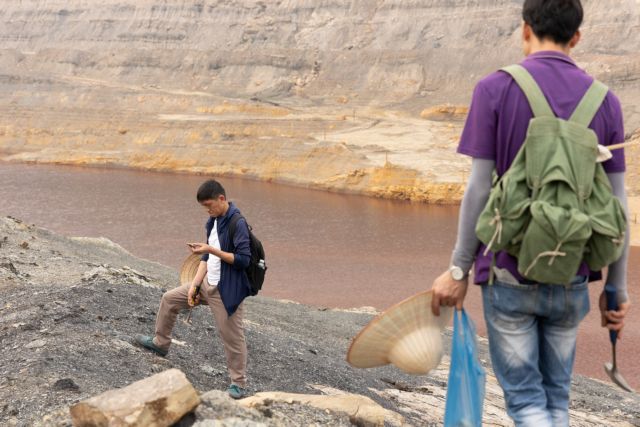
They parked at the edge of the sprawling mining site and shouldered backpacks filled with basic tools: hammers, chisels, small brushes, specimen bags, water and packets of peanut candy to keep them going through the day.
After a quick exchange, they split up, each taking one side of the exposed slope. Heads bowed, they walked slowly, eyes scanning the rocky ground.
There was no high-tech equipment, no ground-penetrating radar. They relied solely on experience and subtle clues: a fossilised leaf imprint, a petrified tree trunk or traces of ancient crocodile dung.
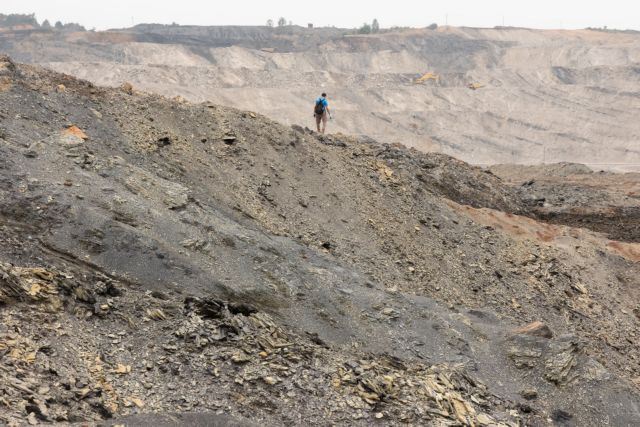
"Spotting fossils here is extremely challenging," Chuyển said.
"They blend almost perfectly with the coal and surrounding rock. We have to follow surface signs before focusing on a promising area."
After three years of regular surveys, the two men know the terrain intimately. What others see as mere dirt walls cut by excavators, they recognise as sedimentary layers dating back tens of millions of years. Unusual colour streaks, fissures or oddly textured fragments are enough to stop them in their tracks.
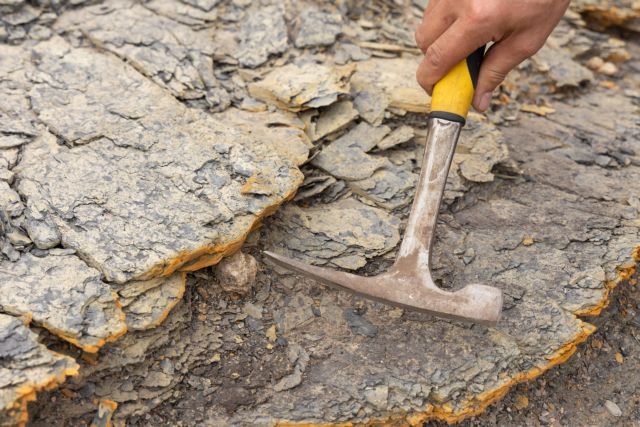
Yet even deep familiarity cannot guarantee success across a 1,000-hectare site. Some days, they hike for kilometres under the sun, finding only broken fossils. Other days, promising trails disappear into rubble.
Still, they return whenever they can. In palaeontology, the work consists mostly of patient searching. Actual discoveries are rare.
By the fifth day, exhaustion was etched on their faces. As usual, they separated at the edge of a freshly exposed seam. They moved methodically, crouching for long stretches to examine shale layers before moving on.
Near noon, amid the vast silence broken only by distant excavators, Vĩnh's voice rang out.
'We can't save it'
Following their unspoken rule, Chuyển quickly packed his gear and hurried over. At Vĩnh's feet, a brownish-white shape protruded from the damp soil. One glance told them it was a large turtle shell, bigger than most they had found in Na Dương.
Without a word, Chuyển handed over a chisel. They worked with painstaking care, lightly tapping and brushing away dirt. But as the shell emerged, both men saw what they had feared. Exposed to moisture for too long, the fossil had become brittle and porous. With every layer of soil removed, small pieces crumbled away.
Vĩnh stopped. He stared at the damaged shell for a long moment, then shook his head.
"What a shame," he said. "It's so large, but we can't save it."
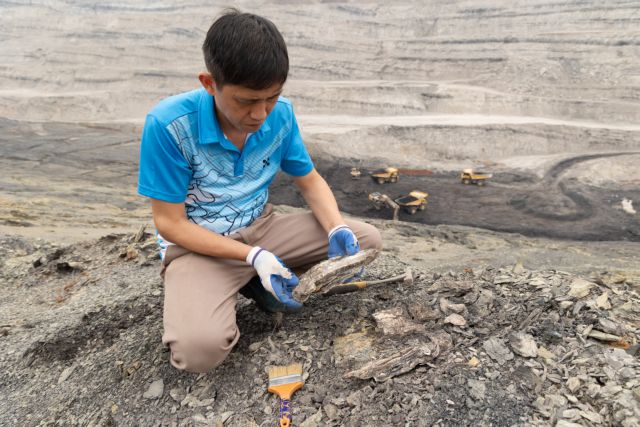
Experience had taught them not to push further. They photographed the find, recorded its coordinates and gently reburied the site. A remarkable fossil had been discovered, yet it could not be taken.
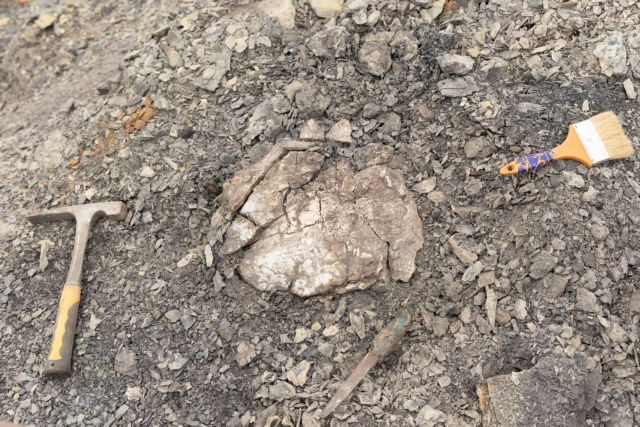
The disappointment passed quickly. They picked up their tools and continued.
Vĩnh returned to an area rich in fossilised crocodile dung, convinced something more lay buried below. On the other side of the site, Chuyển shifted his search toward coal seams where anthracothere remains had appeared before.
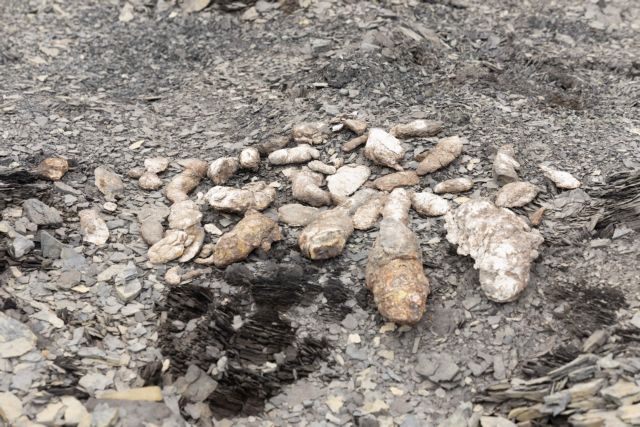
Their familiar rhythm resumed: walk, observe, move on.
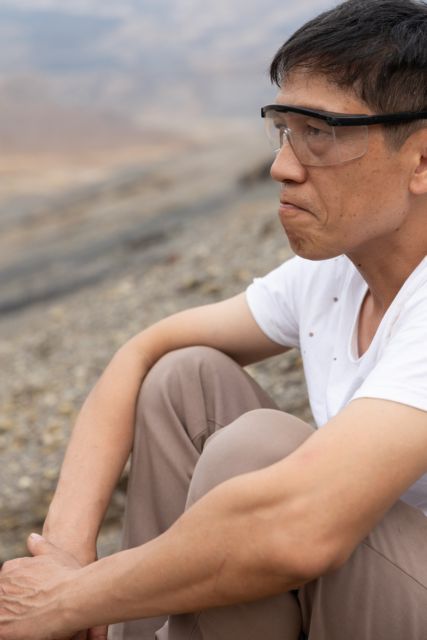
"Sometimes we feel incredibly tired," Vĩnh admitted. "But the possibility of finding an intact specimen keeps us going."
A fragile find
Late that afternoon, their persistence was rewarded. At another freshly exposed section, Vĩnh uncovered a second turtle shell, which was almost perfectly intact. Not long after, Chuyển found a tooth and a suspected limb bone from an anthracothere. The specimens were modest in size, but they meant the expedition had not been in vain.
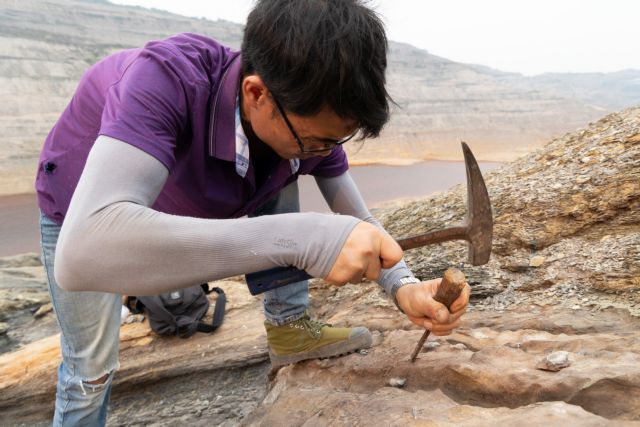
Vĩnh carefully brushed away the remaining soil and wrapped the fossils in protective padding. For the first time in days, broad smiles broke across both men's faces.
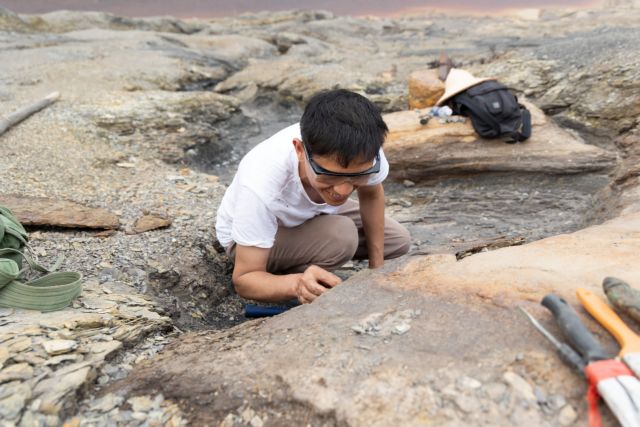
The satisfaction of making a discovery goes far beyond simply returning with specimens. For Vĩnh and Chuyển, the most profound feeling is the quiet realisation that they may be the first humans to lay eyes on these creatures since they were buried tens of millions of years ago.
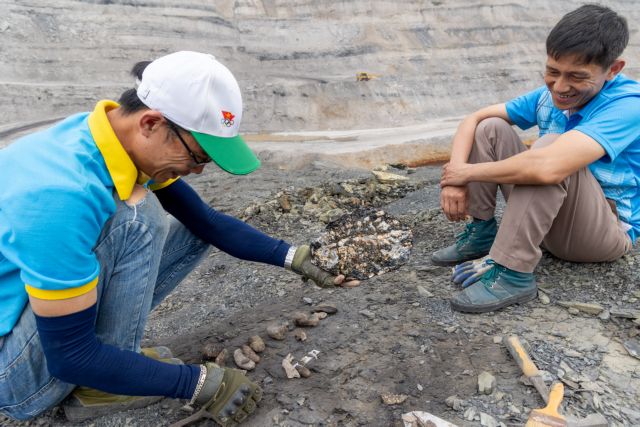
"When I finally hold a fossil in my hands, I feel incredibly happy. It makes all the hard work worthwhile. And then I realise something extraordinary. I may be the first person to see this animal since it was buried 30 or 40 million years ago," Vĩnh said.
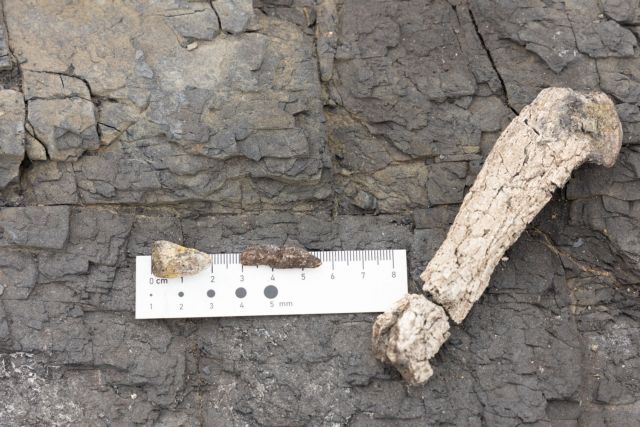
"From 2021 to 2022, Lạng Sơn Provincial Museum conducted surveys, but it wasn't until 2025 that we found a number of valuable specimens, including those that are rarely discovered elsewhere in the world, such as the jaw specimen of an anthracothere," said Nguyễn Gia Quyền, head of the Curatorial Department at Lạng Sơn Provincial Museum.
"In particular, that anthracothere fossil is the first of its kind to be acquired by the Lạng Sơn Museum. It can be said that this is a highly valuable artifact for the research efforts of palaeontologists and archaeologists."
In the Na Dương Basin, layers of black coal, red earth and yellow clay stack upon one another like the pages of an immense history book. Every fossilised leaf, every fragment of petrified wood and every bone weathering out of the hillside tells the story of a world that existed long before humans ever walked the Earth.
Vĩnh still remembers the first time he set foot here. "It felt completely different," he recalled. "As if I had stepped into another world. Na Dương is unlike anywhere else. It almost feels like another planet."
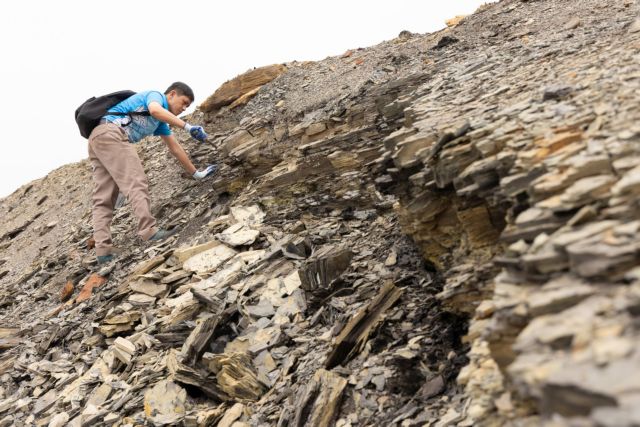
Perhaps that feeling is why they keep returning.
"We always hope to discover more specimens," Vĩnh said.
"The richer the museum’s collection becomes, the more complete the story we can tell."
For Vĩnh and Chuyển, collecting fossils is not simply an act of scientific curiosity. It is a race to document a disappearing record.
“If these fossils are not collected and preserved now, future generations may never know what this land once looked like or what kinds of life flourished here,” Chuyển said.
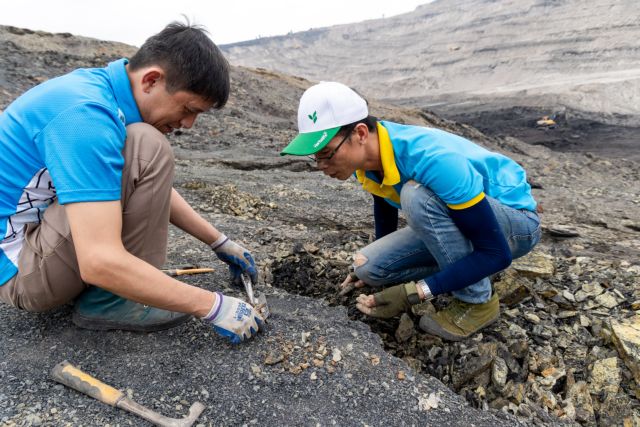
Racing time
Every day, excavators remove another section of the basin to reach the coal below. Newly exposed slopes offer fresh opportunities, but only briefly. Some fossils are shattered by machinery. Others crumble after days of exposure to rain, heat and humidity.
That is why the two palaeontologists return whenever they can. They do not expect every expedition to produce a remarkable specimen. Often, several days of searching yield only fragments, or a discovery too fragile to be removed. But each visit gives them another chance to rescue a small part of the distant past.
While Vĩnh and Chuyển toil in the field to unearth specimens, their superiors back in the office grapple with burdens of their own.
"Regarding time and the funding allocated for these tasks, they remain limited. Therefore, every year, despite the low budget, we still make every effort to conduct surveys and research in order to discover and retrieve as many artefacts as possible to bring back to the museum," Quyền shared with Việt Nam News.
Recognising the importance of the Na Dương Basin, Lạng Sơn Province has incorporated it into the Lạng Sơn UNESCO Global Geopark, which in 2025 became Việt Nam's fourth UNESCO Global Geopark. The designation reflects the region's geological significance, including a fossil record that offers a rare glimpse into Southeast Asia's ancient ecosystems.
The Na Dương Coal Company has also worked with museums and research institutions to facilitate fossil collection and fieldwork in the area.
But the basin is vast, geologically complex and still only partly understood. Unlocking its scientific potential will require more than access to the mine. It will require sustained investment in researchers, equipment and the technical expertise needed to document and preserve what lies beneath the ground.
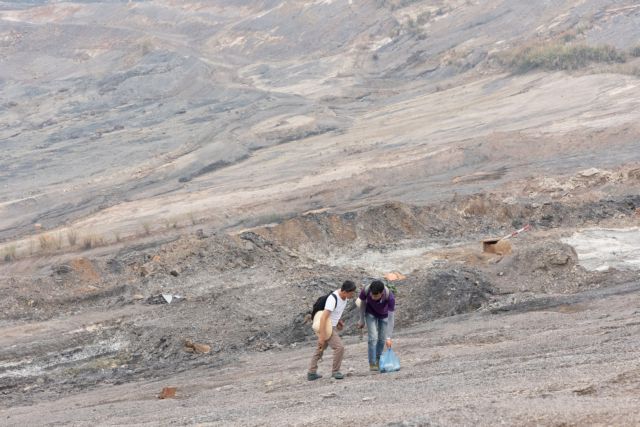
Evening came quickly over Na Dương. Excavators continued moving across the mine as Vĩnh and Chuyển wrapped the day’s specimens in protective padding and secured them inside their backpacks.
By the next morning, another layer of earth would have been stripped away and another chapter of the basin’s history exposed.
Somewhere beneath the ancient sediments, perhaps the crocodile from Vĩnh’s recurring dream was still there, waiting in the darkness.
But at Na Dương, nothing can wait forever. — VNS
