Weather:
- Ha Noi 23oC
- Da Nang 26oC
- Ho Chi Minh 27oC
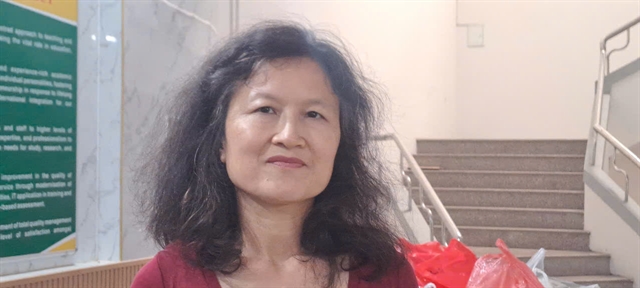
Growing up in France in a family with Vietnamese roots, journalist and writer Đoan Bùi has had her book Le Pays de nulle part, or Xứ sở vô danh (commonly referred to as Neverlands), translated into Vietnamese and published in Việt Nam. Reporter Công Thành of Việt Nam News talks to her about her journey.
Can you tell us more about yourself and your book?
I’m a senior reporter at the weekly Le Nouvel Obs, but I am also a writer. I wrote a novel, La Tour (2022), as well as memoirs.
Xứ sở vô danh is my second book translated into Vietnamese. The first one was Le silence de mon père, or Người Cha Im Lặng (The Silence of My Father) which was introduced in Việt Nam in 2018 by Phương Nam Books and the Vietnamese Writers Publishing House.
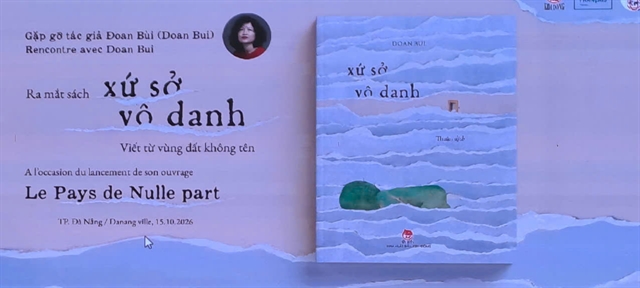
‘Xứ sở vô danh’, or Neverland, has just been published by Kim Đồng Publishing House. It tells the story of a mother's sorrow following the loss of her daughter, Mê Linh, who was born prematurely and passed away 15 days after birth.
I began this book more than 10 years ago. The novel tries to explore the loss and torment of a mother whose newborn girl passed away just a few weeks after being born. It is a tale about grief, but more than anything, it is a tale about love.
Somehow, this book about grief is also deeply connected with my relationship with Vietnamese. Vietnamese is my mother tongue, but having been born in France, my Vietnamese was gradually displaced by French. I always felt shame at the idea of having lost my mother tongue. I was ashamed of not being able to share and convey my parents' tongue.
My grandmother used to live with us. She couldn’t speak French. She explained and taught me many things about culture, lifestyle and Việt Nam. I could feel the beauty and meaning of a Vietnamese word – thương – as it expresses familial love, tender love and deep compassion in sorrow or sadness. But I could not answer. I was at a loss for words.
In 2005, my father had a stroke. He became aphasic and could not talk any more. I realised I knew so little about his story and about Việt Nam. I started investigating my family’s past, and my book The Silence of My Father came out in 2017.
I was so proud when it was translated into Vietnamese, but I couldn’t read it! I realised I was like my father: I had lost my own language. Then I started my journey learning Vietnamese again and it really changed my life. While writing Neverland, I always thought about the beauty of this one word that I had never forgotten: Thương.
I could feel the meaning of it when I was a child: my parents would not say bệnh viện (hospital), they would say nhà thương (formerly used by people living in southern Việt Nam). I thought it was funny. The "house where you love"? At that time, I didn't realise there was this double meaning. Wound. Like vết thương. I find it so beautiful.
It really explains a lot about grief. Because when you grieve for someone you love, love doesn’t vanish. It is still there, but tainted with the pain of the loss. A lot of the scenes in Neverland take place in a hospital, where the mother takes care of her daughter, who is going to die.
There is pain, but there is also infinite love. The same is true when you stay with someone you love, just before he or she dies. There is so much love in caring for people just before they leave us. There is all of this in this beautiful word: thương. It cannot be translated into English or French.
When I had the chance to read the Vietnamese version of my book, translated by Thuận, a writer I love, and published in Việt Nam by Kim Đồng Publishing House, I could read it from beginning to end. I felt so proud and also deeply moved that I could read my book entirely in Vietnamese.
I even felt it was, somehow, closer to my soul in Vietnamese: for example, those very simple words mẹ (mother) and con (child), they go right into my heart. My lòng, (heart, mind or feeling), they don't have the same impact when translated into another language. Maybe because Vietnamese belongs to my inner soul, or maybe because this is the language of family, of love, I felt my book found its place in this very language.
In French, the title is Le pays de nulle part (The Land of Nowhere) and it could be translated into English as Neverland like in Peter Pan. In Vietnamese, we had discussions with Thuận, the translator. At first, she suggested Xứ sở hư vô but I felt hư vô (nothingness) was too dark.
So we agreed on Xứ sở vô danh, or "the land without a name". Because this grief, losing a child, is difficult to "name". Also, there are a lot of traditions where young babies, if they die too early, aren’t given names. They are vô danh (nameless).
What message do you want to send to readers?
This is a book about grief, but this is mainly a book about the love that remains after death. Books are like fireflies in the dark. You need to be in the night, in utter darkness, to see fireflies, and books are those fireflies that show you the way when you are in the darkness.
My grandmother told me that in Việt Nam, đom đóm (fireflies), are the souls of the deceased. I like to think that the ghosts of the people that we loved, that we still love, still accompany us and protect us, like our ancestors at the ancestor altar. A child who loses his parents is an orphan. A woman losing her husband is a widow. But there is no word for a mother who has lost her child. That is this grief, this taboo, that I am addressing in my book.
But grief and loss are quite universal. Somehow, having been through this loss helped me understand my parents' journey. They lived as immigrants, far away from their homeland, and their family was scattered during wars.
Sorrow of war. That is what Vietnamese novelist Bảo Ninh said. I met the "sorrow of war" - in Ukraine. I have been there several times since the conflict began in 2022. I remember meeting a mother who lost her 13-year-old son. I still remember her pain. I talk about her beloved son in my book as an homage. That’s what some books are for, to honour the dead.
What are the other emotions shared in the book?
In my book, I describe the writer as a squid. It changes colour to adapt to its environment. And it also spits ink to leave a trace. This is the job of the writer.
I also sometimes think the writer is a spider. The spider is a very patient animal. It weaves its web all day long, all night long. The web might seem fragile, but it is more solid than it looks. Many scientists marvel at the material of the spider threads. The spider thread is a kind of silk and it has many virtues. In traditional medicine, it is known to heal wounds; it is antiseptic.
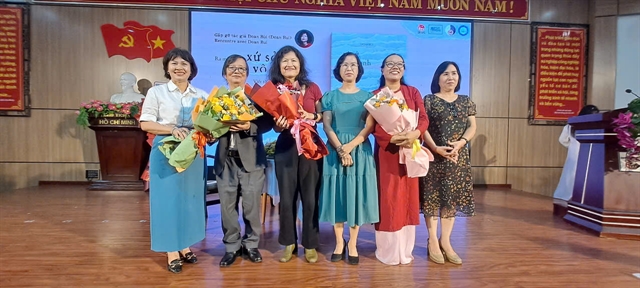
My journey learning Vietnamese is a beautiful web that I am weaving. It has helped me understand myself deeply. I am amazed that I can notice, somehow, fragments of Vietnamese in my writing in French. Marguerite Duras, a great French writer, grew up in Indochina during colonial times. As a child, she could speak Vietnamese. I am moved to see that in her later works, her style changed, as if she was trying to look for the music of Vietnamese in her sentences.
Maybe all writers try to find this particular music, and I am also trying to find it. And this melody is Vietnamese. I feel that there is an invisible tie connecting heart to heart, in every Vietnamese person. VNS
