Weather:
- Ha Noi 30oC
- Da Nang 26oC
- Ho Chi Minh 30oC
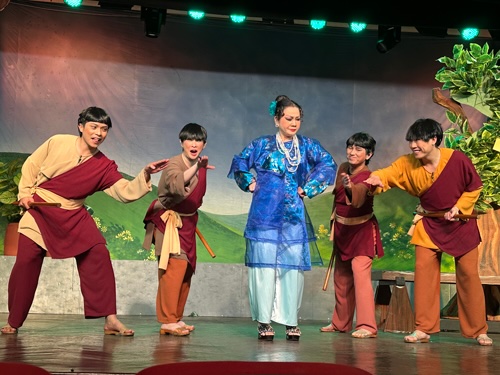
HCM CITY – As artificial intelligence (AI) gains ground in creative fields, theatre practitioners are calling for clear boundaries to preserve artistic integrity.
AI has become a global trend, and theatre cannot stand outside this. However, engagement does not mean dependence.
Establishing a “safe distance”
AI can support writers in generating ideas, suggesting structures and even mimicking styles.
But if the entire creative process is handed over to machines, the resulting work becomes anonymous, stripped of any personal imprint.
“A vọng cổ line must come from the artist’s heart. Machines can produce sound, but not sentiment,” said People’s Artist Lệ Thủy.
Meritorious Artist Công Ninh stressed: “Creativity is a process of accumulation. Artists must live with their characters, must go through their own experiences to create a role. AI may shorten preparation time, but it cannot replace that journey.”
According to experts, AI is forcing a redefinition of creativity itself. When a product is created with algorithmic support, its value lies not in speed or smoothness, but in the depth of thought and the personal imprint left by the artist.
AI may help artists move faster at certain stages, but it cannot walk the path they must take themselves.
One of the key issues arising from AI’s involvement in creation is transparency.
Who is the true author of a theatrical work? How should the contributions of humans and technology be measured? Without clear regulations, the risk of “misrepresenting creativity” is real.
“Artistic creation is always tied to personal responsibility. When using AI, writers must disclose the level of its involvement. That is how the integrity of a work is protected,” suggested author Nguyễn Thu Phương.
Practitioners believe transparency is not only a technical requirement but also an ethical standard. A work of art must be recognised for what it truly is in order to safeguard the value of creative labour.
Creative ethics are not abstract, they are tied to professional honour, personal credibility and public trust.
As AI becomes more deeply embedded in the creative process, the need for transparency grows more urgent.
AI should be used as an assistant, while the artist remains the final decision-maker. Reversing this relationship risks disorienting the creative process.
“What matters is establishing a ‘safe distance’ between technology and creativity. AI can participate, but it must not dominate,” said Meritorious Artist Lê Nguyên Đạt.
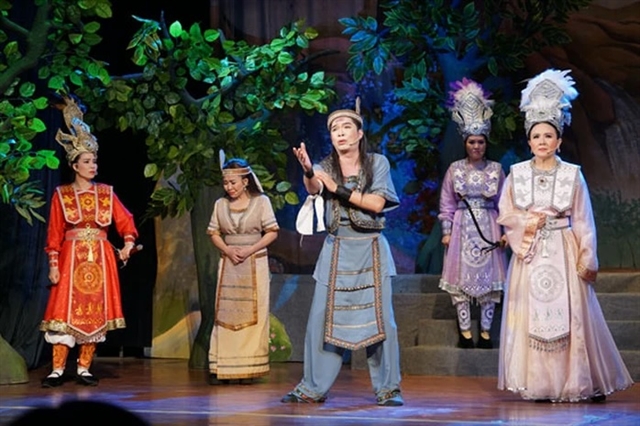
Solutions
Vietnamese theatre carries distinct characteristics, from language to modes of expression. Cải lương, tuồng and spoken drama are all rooted in specific cultural frameworks.
As a data-processing tool, AI struggles to fully recreate these deeper layers without guidance from artists.
A vọng cổ line must follow the correct rhythm, but it must also carry the essence of the southern region. A spoken drama scene requires logical structure, but also the breath of real life. These elements cannot be generated by algorithms alone.
Theatre is the living memory of a community; without its cultural foundation, a work loses its roots.
“This year, the HCM City Department of Culture and Sports is organising the second HCM City Theatre Festival focusing on cải lương. I believe more seminars and discussions are needed to examine AI’s impact on theatre,” said People’s Artist Trần Minh Ngọc.
Experts advise that when using AI, artists must remain conscious of their role in preserving the “soul” of a work. Technology may expand form, but content must be nurtured from cultural foundations.
To ensure AI becomes a driving force rather than a threat, a comprehensive set of solutions is needed, from management to creative practice.
First, clear regulations on AI use in creative work must be established. Competitions and festivals should define criteria on acceptable levels of AI use, disclosure requirements and evaluation methods. This would create a transparent playing field and reduce disputes.
Second, technology should be used to regulate technology. AI-detection tools should be deployed alongside the professional judgement of expert panels. Cross-checking can improve reliability.
Third, artists should be trained in technological competence. Equipping practitioners with knowledge of AI will help them use it effectively without becoming dependent. Mastery of tools leads to greater creative autonomy.
Fourth, creativity rooted in cultural identity should be encouraged. Works that reflect Vietnamese cultural characteristics and strong individual voices should be prioritised in staging, performance and awards. This helps maintain a solid foundation amid technological change.
Fifth, the role of arts councils should be reinforced. In an era where AI can generate content at scale, their “gatekeeping” function becomes even more critical. Evaluation must focus on artistic value rather than being misled by surface polish.
Ultimately, theatre remains a human story.
AI can produce a fluent script, a technically “correct” piece of music, or a well-constructed stage design. But theatre has never been measured by smoothness alone.
It is measured by its ability to move audiences. A glance from an actor, a pause on stage, a line spoken from lived experience, these are what give art its enduring power. – VNS
