Weather:
- Ha Noi 29oC
- Da Nang 26oC
- Ho Chi Minh 30oC
Nguyễn Mỹ Hà
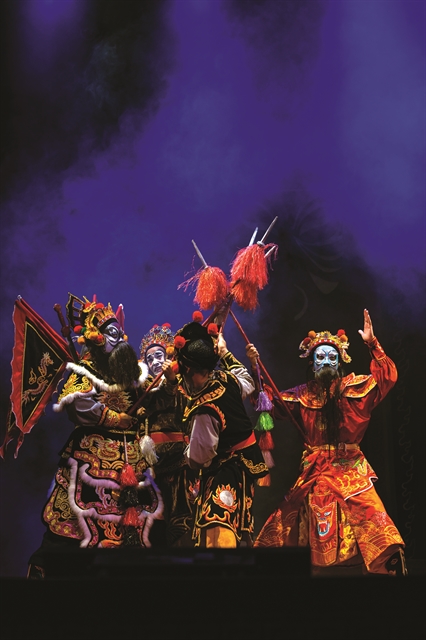
From around 3 pm at Hồng Hà Theatre in the Old Quarter of Hà Nội, about a dozen people arrive to rehearse for their show later that night. Clad in jeans and sneakers, sweatshirts or tank tops and pants, they carry their signature horse whips or spears as they prepare for the final rehearsal for the night’s gala. It was named Mã Khởi Nguyên Xuân, or The First Gallop of the New Spring, a title chosen in the hope of welcoming a new year marked by renewal and success.
The traditional music band was also ready for the rehearsal in their musical pit. Hồng Hà Theatre has over 400 seats, a size that fits tuồng – classical opera – perfectly, as viewers can be so close to their artists and clearly follow even the smallest eye movements, which speak volumes in this type of art.
Pouring hot green tea from a large pot, actor Vũ Mạnh Linh, 38, looks just like any man his age, in jeans and sports shoes. In a few hours, he is going to have a total makeover. Soon, no one would recognise the man pouring tea and waiting for his turn to rehearse.
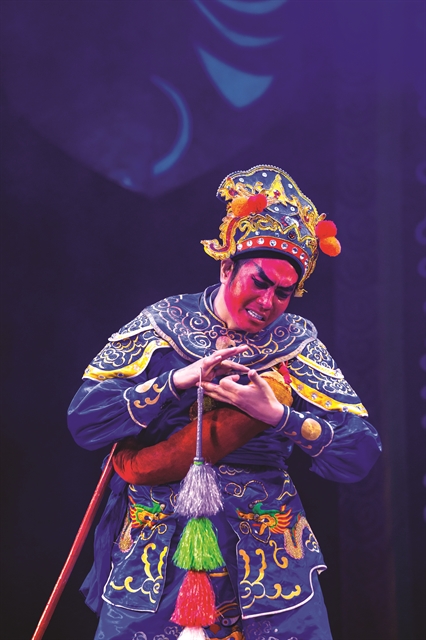
“I’m going to play Đổng Kim Lân, a general who had to help the infant crown prince cross a mountain pass at night while rebels were surrounding them,” Linh says of the role he learned in college back in 2005, exactly 20 years ago.
It’s a classic main hero role that everyone learning to become a tuồng artist knows well. Everyone loves the demanding role, yet only a few can truly master it.
Fresh from the National Tuồng and Traditional Music Festival that ended last November, Linh won a gold medal for this role. The festival gathered seven theatres in the country that dedicate themselves exclusively to the traditional art of tuồng.
“The south-central and southern art troupes brought their best works to the festival,” Emeritus Artist Kiều Oanh says. “They are really great and we look at them with deep respect. But we were quite competitive we wanted to bring out the best in a competition. So did they.”
“In tuồng, every role is demanding, physically, emotionally and mentally exhausting,” Linh adds. “If you do it well – singing, dancing and acting – then you’ll be invited to perform on many important occasions.
"The biggest demand of a tuồng artist, man or woman, can be summed up in these words: voice, appearance, skills, essence, characteristics and charisma. If you can deliver all of the above, you’re sure to succeed.”
Art of heroism
The hero he played is a classic tragic hero role, where even the name alone commands respect. The tuồng troupe of the newly formed Vietnam National Traditional Theatre has put together a new programme aimed at reaching younger audiences in Hà Nội.
Tuồng is a combined art of singing, dancing and acting to portray the philosophy of moral righteousness, in which a man must remain faithful to his king and devoted to his country. The line of figures in tuồng clearly defines right and wrong, the righteous and the ill-gotten. A red-painted face always signals the hero, who must endure severe trials to prove his loyalty.
Such circumstances are vividly portrayed in the classical tuồng opera Sơn Hậu, one of the most renowned classical plays of Việt Nam.
Some believe the Sơn Hậu scriptwriter was unknown. Other researchers believe it was written by Đào Duy Từ (1572–1634), a military strategist, poet and scholar, a mandarin of great contributions to the Nguyễn Lords, predecessors of the later Nguyễn Dynasty.
Serving his Lords for only eight years, Đào Duy Từ was among the founding officials of the Nguyễn establishment of the state, its geography and the strategic significance of the southern land. Later, the Nguyễn Kings honoured him posthumously and worshipped him in the clan’s temple in Huế. Hundreds of schools and streets across Việt Nam today bear his name.
The script was later polished and brought to today’s performance by his ninth-generation grandson Đào Tấn (1845–1907), who left a profound and lasting influence across Bình Định Province, today part of the enlarged Gia Lai Province.
Sơn Hậu opera, in the south often called San Hậu, is a classic court opera – a masterpiece of literature and performing arts – from a time when tuồng or hát bội dominated all performing spaces in the kingdom. It used to be performed by troupes during harvest festivals at village communal houses in the south. The storyline itself is entirely fictional.
The opera honours the loyalty of the generals to their king and the camaraderie between two friends, generals Khương Linh Tá and Đổng Kim Lân, who attempt to save the newborn prince and rescue his mother from prison. Pursued by the court rebels, Tá is beheaded while holding them back. In a haunting scene, he reaches out for his severed head, places it back on his shoulders and continues singing – an excerpt that remains unforgettable.
Another iconic scene unfolds when Lân, assisted by his fallen friend Tá – now incarnated as a radiant guiding light – journeys through the night toward dawn and the new citadel of Sơn Hậu, where the infant prince will one day ascend the throne.
The opera has three acts, each lasting four hours if performed in full. Under the Nguyễn Dynasty, it was staged over three days, from midday until midnight.
Symbolic convention
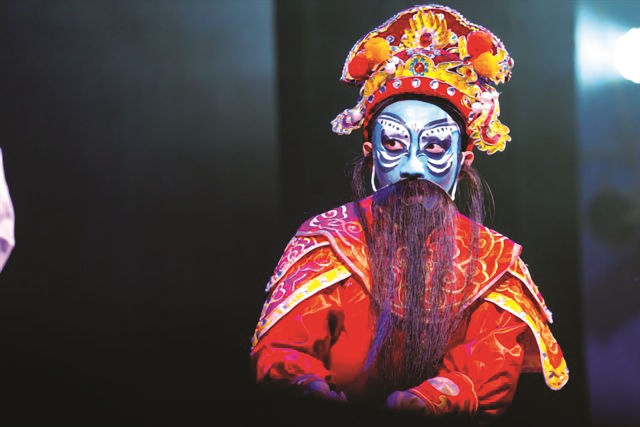
In traditional performing arts of Việt Nam, tuồng included, the overriding method can be comprised in several features: stylised gestures and movements, including the use of spears or horse whips; face make-up and masks drawn in dramatic colours and patterns; and staged acting that often includes dance, mime and martial arts with sophisticated language spoken in an abstract way against the background of a simple, even minimalistic stage setting.
“Dancing in tuồng is an art of its own,” said Emeritus Artist Tống Xuân Tùng, 46. “There are many sets of movements that signify meaning – hand gestures, pointing sequences, arm swings, just to name a few. The most important thing is to let the movements follow the lyrics.”
“You must learn to open up your arm and leg joints. Stretching on the floor is essential,” Tùng adds.
Reflecting on his journey to becoming an Emeritus Artist – an honour bestowed by the State – Tùng says he has played many types of characters.
“But the hardest and most exhausting dancing of all was playing the evil roles. You have to dance low, lowering yourself closer to the floor,” Tùng says. “Bộ yêu refers to the set of evil characters. Yêu here does not mean love, but yêu tinh – spirits such as foxes, fish or rooster demons. These roles demand acrobatic movements and sometimes require carrying a female partner on your back.”
The use of weapon props in tuồng is as essential as dancing. The weapons – all made of wood, never metal – include swords, spears, bows, broadswords, staffs and daggers.
When in real life weapons are used to hurt opponents in conflicts or war, on tuồng stages weaponry props are used to honour the beauty and scale of the heroes. They are deliberately smaller and lighter, crafted to ensure performers’ safety.
It is almost obligatory to have fighting scenes in tuồng operas. Fighting has always been part of the appeal, as players present their expertise not only in using weaponry but also in dancing, making it eye-catching. In certain schools, players have to learn martial arts alongside singing, dancing and acting.
Other symbolic props include horse whips to represent riding, flags for chariots and cloth banners to signify water.
The horse whip is a unique and lively prop on the tuồng stage. It is a highly symbolic tool used in many instances. Artists use details to help the audience see the full picture: they can wave the horse whip and we see them riding, or use the bow and we hear the water around the boat. With the horse whip alone, we know how hard and how long the road was for the warrior.
Importantly, tuồng does not reserve heroism solely for men. Female generals are portrayed as both powerful and graceful, equally patriotic and resolute. A woman general may appear wielding double swords, one in each hand.
The power of women
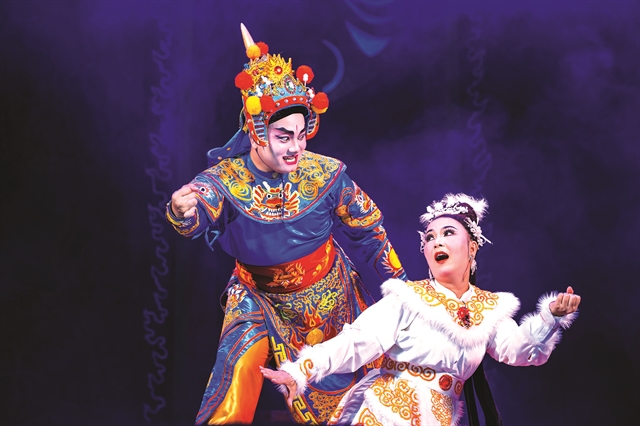
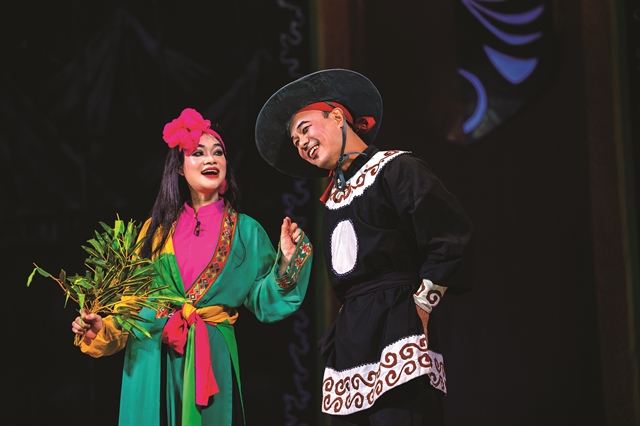
Ông Già Cõng Vợ Đi Hội (Elderly Man Carries Young Wife to Festival) is a classic double-role piece polished and popularised by People’s Artist Đàm Liên in the 1970s. During her career, Liên performed the role more than 2,000 times. Emeritus Artist Oanh learned the piece directly from her and later made her own name through it.
In this scene, Oanh plays both a young woman and her elderly husband, who carries her to the festival. Playing the woman requires singing in a female register, dancing and glancing coyly; when shifting to the elderly husband, the artist must instantly change voice, posture and movement. Even laughter becomes a challenge – from a woman’s staccato giggle to a man’s booming roar.
At the festival, spoiled young men flirt with the woman, but in keeping with tuồng’s moral code, the elderly husband asserts his dignity and protects his wife – a plot rarely seen in contemporary theatre.
“I performed this piece many times both at home and abroad,” Oanh says. “I remember performing in the United States about 10 years ago and after the show, a lady came up to me and hugged me. She said she understood everything, which made me really happy.”
“Back home, I enjoy removing the heavy make-up, walking out of the theatre and hearing people still talking about the play and about me, but they do not recognise me.”
Tuồng is not only about honour and heroism. It also delights in satire. Ngũ Biến (Five Transformations) is a comic masterpiece that sends audiences into laughter.
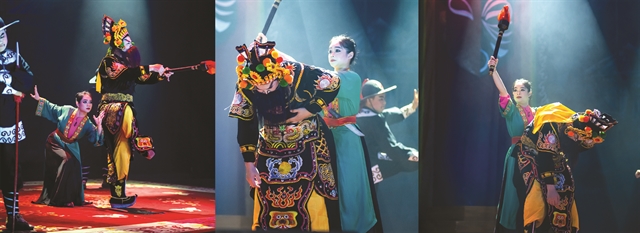
Emeritus Artist Đỗ Quyên, in one excerpt, had to reincarnate into five personas, including a young boy tending buffalo, an elderly woodcutter and a blind fortune-teller.
This masterpiece highlights the artist’s versatile expertise in singing, dancing and acting across all the personas depicted. It is a challenge but also a multi-persona role that stamps quality on the performance.
The rapid role changes drive the audience crazy yet thrilled, carrying them from one chill to the next thrill that raises their hair as the play unfolds on stage.
This year, the Vietnam National Traditional Theatre – newly united from three separate traditional theatres – aims to once again draw local audiences, even in a world crowded with modern entertainment.
Watch tuồng live just once, and your life may never be the same. Hats off to the artists – for their skills, discipline and devotion. They capture hearts quietly, then never let go. – VNS
