Weather:
- Ha Noi 31oC
- Da Nang 30oC
- Ho Chi Minh 33oC
Football
HÀ NỘI — Several national sides reached the 2025 Asian championship finals after years of careful planning, underlining how long-term squad building is essential to staying competitive on the international stage.
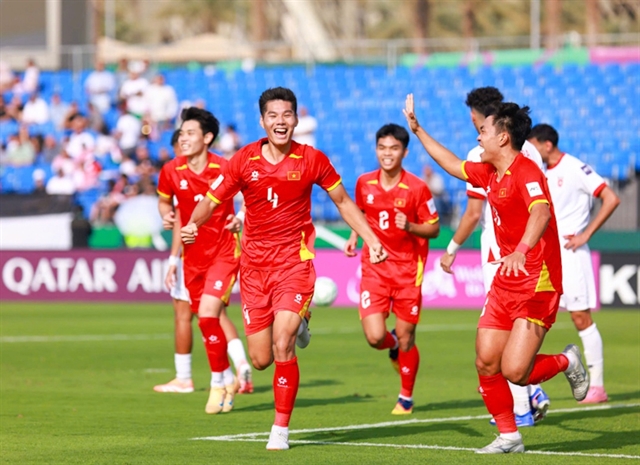
This year, Vietnamese football will seek to turn that same strategic vision into silverware, with the men’s national team targeting the 2026 ASEAN Cup and the 2027 AFC Asian Cup qualifiers as defining campaigns.
In the 2027 Asian Cup qualifiers, Việt Nam remain firmly in contention in Group F despite uncertainty surrounding Malaysia’s use of naturalised players, an issue that has drawn scrutiny and could yet affect the group standings. The Vietnamese coaching staff have adopted a measured, professional approach, constructing their squad strictly from eligible players and placing emphasis on decisive fixtures.
According to the Việt Nam Football Federation, head coach Kim Sang-sik and his staff have scheduled a friendly against Bangladesh on March 26 during the FIFA international window to fine-tune preparations for the crucial encounter with Malaysia on March 31.
While Bangladesh are not considered on a par with regional heavyweights, the fixture offers a valuable opportunity to test tactical systems and assess individual form under match conditions.
Việt Nam currently sit second in Group F on nine points, three behind Malaysia. Under the head-to-head rule, they must secure victory by at least five goals to progress, a formidable task, yet one that appears attainable with home support and disciplined execution.
The 2026 ASEAN Cup, running from July 24 to August 26, presents another opportunity to assert regional dominance. As reigning champions, Việt Nam will face stiffer resistance. Indonesia and Malaysia have strengthened their squads with European-born players, while Thailand continue to rely on a well-developed domestic structure. To defend their crown, Kim must add depth in midfield and attack to cope with rising standards across Southeast Asia.
Trần Anh Tú, vice president of the Việt Nam Football Federation, reaffirmed the federation’s wider ambitions.
“We also aim to retain the women's futsal team’s title and for the men’s team to reach the finals. Achieving these goals requires thorough and systematic preparation. The VFF will provide comprehensive support to ensure teams have the necessary logistics and technical resources,” Tú said.
At youth level, the 2026 AFC U23 Asian Cup, concluded in January, served as a benchmark for players born between 2003 and 2005. Many from this cohort have featured regularly in regional tournaments, forming a stable core for the senior team’s next phase.
For the Asian Games, the VFF will field the U21 side, bridging the gap between youth football and the full national team. Exposure to varied opposition will sharpen their competitive edge and strengthen the pipeline to the U23 and senior squads beyond 2026. Maintaining that pathway is crucial to avoiding the generational lapses that have hindered several regional rivals.
The U17 men’s team will also compete in the continental championship in May, with qualification places for the World Cup at stake. A strong performance at the Asian finals would open the door to global competition and reinforce confidence among a promising generation.
Futsal remains a pillar of Việt Nam’s football structure. Both the men’s and women’s teams are consistent participants in Asian tournaments, reflecting sustained investment and long-term planning.
Women’s football eyes new milestones
The women’s programme enters 2026 determined to consolidate recent gains and push further onto the world stage. After their historic debut at the 2023 FIFA Women’s World Cup, the national side are targeting qualification for the 2027 tournament, making sustained presence at major competitions a strategic objective.
The 2026 AFC Women’s Asian Cup in March will feature strong contenders including Japan, India and Chinese Taipei. Yet coach Mai Đức Chung and his squad have realistic ambitions of reaching the quarter-finals if they maintain tactical discipline and cohesion.
In April, the AFC U20 Women’s Asian Cup Thailand 2026 will offer a pathway to the Youth World Cup. The U20 side face stern tests against nations with established youth academies and elite development systems. Progression to the knockout stage will demand rigorous preparation in fitness, tactics and mentality, as only the leading teams will preserve hopes of world qualification.
Meanwhile, the U17 women’s team will contest the AFC U17 Women’s Asian Cup in May. The tournament will provide invaluable exposure to international standards and serve as a measure of the country’s youth training framework. Performances at this level are likely to shape the composition of the senior national team over the next decade. — VNS
