Weather:
- Ha Noi 25oC
- Da Nang 25oC
- Ho Chi Minh 26oC
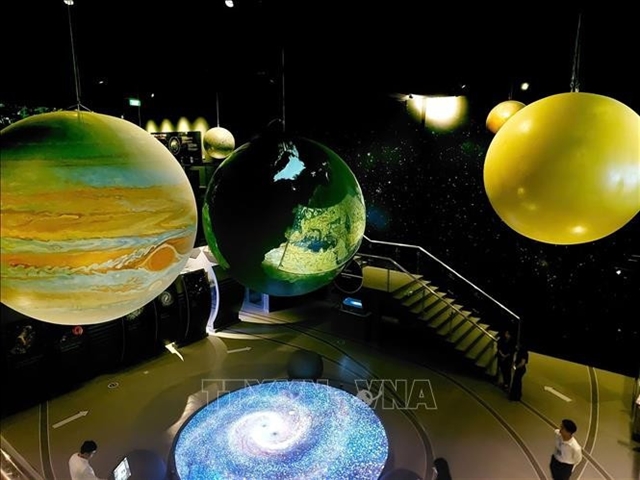
HÀ NỘI — The Việt Nam Space Centre officially inaugurated the Việt Nam Space Museum at the Hòa Lạc Hi-Tech Park in Hà Nội on August 21.
The event marked a major milestone in more than a decade of persistent effort by the centre and the Việt Nam Academy of Science and Technology (VAST) to develop domestic satellite capability and gradually master space science and technology.
Construction of the museum began in October 2022. Encompassing over 3,000sq.m, the museum features both indoor and outdoor exhibition spaces, organised into five thematic zones.
Visitors can explore large-scale models of the Solar System, interact with a functioning Sun Clock, and engage with hands-on demonstrations of scientific concepts such as light, sound, and gravity. The museum also offers educational displays on planets, galaxies, and the structure of the universe.
Beyond science, the museum integrates Vietnamese cultural identity into its exhibits. Ancient star maps, a digital display of the Đông Sơn drum, and storytelling elements based on national legends convey a distinctly Vietnamese perspective on space exploration and national aspiration.
Addressing the inauguration, Deputy Prime Minister Nguyễn Chí Dũng praised the Việt Nam Space Centre and the VAST for their contributions to the nation’s scientific development. He highlighted the museum’s educational value, offering rich, engaging experiences to promote scientific curiosity, especially among young people. In the context of a rapidly evolving global landscape, he noted that many countries are investing in space research as a means of strengthening strategic capabilities, and emphasised that Việt Nam must do the same.
He underscored that science, innovation, and digital transformation must be regarded as key pillars in Việt Nam’s effort to overcome the middle-income trap and achieve high-income status by 2045.
To that end, he called on the Việt Nam Space Centre to remain focused on mastering critical space technologies and developing low-Earth orbit satellites made in Việt Nam. He also urged the institution to build a clear roadmap for satellite development aligned with national goals, positioning the VAST as the country’s leading satellite R&D centre.
According to the Deputy PM, the centre must also actively connect with the broader innovation ecosystem, leveraging satellite data to develop high-value products and services that can support the digital economy, enhance public governance, and meet society’s evolving needs.
He expressed his hope that the museum would evolve into a dynamic STEM education hub, bridging scientific knowledge with public awareness, inspiring youth interest in space and technology, and reinforcing the relevance of science in everyday life.
Deputy PM Dũng affirmed the government’s full support for the VAST and the Việt Nam Space Centre, encouraging them to continue pioneering national innovation in science and technology. VNA/VNS
