Weather:
- Ha Noi 22oC
- Da Nang 24oC
- Ho Chi Minh 25oC
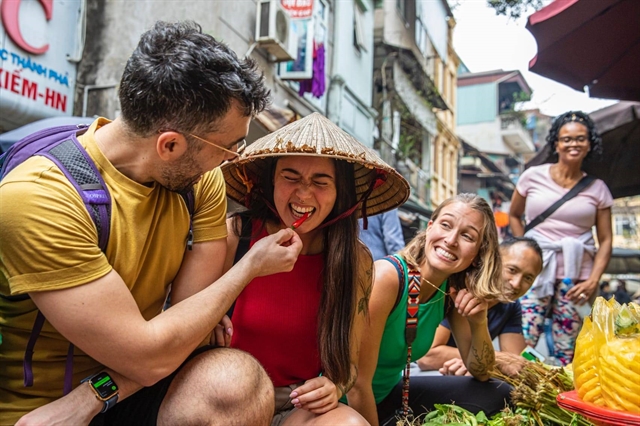
HÀ NỘI — Việt Nam welcomed more than 17.7 million international visitors in the first nine months of this year, up 14.5 per cent year-on-year, putting the tourism sector close to 71 per cent of its target of 25 million foreign arrivals for the full year.
The figure reflects not only the continued recovery of international travel but also Việt Nam’s growing appeal as a destination offering a broad mix of beaches, heritage, cuisine, urban experiences and leisure activities.
September alone saw 1.77 million international arrivals, an increase of 16.1 per cent over the same month last year, according to the Vietnam National Authority of Tourism (VNAT).
Air travel remained the dominant gateway, accounting for 83.2 per cent of international arrivals in the nine-month period. Another 15.4 per cent entered by land and 1.4 per cent by sea, highlighting the continued importance of international air connectivity in bringing visitors to destinations across the country.
Broader markets
China and South Korea remained the two largest source markets, together accounting for nearly 40 per cent of all international arrivals.
China led with 3.9 million visitors, or 22.4 per cent of the total, while South Korea followed with 3 million, or 17.3 per cent.
Their large populations, geographical proximity, convenient air connections and diverse travel preferences make the two markets important sources of visitors for Việt Nam’s beach holidays, resorts, city breaks, shopping, cuisine and entertainment.
Russia ranked third with about 1.1 million visitors, making it the largest European source market. Chinese Taipei ranked fourth with 964,000 visitors, followed by the US with 764,000.
The remaining markets in the top 10 were Cambodia, with 688,000 visitors; Japan, 674,000; the Philippines, 523,000; India, 505,000 and Australia, 485,000.
Europe recorded the strongest growth among major regions, with arrivals rising 55 per cent. Visitors from Oceania increased 21 per cent, the Americas by 20 per cent and Africa by 29.4 per cent, while arrivals from Asia grew by 7.6 per cent.
Russia was the standout performer in Europe, with arrivals rising by 160 per cent to more than one million. The market has strong demand for beach holidays, longer stays and winter escapes, while improved air connectivity and the growing capacity of Việt Nam’s resort destinations have helped support the surge.
Broader markets
China and South Korea remained the two largest source markets, together accounting for nearly 40 per cent of all international arrivals.
China led with 3.9 million visitors, or 22.4 per cent of the total, while South Korea followed with 3 million, or 17.3 per cent.
Their large populations, geographical proximity, convenient air connections and diverse travel preferences make the two markets important sources of visitors for Việt Nam’s beach holidays, resorts, city breaks, shopping, cuisine and entertainment.
Russia ranked third with about 1.1 million visitors, making it the largest European source market. Chinese Taipei ranked fourth with 964,000 visitors, followed by the US with 764,000.
The remaining markets in the top 10 were Cambodia, with 688,000 visitors; Japan, 674,000; the Philippines, 523,000; India, 505,000; and Australia, 485,000.
Europe recorded the strongest growth among major regions, with arrivals rising 55 per cent. Visitors from Oceania increased by 21 per cent, the Americas by 20 per cent and Africa by 29.4 per cent, while arrivals from Asia grew by 7.6 per cent.
Russia was the standout performer in Europe, with arrivals rising by 160 per cent to more than one million. The market has strong demand for beach holidays, longer stays and winter escapes, while improved air connectivity and the growing capacity of Việt Nam’s resort destinations have helped support the surge.
Other European markets also posted solid growth. Arrivals from France increased by 13.6 per cent, the UK by 9.7 per cent, Germany by 16.1 per cent, Poland by 49 per cent, the Czech Republic by 26.6 per cent, Belgium by 19.5 per cent, Sweden by 23.6 per cent and Switzerland by 25.7 per cent.
Asia nevertheless remained the backbone of Việt Nam’s international tourism, accounting for 74.5 per cent of total arrivals.
Growth from some major Northeast Asian markets was more modest, with China up just 1.5 per cent, while South Korea declined by 5.5 per cent and Chinese Taipei rose by 4.1 per cent.
The picture was considerably brighter in Southeast Asia. The Philippines posted growth of 55.2 per cent, Cambodia 40.5 per cent, Singapore 29.8 per cent, Indonesia 25.5 per cent, Malaysia 18.1 per cent and Thailand 10.1 per cent.
India, one of Việt Nam’s increasingly promising markets, also recorded strong growth of 33 per cent, while Australia grew by 21 per cent.
Greater value

The growth comes at a time when international tourism continues to face a challenging global environment, from geopolitical uncertainty and economic difficulties to higher transport and energy costs, increasingly intense competition among destinations and rapidly changing traveller preferences.
The latest report from UN Tourism said international tourism grew by a modest 0.4 per cent globally in the first half of 2026. Against the backdrop of continuing headwinds, the organisation lowered its forecast for international tourism growth for the full year to 1–2 per cent, from the 3–4 per cent projected in January.
Against this backdrop, Việt Nam’s double-digit growth in the first nine months points to the growing appeal of the destination, supported by its safety and stability, efforts to diversify source markets, a broad range of tourism products, improving air connectivity and greater service capacity.
The country’s international standing has also continued to improve.
According to a report released by the World Economic Forum on September 25, Việt Nam’s 2026 Travel and Tourism Development Index (TTDI) score reached 4.15, up 6.3 per cent from 2024. The increase was the second-highest rate of growth recorded globally and helped Việt Nam climb seven places to rank 52nd worldwide.
At the 2026 World Travel Awards for Asia, Oceania and the Indian Ocean, held in the Maldives, Việt Nam was named Asia’s Leading Destination and Asia’s Leading Heritage Destination.
These achievements point to a tourism sector gradually shifting its focus from simply attracting more visitors towards creating greater value from each trip.
VNAT has emphasised the need to improve quality and pursue sustainable growth, with longer stays, higher visitor spending, richer experiences and greater added value becoming increasingly important goals.
This direction also reflects the broader cultural-development vision set out in Politburo Resolution 80, issued in January 2026, which places culture at the heart of sustainable national development and highlights cultural resources and identity as an endogenous strength and a source of soft power.
For tourism, that means looking beyond visitor numbers to the stories, heritage, landscapes, cuisine and living culture that give a destination its distinctive character.
As Việt Nam approaches its 25-million international visitor target, the next challenge is therefore not simply to welcome more travellers, but to encourage them to stay longer, explore more deeply and take away experiences that make them want to return. — VNS
