Weather:
- Ha Noi 27oC
- Da Nang 26oC
- Ho Chi Minh 27oC
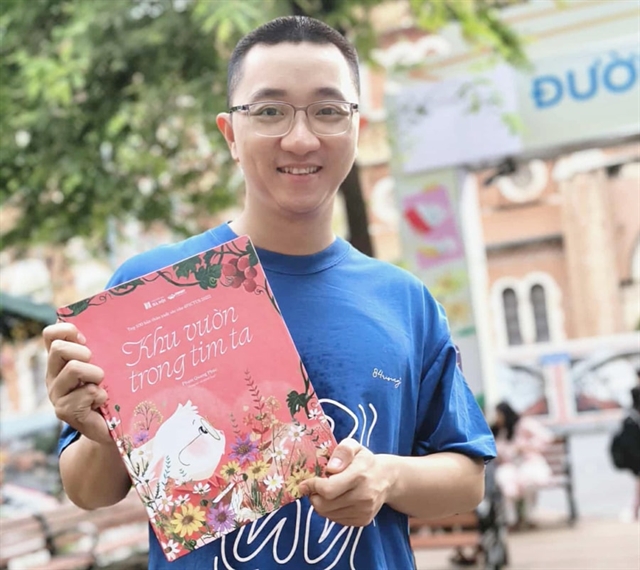
Illustrator Phạm Quang Phúc, who mostly works on children’s books, is turning the page on his childhood dream of writing for young readers. He won the ASEAN Children’s Book Illustrator award for Best in Fiction in 2018 for Everywhere Monster and was the second prize winner at the Samsung Kids Time Authors’ Award 2016 for The Party of Cats’ King.
His book Khu Vườn Trong Tim Ta (The Garden of Us) is among a list of 150 outstanding titles in the Bologna Ragazzi Award Amazing Bookshelf 2026 at the 63rd Bologna Children’s Book Fair, taking place in Italy from April 13 to 16. Phúc spoke to the media about children’s book illustration.
The Garden of Us has been selected for the 150 Amazing Bookshelf at the Bologna Ragazzi Award 2026. Were you surprised by this?
I was both surprised and overjoyed. I had faced significant challenges in finding a publisher, as the book explores a theme often considered too heavy for children and not easily marketable.
However, it has proven that a work created with genuine passion can take on a remarkable journey. This recognition marks a proud milestone for me, and it has given me greater motivation and confidence to pursue future projects.
What does the presence of Vietnamese picture books at prestigious international publishing events such as the Bologna Children’s Book Fair 2026 mean for you and other authors and the domestic children’s publishing sector?
I believe my small achievement is just an encouragement for young people in Việt Nam who aspire to pursue writing and illustrating picture books.
I’m not alone. Many of my peers have also achieved notable success in the international book market. These milestones demonstrate the strong potential of Vietnamese creators. With the right level of investment and serious commitment, they can succeed and help leave a more distinct mark on Việt Nam’s reading culture in the future while gaining the recognition it truly deserves in the global market.
You are popular as the only Vietnamese illustrator involved in the global edition of Harry Potter: The Hogwarts Library. Could you tell more about this?
It felt like a childhood dream come true: a rare, once-in-a-lifetime opportunity that I was fortunate to secure. I went through months of trial sketches and multiple selection rounds before being chosen as one of the project’s seven official illustrators.
This has also been the longest illustration project I’ve ever worked on, spanning more than a year and a half. I was especially fortunate to be selected to design the book’s cover. The project has helped bring my artwork to a much wider readership.
How did The Garden of Us offer you a different creative experience?
Unlike my work on the Harry Potter project, where I contributed solely as an illustrator, with The Garden of Us I took on both writing and illustration, which made the process considerably more challenging.
At the outset, I had to make all the key decisions myself, from shaping the storyline and developing the characters to defining the visual direction, the overall colour palette and executing the full set of illustrations.
Fortunately, the children’s book brand Crabit Kidbooks later came on board, offering valuable feedback and editorial support that helped refine the work into its best possible form.”
What is The Garden of Us about?
I had conceived the idea for this book a long time ago, but it was only after my grandfather passed away and I lived through the COVID-19 pandemic that I resolved to complete it.
The book tells a simple story, yet carries a message I deeply wanted to share: one of empathy and encouragement for those who have lost loved ones unexpectedly.
I grew up in the suburbs where, from an early age, I became familiar with my grandfather and father heading out at dawn to tend sedge fields, harvest water spinach and sell it at the market, and raise livestock.
In my memory, gardens and fields were places filled with some of my most cherished moments with my parents and grandparents. I came to see these gardens as the essence of childhood, an idea I carried into the book.
As it is a children’s picture book, I also employed a range of creative techniques to make the story more visually engaging and appealing.
Could you further explain how you use colour and visual language to convey the character’s emotional journey in the story?
I have developed a consistent colour palette across my books, what I would describe as my own signature colour style. Each colour carries a distinct emotional tone, and in every project, one of the biggest challenges is deciding which palette should take the lead.
For this book, I chose pinkish reds and fresh green, inspired by flowers and garden vegetables, for the more joyful scenes, while muted mossy tones and withered leaf hues were used to convey moments of sadness.
When carefully chosen, these colours help guide readers’ emotions, drawing them naturally and intimately into the ‘garden’ within their own hearts.
Could you tell about your creative process, with a focus on children’s picture books?
I still have many ideas, and the task ahead is to develop them into fully realised works. I approach my creative process with the mindset of doing my best without placing pressure on achievements.
I make books because I see it as a personal joy. In many ways, I am my own reader, writing and illustrating the kinds of stories I would want to read myself. — VNS
