Weather:
- Ha Noi 17oC
- Da Nang 24oC
- Ho Chi Minh 30oC
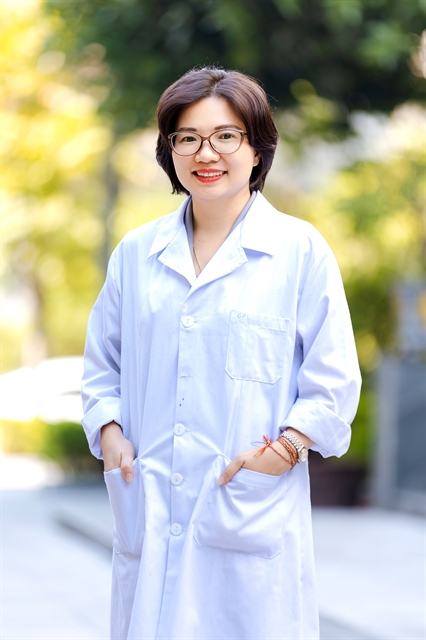
Associate Professor Dr Tô Thị Mai Hương, deputy head of the Department of Research, Innovation and External Relations and also head of the Executive Board of the Innovation and Start-up Centre under the University of Science and Technology of Hà Nội
As you can see, Việt Nam is a leading country in rice production and exports globally. However, we are also facing issues related to climate change, such as drought, salinity intrusion, extreme temperatures and emerging diseases. We therefore need solutions to develop sustainable rice varieties that are capable of adapting to adverse environmental conditions.
At our laboratory, we are taking advantage of a collection of over 200 indigenous rice varieties that have been sequenced to discover new genes and to study their functions, as well as the stress response mechanisms of the rice plant. We have also used new gene editing technology to help the rice plant better respond to the environment.
My project focuses on the problem of reducing emissions. As we know, rice plays a very important role, but it is also a huge emitter of methane gas. We use a new technology called Prime Editing, a precise gene editing technique, to intervene in certain rice genes to try to alter the plant's root microbiome and optimise its carbon transport system, helping the plant maintain productivity while reducing methane gas and emissions into the environment.
The Vietnamese Government committed at the COP26 conference to moving towards emissions reduction and carbon neutrality by 2050. These commitments are shared by scientists and the Government, aiming towards green agriculture, sustainable development and environmental responsibility.
Sometimes, like everyone else, I ask myself why we have to take such thorny and difficult roads. There are times when I feel like I am walking that path alone. But as we continue walking, we meet many partners and people who share the same vision and the same desire to help Vietnamese agriculture be greener.
Associate Professor Dr Phạm Kim Ngọc, head of the Department of Nano Materials and Thin Films at the Faculty of Materials Science and Technology, University of Science, Việt Nam National University HCM City
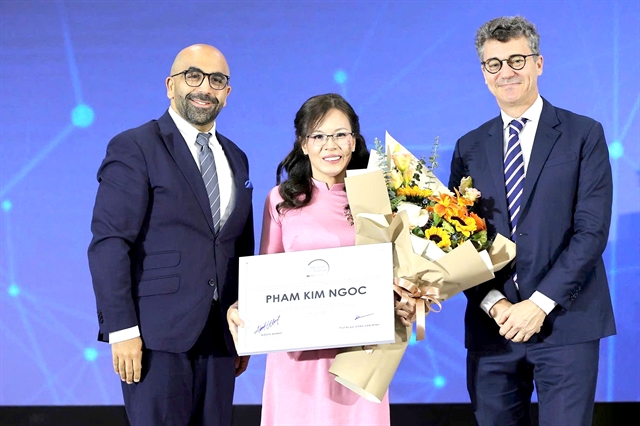
The research field I am pursuing is on semiconductor materials and devices applied in resistive memory chips and potentially also in artificial intelligence (AI).
Since I stepped into the university environment at the University of Science, I started to feel a passion for the field of materials science. And from then until now, I have continued to pursue nanostructured materials and their fascinating applications.
I am doing research on the design and fabrication of resistive memory chips, and orienting their application as artificial synapses in AI.
As we know, in the digital era and the explosion of information technology, one of the current challenges is the speed of information processing. For traditional computer systems, processing speed as well as energy consumption is a huge challenge. We use a resistive memory chip acting as an artificial synapse, so it can connect, process and store information right there. We can increase the data processing speed significantly as well as save energy.
Integrating resistive memory chips into such a computer system will help accelerate the application process of current AI development technologies, such as image recognition, digit recognition or facial recognition.
With the current results that my group has seen, we have successfully fabricated resistive memory chips with an integration density of 16x16, corresponding to 256 memory cells. My group’s goal in the next few years is to use modern fabrication technologies in semiconductor clean rooms to increase the integration density of memory chips to 32x32 or 64x64 to truly make a real semiconductor device, a real memory chip, and be able to put it into practical application.
In Việt Nam, fabrication and analysis equipment for semiconductor devices currently still has some limitations. That is one of the challenges in the application direction of resistive memory chips in the field of AI. It requires knowledge of physics, materials science, circuit design and fabrication of nano-electronic devices, as well as AI.
To solve those difficult challenges, our group has also connected with other research groups. From there, we gain more motivation, equipment and experience from experts, helping us walk a more steady path in our research field.
I, like other female scientists, have certain difficulties regarding health, time and finding a balance between research work and life as well as teaching. But with the support of my family, the encouragement of colleagues and the spirit of collaboration with my students in the group, their growth and maturity are a source of joy and motivation that help me move forward firmly on the road ahead.
Dr Lê Linh, Postdoctoral Researcher at Stanford University in the US

My research field is primarily materials science and engineering, focusing on researching co-solvents and electrolytes applied to lithium batteries for electric vehicles.
When I was studying at university in HCM City, I had a professor who inspired me the most. That person is also currently studying and working in the US. That was the serendipity that allowed me to go abroad to study and work. Also, when I interact with leading professors, those who are pioneers in research fields for electric vehicles, I find it very interesting. This gives me the motivation to continue and focus my research on this field.
My project mainly focuses on researching co-solvents and additives to apply to electrolytes in lithium batteries. The lithium battery I am researching is a new generation lithium-sulfur battery. It is the next-generation battery line after lithium-ion.
Everyone knows that lithium-ion batteries are the most developed type and are the most commonly applied in electric vehicles or electronic devices. However, the lithium-sulfur battery I am currently researching is being studied more widely. It meets the needs for a longer cycle, higher capacity, shorter charging time and significantly lower cost. It can thus be accessible to a wider range of consumers.
Industrialisation is happening very rapidly, especially in Việt Nam, a developing country. Transportation is also a major issue in Việt Nam. Currently, there are policies limiting the use of gasoline (petrol) vehicles. This will contribute to the development of electric vehicle research.
The battery I am researching will reduce costs significantly. All consumer segments can therefore access it and own products like electric bikes or electric cars. First, it protects the environment, and second, it offers a more interesting experience, because for electric vehicles, the operation is smoother, and maintenance costs are relatively lower.
The difficulty in my research project lies in funding and finding skilled workers. Also, because it is a new topic, existing research is scarce, so it is very difficult to find existing studies to use as a reference to continue developing my ideas.
As for personnel, I need many scientists with new ideas who can work at high intensity to develop those ideas and apply them in practical conditions.
In terms of funding, I need a stable and long-term source to continue maintaining my research. This is true in Việt Nam and the world over, we really need stable funding. It must be enough to cover materials, equipment, analysis or personnel expenses.
Whether talented or not, with effort and passion, we will overcome everything and achieve our desires. — VNS
