Weather:
- Ha Noi 28oC
- Da Nang 27oC
- Ho Chi Minh 28oC
by Nguyễn Mỹ Hà
Ten years on from its launch, Quân Khu Nam Đồng steps from page to stage, proving some stories never take their final bow. Scripted for theatre, the play premiered last November at Tuổi Trẻ Theatre in downtown Hà Nội. Despite the venue’s limited 300 seats and a schedule of performances every other week, public interest has not dwindled.
The Youth Theatre's small size may limit the number of spectators, yet it offers a rare privilege. Audiences sit close enough to see every gesture, hear each line clearly and watch emotions evolve in real time, even the actors’ tears.
"It feels so authentic to me," said a grey-haired man in the audience. "We lived just like that."
The original book by Bình Ca is a blend of inner-city youths navigating youthful dreams alongside a call of duty to their country, evaluating friendship, love and family values to find their voices and roles in a city technically at war, marked by bombardment sirens and few peaceful moments. At times, they get into trouble with the law, going too far in their attempts to reinstate justice when pushed by city gangsters. After it first hit the stands in 2015, the book was in such demand that it was reprinted 15 times within four years.
The stage setting at times feels excessive, with the director attempting to include almost every detail of the period. That era was notorious for lacking even the basics of daily life, yet the stage appears crowded: a public electricity pole with yellowish light, simple wooden sofas and chairs, boys’ rubber sandals, soldiers’ plastic shoes, their fathers’ signature military hats and green uniforms. Comfort is reduced to a minimum, yet these details speak volumes about the people’s souls, their sacrifices and their longing for peace.
Youth Theatre has two casts for the play, one featuring current stars. The cast we saw consisted of less famous artists, yet their performance was top-notch and deeply moving. We laughed heartily in one act, then cried in the next. It has been a long time since Hà Nội audiences have so fully embraced a theatrical production, recalling the 1980s and the works of Lưu Quang Vũ.
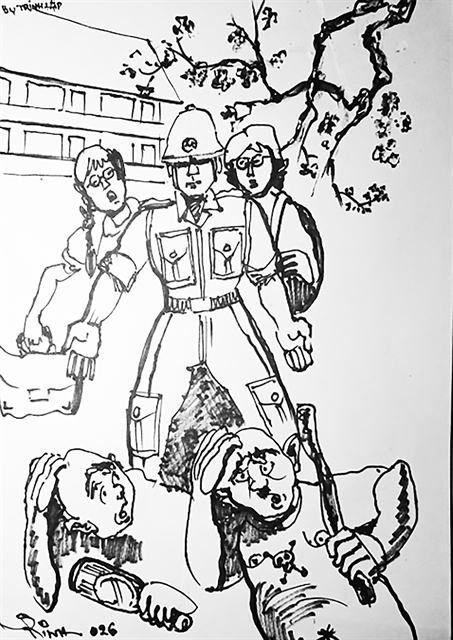
The play depicts a group of teenagers in their final year of high school, eager to assert themselves, their attitudes and their rights against gangsters who bully classmates and confiscate valuable personal items of the time, such as an ink pen, a pair of rubber sandals or even a shirt. With no male role model to guide them, the boys put on their fathers’ military shirts and trousers, pretending to be soldiers, drawing confidence to stand up to the gangsters.
At times, the storyline recalls West Side Story, but the difference here is that these military children aspire to join the army like their fathers, fighting for their country’s freedom. Even without the regular presence of father figures, their influence remains vital in shaping the children’s upbringing.
Dotted with scenes of high school romance and jealousy, the plot later turns as young couples go to war, hoping to reunite with their sweethearts on the front line.
But life during wartime is no easy game. Many die on the battlefield, unable to reunite with their loved ones.
We attended with a group of former high school friends and recognised ourselves here and there among the characters.
For audiences today, the play reflects real life transformed into art, offering a passage back to the innocence of earlier days. Yet for others in today’s troubled world, bombs still fall on schools, killing children, destroying classrooms and shattering unfulfilled dreams.
Though the story is set 50 years ago, it still feels vivid and immediate, as if it were only yesterday.
Watching news of bombs striking a girls’ school in Iran, followed by statements that it was unintended, echoes a familiar pattern. Similar claims were made in 1972 when bombs targeting so-called strategic sites in Hà Nội, Hải Phòng and Quảng Ninh struck civilian locations, including Khâm Thiên Street, Bạch Mai Hospital and the Hà Nội Foreign Languages College library, among many others.
Quân Khu Nam Đồng shows how, even in the darkness of war, people in Hà Nội in particular and across Việt Nam more broadly sought to maintain dignity and faith that justice would prevail, peace would return, love would endure and communities would survive against all odds.
Stories of Nam Đồng, the Military Quarter, remain a reminder of how dearly peace was won and why history must be remembered and passed on, so future generations can protect that hard-won independence and freedom. — VNS
