Weather:
- Ha Noi 26oC
- Da Nang 30oC
- Ho Chi Minh 28oC
By An Phương
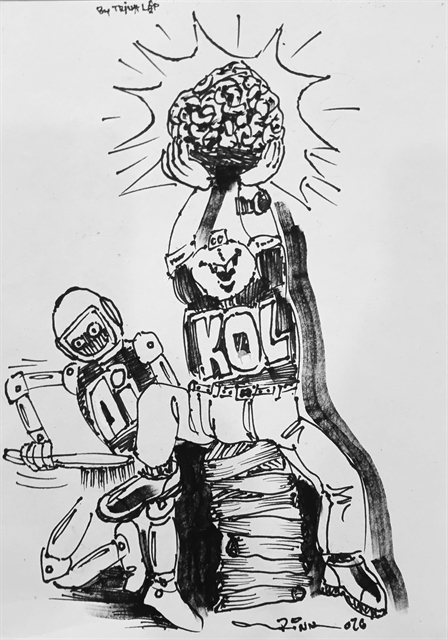
HCM CITY — With artificial intelligence (AI) able to produce polished content at unprecedented speed and scale, key opinion leaders (KOLs) are being forced to rethink what they offer audiences, and why people should continue to trust them.
AI is generating an unprecedented volume of content, making it increasingly difficult for internet users to distinguish reliable information from misinformation. In an increasingly crowded digital landscape, original content and public trust are becoming a creator’s most valuable assets.
“It is so easy to stumble upon fake news created or shared by social media users with thousands of followers. Imagine if those people were key opinion leaders. The impact could be unimaginable, especially when it comes to societal and political issues,” Cương Vũ, 32, told Việt Nam News.
“I understand that some content is created purely for entertainment. However, it is ultimately up to the audience to decide what they perceive as reality. A single funny moment can potentially lead to a great deal of misunderstanding later on,” he added.
As AI makes content easier to produce, replicate and polish, maintaining credibility is becoming an even greater challenge, particularly for KOLs who have built their reputation over many years. Influencers are increasingly having to recognise the heightened responsibility that comes with their digital footprint.
“The challenge today is to create content that remains engaging while retaining a distinct personal identity. As AI continues to advance, producing polished and visually appealing videos is becoming increasingly easy. This makes having a distinctive voice and staying authentic even more important, as they help audiences feel a sense of familiarity and build a lasting connection with them,” KOL Hà My, 30, said.
Beyond authenticity, KOLs are also facing growing pressure to keep pace with the sheer volume of content being produced and the increasing frequency at which audiences consume it.
According to KOL Dino Vũ, 34, publishing content daily has almost become a necessity.
“The rise of AI has made it easier to meet this growing demand, particularly for short-form content,” he said.
“At the same time, however, it has created another challenge for human creators: how to compete in an environment where machines can produce content at a scale that individuals simply cannot match.
“We cannot compete with AI in terms of quantity. When AI can constantly meet the demand for content, creators need to find other ways to provide value.”
From my viewpoint, this shift also requires creators to rethink their role in shaping how audiences consume information. When short-form content can provide an instant answer to almost any question, creators have a greater responsibility to encourage audiences to look beyond quick fixes and understand the context behind an issue.
Dino Vũ added: “We also need to train audiences to approach knowledge differently. Instead of simply giving them a quick answer to a simple question, we should encourage them to understand the issue from its foundations. That is where human creators can still provide value.”
In this sense, the competition between KOLs and AI may not ultimately be a race to produce more content, but a question of what kind of value content can create.
While AI can generate content at unprecedented speed and scale, human creators can draw on personal experience, judgement and a genuine understanding of their audiences to build connections that go beyond a single view or click.
Cương Vũ said: “I’ve always appreciated content that stands the test of time, whether it’s a useful tip or a piece of information that people can come back to. I enjoy being entertained, of course, but I value content that is genuinely useful. I now expect more content from my favourite KOLs, but I still believe quality matters more than quantity.”
Both Dino Vũ and I agreed that as AI becomes increasingly capable of replicating simple and formulaic content, the value of human creators might lie less in what they produce and more in how deeply they think.
For KOLs, rebuilding trust therefore requires more than maintaining a personal image; it calls for greater self-awareness, critical thinking and a willingness to create content with substance and long-term value.
KOL Chloe Nguyễn, 29, stressed the importance of upholding clear standards to build digital trust and contribute to a more sustainable creative future.
“The first is transparency. Today, whenever content involves commercial interests or the use of AI, creators should provide enough context for audiences to make their own informed judgements," she said.
"The second is responsibility for what we say. Having influence means that our opinions can affect the purchasing decisions, views and even behaviours of a large number of people," she said.
"And finally, we need to keep learning. Technology is changing very quickly, and I don’t think we can afford to stand outside those changes. What we can do is learn how to use these tools to make our work more effective while continuing to use them responsibly.”
Dino Vũ echoed this sentiment, adding that while creators must naturally comply with relevant laws, regulations and platform policies, ethical responsibility should remain their true starting point.
Furthermore, Hà My stressed that AI itself should not be seen as a threat to the creative industry, but rather as a tool that creators need to learn to use effectively.
“I don’t think AI is inherently bad. On the contrary, it is a useful tool that can help content creators work more efficiently and sustainably. For example, AI can support the editing and image-processing stages, helping KOLs save time and resources while achieving the results they want," she said.
"The question is how AI is used. When technology makes the creative process more efficient, we can produce more and better content, which can ultimately contribute to a more sustainable creative ecosystem,” Hà My added.
As technology becomes increasingly capable of producing content that is polished, fast and visually impressive, Chloe Nguyễn believes that what ultimately keeps audiences coming back is something much more human: sincerity.
“In an era when technology can create so much content that is beautiful, fast, and seemingly perfect, I believe what makes people stay and trust you in the long run is sincerity. Sincerity in the way you share, in the experiences you talk about, and even in being honest when there is something you don’t know,” she said.
For Hà My, the core principle is equally clear: originality.
“Originality is the keyword I would use to define the essence of ‘rebuilding trust’ in the digital era,” she said.
Ultimately, KOLs need to offer something that cannot simply be generated by AI: a genuine human perspective shaped by experience, thought and personal values.
After all, trust is built between people. It is one of the strongest connections we have. The role of a KOL, therefore, is to be someone people can trust, not simply because of the content they create, but because of who they are. — VNS
