Weather:
- Ha Noi 36oC
- Da Nang 27oC
- Ho Chi Minh 33oC
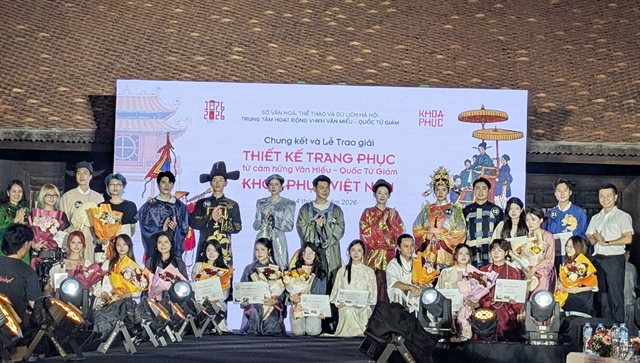
HÀ NỘI — The Văn Miếu–Quốc Tử Giám (Temple of Literature) Culture and Science Centre has awarded prizes to outstanding designs in a costume competition inspired by the famous Hà Nội heritage site.
The top prize went to Nguyễn Thùy Linh, a student at the Hà Nội University of Architecture.
Rather than replicating traditional attire associated with the imperial examination era, the collection combines new materials, techniques and silhouettes, making it suitable for contemporary wear.
“I wanted to present the collection as a work of art that celebrates beauty while conveying to young people today the values of learning and the tradition of academic pursuit passed down by our ancestors,” Linh said.
Another student from the same university, Mai Thị Ngọc Ánh, received the Creative Inspiration Award for her Vinh Quy design. It was inspired by the traditional custom of vinh quy bái tổ, or returning home to pay tribute to one's ancestors, in which successful examination candidates returned home to honour their ancestors.
“For me, the competition was a very interesting platform,” Ánh said.
“It gave us an opportunity to explore the heritage left by previous generations, while also encouraging us to seek new ideas and create innovative designs for Vietnamese fashion today and in the future.
“Through the competition, I gained a deeper understanding of the traditional values associated with Văn Miếu, as well as the Vietnamese tradition of valuing learning that has been passed down for generations.”
The competition featured two rounds, with 30 designs selected for display and 15 shortlisted for awards. The jury comprised cultural researchers, heritage experts, designers and fashion lecturers.
According to designer and jury member Quang Hòa, the entries reflected serious efforts to explore the culture of Việt Nam’s ancient examination system while connecting traditional values with modern life.
Each design offered a distinct perspective, reinterpreting Việt Nam’s examination culture through contemporary fashion. The designs featured a range of materials and techniques, including silk, silk thread, chiffon, hand embroidery and indigo dyeing.
Organisers said the competition received more than 100 entries over three months from university students across the country and young designers inspired by Vietnamese cultural heritage.
Through contemporary design, values such as respect for learning, respect for teachers and recognition of talent are being reinterpreted, offering more diverse and accessible perspectives, particularly for younger audiences.
The competition is part of activities marking the 950th anniversary of the founding of Quốc Tử Giám, Việt Nam’s first national university (1076–2026) at the Temple of Literature.
One of Hà Nội’s most renowned historical sites and tourist attractions, as well as an important symbol of Vietnamese cultural heritage, the Temple of Literature was built in the 11th century during the Lý dynasty (1010–1225). It is closely associated with the country’s Confucian tradition.
The complex comprises Văn Miếu, a temple dedicated to Confucius that reflects the influence of Confucianism in Việt Nam’s feudal era, and Quốc Tử Giám, the country’s first national university.
Between 1076 and 1779, the university educated thousands of talented scholars who went on to serve the country.
The 82 stone stelae recording doctoral laureates at the site were recognised by UNESCO as documentary heritage under its Memory of the World Programme in 2010. The stelae provide an important record of the imperial examination system under Việt Nam’s feudal dynasties. — VNS
