Weather:
- Ha Noi 32oC
- Da Nang 27oC
- Ho Chi Minh 30oC
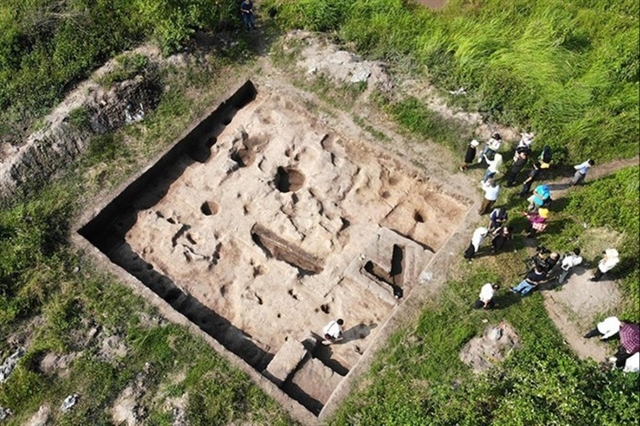
HÀ NỘI — Vườn Chuối (Banana Garden), an archaeological site in Hà Nội’s Hoài Đức commune discovered in 1969, vividly reflects the continuous habitation of ancient residents on Thăng Long – Hà Nội land over nearly 4,000 years, spanning the Phùng Nguyên, Đông Đậu, Gò Mun, Early Đông Sơn, and Late Đông Sơn cultural periods.
Since its discovery, Hà Nội's Department of Culture and Sports, in coordination with the Việt Nam Institute of Archaeology, has conducted 11 excavation campaigns, covering a total area of more than 7,500sq.m.
The largest excavation, carried out from March 2024 to March 2025 on over 6,000sq.m in the western part of the site, revealed residential spaces, daily activity traces, stone tool and ceramic workshops, and burial areas of the ancient inhabitants.
The results show that Vườn Chuối was an organised ancient Vietnamese village with a clear social structure, division of labour, a system of houses, moats, and production-living areas distributed logically. These findings confirm the role of residents in occupying and mastering the Red River Delta, laying the foundation for the formation of the early Vietnamese State.
In 2025, the Hà Nội Museum, in collaboration with the Institute of Archaeology and the University of Social Sciences and Humanities under the Việt Nam National University, Hà Nội, will continue to organise and analyse the large volume of artefacts recovered from the 2024 excavation.
Research on the settlement layout indicates that the earliest inhabitants initially lived on elevated mounds. Over time, they expanded into low-lying areas, leading to the construction of stilt houses, longhouses, and surrounding moat systems. This evidence suggests a well-organised and stable community.
Experts also discovered traces of the ritual of incisor extraction in adults, which was common during the late Phùng Nguyên culture 3,500 years ago, and a custom with social and spiritual significance. Craft production of jade, wooden, ceramic, and bronze objects reached a high level of specialisation. The jade-working area was arranged separately at the village entrance, possibly linked to ritual spaces.
This year, over 15,000 artefacts made of stone, bronze, ceramics, wood, bone, and iron have been recovered, along with tens of thousands of tonnes of ceramic fragments and soil containing plant remains.
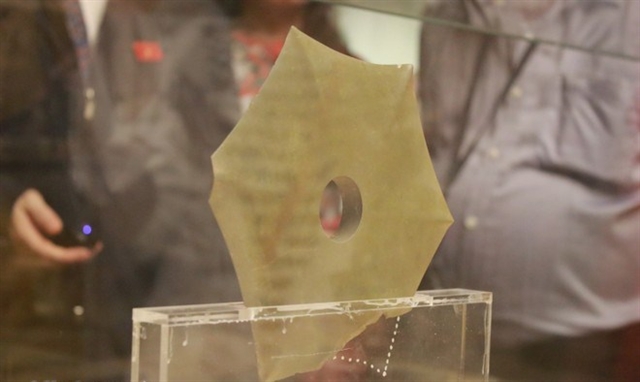
Among these, three groups of rare artefacts stand out. The items include green jade axes, the symbol of a leader’s power, discovered in a Pre-Đông Sơn burial, dating back approximately 3,500 years.
Also recovered were phoenix-headed ornaments, reflecting the belief in totemic worship, and a collection of jade objects, including bracelets, earrings, beads, and tooth-shaped pendants, representing the elite class of ancient society.
These discoveries provide valuable documentary evidence, affirming the special historical and cultural significance of the Vườn Chuối site in the development of the Metal Age in northern Việt Nam.
Recognising its outstanding historical and cultural values, the Hà Nội People’s Committee issued Decision No. 3134/QD-UBND dated June 23, 2025, officially designating the Vườn Chuối Archaeological Site as a city-level relic site. — VNA/VNS
